

I take umbrage with the idea of taxes as an investment. Given the opportunity, even the two-faced Dems spouting nonsense about our patriotic duty to let the government rob us would put their money into something else. Even just your own pocket is likely to produce better results in both the short and long term than local, county, state, or federal tax “persons” absconding with the fruits of your labor.
We need only look at the plethora of fraud stories being cracked like nuts by independent investigators, see also citizen journalists. Nearly a quarter of Federal spending, all of which has done little more than grow the federal deficit, has been “invested” in waste, fraud, theft, and whatever other words you can manage to describe the systemic abuse. From bureaucrats to so-called police agencies that look the other way, fraud is the single biggest thing the government does with your money (and your great-grandchildren’s plus interest). It’s bigger than the Department of Defense budget, which, no matter what our opinion of that might be, can manage a clause or two in the Constitution to justify its existence.
Return on investment? WalletHub just released its latest survey, but Blue States laundering federal money doesn’t actually factor in. Its focus is the state level, and I could not have missed it if I tried. New Hampshire landed in the number one spot again for return on investment when it comes to taxes at the state level.
This is the umpteenth time for the Granite State, added to several other lists of things like economic freedom, low overall total tax burden, quality of life, low poverty, high health outcomes, and high standard of living. When I chose to escape from New York in 1990 (the state, not the City), I picked the right place, but it is surrounded by blue states working as hard as they can to take us on with them.
I won’t go into detail since I’ve already done so elsewhere, ad nauseum. But I can’t NOT talk about so-called taxpayer ROI because someone went to the trouble, and there are lessons to be learned.
New Hampshire has all those great things, including the best return on taxpayer investment (gag!) alongside having one of the lowest total tax burdens in the country. Our twin state, Vermont, has some great things, but neither the total tax burden nor taxpayer return on investment is it.
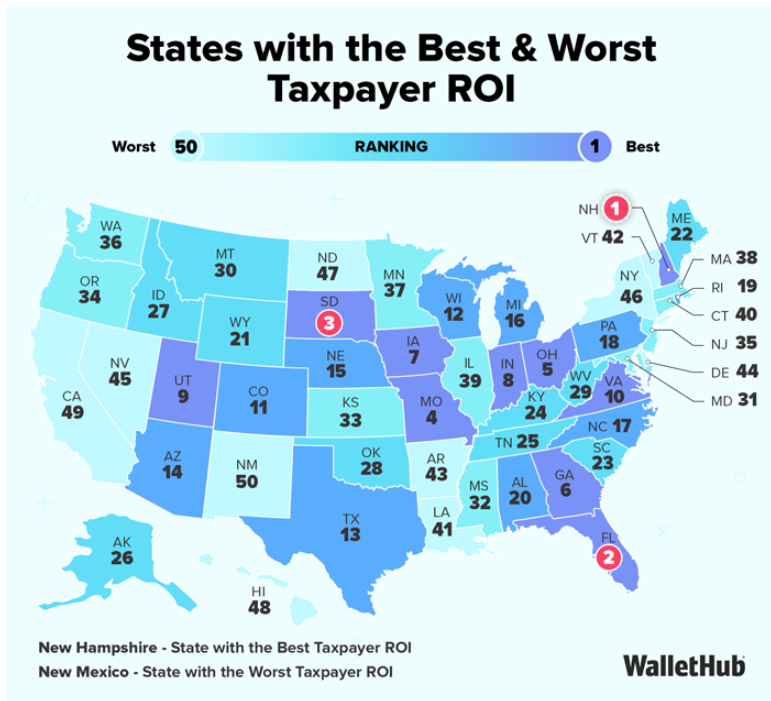
While NH is number 1 for ROI and number 48 for total tax burden, Vermont is 42nd for ROI and third for total tax burden. Hawaii is number one for total tax burden and 48th for ROI, while New York (from whence I fled, anon) has the second-highest total tax burden and is 46th on the WalletHub ROI calculator.
Lesson: It looks like the more money the state takes from you, the less value it produces.
California ranks 4th in total tax burden and 49th in ROI, according to WalletHub.
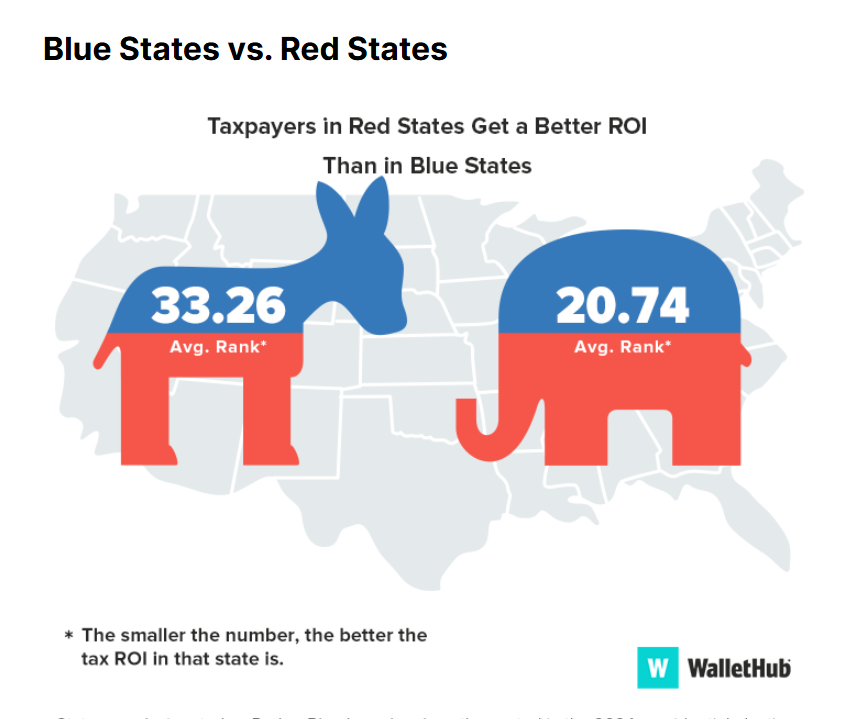
Generally, Blue states’ ROI is more than 13 points lower than red states.
Maine, which under Janet Mills shot up (or maybe down) the rankings, landing at 5th highest tax burden and only 22nd in return on investment (gag!).
Rhode Island is the only New England state to do better at 19th for ROI, with Taxachusetts at 38 and Connecticut at 40, tenth and thirteenth highest, respectively, for total tax burden.
We should expect Virginia, under its new Democratic regime, to fall from 10th in ROI (that was before Dems took over) into the twenties or thirties before Abigail and company are done.
Puts a new spin on the Democrats’ affordability narrative, yes? Not only will they take more from you, creating a much larger financial burden, but they will waste a lot more of it.
That’s without the federal fraud accumulating in mostly Blue States in the tens to hundreds of millions and likely billions or hundreds of billions in places like California.
That is generational debt on an epic scale, not just the result of Democrat policy, but a systemic obsession with the notion that Democrats know better how to spend it than you do. Democrats are arrogant, obnoxious, careless crooks who use empathy and outrage to steal from productive people who quite obviously would make better use of their own money than any elected Democrat or their bureaucratic homunculi.
I may have that backwards. Occasional Contributor Kevin P. Tyson has an excellent piece on Iran (at his Substack) that reminds us that.
Gaetano Mosca’s most important contribution to political science was not simply the observation that organized minorities rule disorganized majorities, though that remains foundational. His deeper insight concerned what he called the second stratum of the ruling class: the broader layer of administrators, military officers, functionaries, local notables, and institutional operatives who translate elite power into day-to-day governance. Mosca argued that this second stratum, not the visible sovereign at the apex, determines a regime’s true durability. A regime can lose its king and survive. It cannot lose its officer corps and survive.
This explains the Elected and activist Left’s militant objection to Trump’s federal employee house cleaning. The same problem exists on The Hill, where staffers who meet the definition of Mosca’s second stratum are adopted by newly minted members, many of whom contract from the notorious Georgetown Flu.
Blue States are less efficient in part because their state governments emulate the swamp in DC. The larger the government, the more second-stratum parasites will vote to sustain it. More of them and bigger budgets suck the velocity potential of every single tax dollar collected, which also explains the stark terror experienced at the idea of fewer federal dollars or fraud investigations into how they are wasted.
Before Minnesota wasted 9 billion, everyone in the bureaucratic bread-line got a piece and, as it turns out, so did the politicians, none-too-interested in ensuring that the money the government took from you went to the things they promised it would.
It never does, which is why they must always demand more until, as it must in every Democrat-socialist experiment, it collapses in on itself.
This WalletHub litmus is dark clouds on the horizon.
Democrats always spend more, so no tax plan can reduce the tax burden. A lower tax burden aligns well with higher returns on investment (gag!). The less the state takes, the better the outcome or value for taxpayers, so who benefits from the opposite? Bloated budget-busting governments, and people committing or benefiting from fraud.
The bluer your state and government, the less capable investors they are (of your money).
The fix isn’t hard to see. Fewer or no broad-based taxes. Smaller, more responsible, and transparent government. More money in taxpayers’ pockets, less in the hands of the government.
Red states do better than blue, so do you know what to do?