

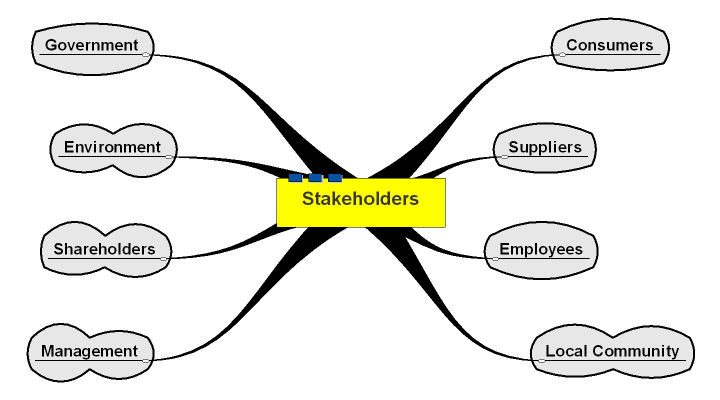
This is Elizabeth Warren’s “You didn’t build that – so we’ll take it” on steroids – owners get “diluted.”
And why suppose that profit is inversely correlated with social values? The supposition is fundamental to the statist left: profit is seen as a sin, a pointless and indeed evil extraction by the bosses, when the whole average product of labor should go to labor alone. But no, it should not, not if the economic pie is to be as large as possible, giving the poor their 3,000 percent improvement. The owners of the company are last in line for payment, as most economist have understood, at the latest in 1921 from Frank Knight’s Risk, Uncertainty, and Profit. The wages, material costs, costs of routine management, and the cost of insurance against calculable risk are all pre-contracted, bought from the outside of the enterprise at their going prices. The stockholder-owners therefore bear the uncertainty of any enterprise, the very uncertainly that [Mariana] Mazzucato in her 2013 book claimed only the State could properly assume. (We do so wish, not for the first or last time, that the a professor of economics exhibited an acquaintance with the elements of economics.)
-Deirdre McCloskey and Alberto Mingardi, The Myth of the Entrepreneurial State
Further:
DBx: “Stakeholder capitalism” (so-called) is a recipe for economic calamity. Those who endorse it – those who call for corporations to aim to maximize the welfare of “stakeholders” rather than the profits of shareholders display an astonishing ignorance of basic economics (and also of advanced economics). As with campaigns to “buy local,” campaigns for “stakeholder capitalism” are a litmus test: Anyone who supports such campaigns thereby reveals his or her economic ignorance.
I look at this new “broadening” of “interested entities” (“stakeholders”) as little more than “heckler voters” in which THEIR interests override that of the actual owners who have put in the sweat equity to build and run a new enterprise. They want the upside of ownership without the responsibility of ownership – no actual skin in the game. They want to forego the financing phase, the risk phase, the build out phase, the management phase, and the angst phase only in wanting to reap the rewards (if there are any) of the entity on the backend.
They want control of the company without the actual responsibilities. The effect of this stakeholder movement is to dilute the importance of the owners without whom there’d be no enterprise.
When you get right down to brass tacks, it is socialism without the word “socialism”.
If everyone gets to determine what happens within and without a company, why bother being an entrepreneur or owner if everyone else ends up with a greater say?
(H/T: Cafe Hayek)
