

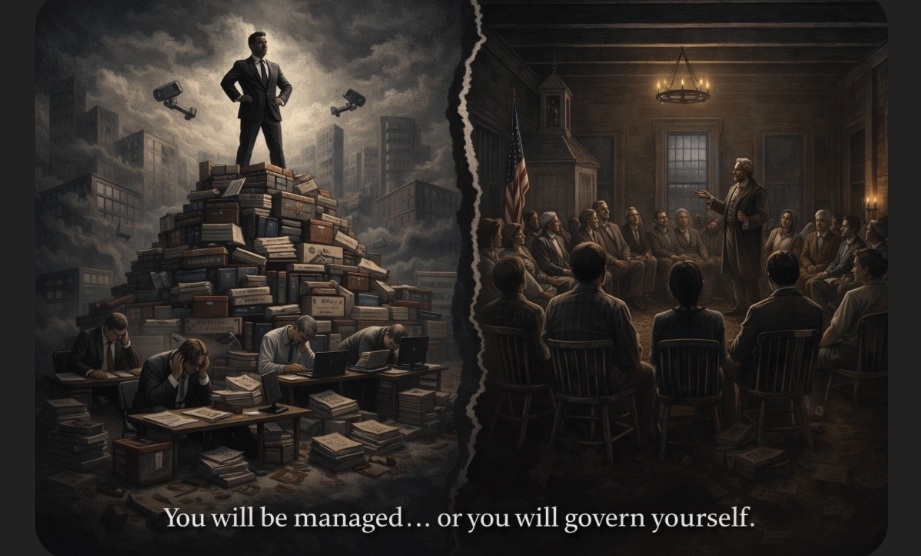
The real battleground
The existential yearnings emerging inside the hearts and minds of people throughout the world—yearnings that no doubt have existed since time began, though not always consciously realized—are stirring like the struggle of a chrysalis. They are the desire to be heard, to be felt, to be recognized, and, above all, to be free from harm and to live together with others in a protected space where government operates as a negative force.
People today are once again exhausted from the recurring errors of human nature and folly, and they have risen again to seek associations that are the least oppressive and most beneficial to the individual. America at its founding was that association, and those values still echo through the centuries. Yet there is an ideological struggle in the midst of this. Words like liberty, freedom, and sovereignty resound through rallies and meetings like the echolalic utterings of a stroke victim, void of meaning and scarcely attached to an archetype that can be relied upon. Man is now torn between self-management and bureaucratic management. These seem to be the prevailing two options. But in either case, he cannot be freed from personal responsibility, despite the modern notion that liberty and freedom mean exactly that. Freedom is synonymous with responsibility—though even responsibility can be outsourced.
Our discussion is a battleground that vacillates between Suárez and Calvin, or Belloc and Clay. Calvinism, by its nature, produces bureaucratic control, moral surveillance, and suspicion of human agency. If man is depraved, as it claims, he is in need of managers. But as Francisco Suárez tells us, if a totally depraved nature cannot be morally accountable, and a will incapable of cooperation cannot be justly commanded, then in Calvin’s system—which collapses responsibility into determinism—man becomes a machine, operated and controlled within the technocratic state in which we now find ourselves. Calvinism extant in New England most likely explains the emergence of the first communist communities in America, and thus the bicameral notions of the ends of government appear early on in our nation’s history. It is a philosophical flaw trapped in the DNA, born to distrust free will and bred to see the emergence of aggressive progressive programs, formalized in New York and now being perfected in New England. Progressive-era planning is Calvinism on steroids, as is the administrative state. We no longer discuss whether government should do such and such a thing, but only what is most expedient, with elections vulgarized into managerial ideology and determinism.
Belloc, in The Servile State, argues that when the state begins coordinating economic and social life “for unity” or “for stability,” it inevitably produces dependency. Clay’s American System—national banks, protective tariffs, federally directed internal improvements, and managed sectional equilibrium—replaces the ebb and flow of self-reliance and the trust that God gives man to bear the burdens and trials of his existence, both with others and within himself. Bastiat encapsulates the entire discussion and reminds us that structural changes to the form of government will create a new philosophy in the people.
Suárez believed that human nature is wounded but not destroyed—that man retains the capacity for moral self-government. The highest political order, then, is one that protects the conditions for that self-rule rather than replacing it with management. Freedom is not license; it is disciplined self-direction under God. That is the anthropology the Founders presupposed when they framed the Constitution—that unity would arrive from a common culture, that we would love the Lord our God with all our hearts, with all our souls, and with all our minds. God would leave us in our free will to serve Him, and no government on earth should ever supplant what God has commanded us. To be free of the shackles of unnecessary government and maniacally protective of self-government is the altar upon which Thomas Jefferson erected The Declaration of Independence. This common altar is America; it is our common creed, as Chesterton says, what our nation was founded on. All other notions are heretical in the strictest sense—that managerialism and determinism are in stark contest with absolute dependence on a Creator, and with the self-reliance that is only proper in the presence of the soul’s dependence on that Creator.
It is a natural occurrence, then, for mankind to build prisons for their own safety and well-being. This tendency is called collectivism. But its real name is Sin. Man is looking inward at his own Tower of Babel or Golden Calf. Moses has disappeared, and he must build something to quiet his existential neurosis. The result is collectivism, which advocates for the organization and control of society in a way that seeks to achieve common goals, often through shared ownership, centralized authority, or communal cooperation. It is an attempt to quiet the resounding fear—either to rule as a self-made god or to be ruled by something upon which to cast your fears.
Thomas Jefferson warns of collectivism in the Declaration when he says, “He has erected a multitude of New Offices and sent hither swarms of Officers to harass our people and eat out their substance.” And that, “He has combined with others to subject us to a jurisdiction foreign to our constitution, and unacknowledged by our laws; giving his Assent to their Acts of pretended Legislation.” Further he protests, “For taking away our Charters, abolishing our most valuable Laws, and altering fundamentally the Forms of our Governments.”
“Jurisdiction foreign to our constitution” means law must arise from the recognized constitutional framework, and authority imposed outside that framework is illegitimate. Government is bound by a written constitutional order, not by abstract sovereignty. So with that, we can say goodbye to The United Nations without hesitation, and affirm that there is a list of specific permissions and boundaries within which government can act.
In short, what is born from these grievances are American principles: constitutional authority over arbitrary power, structural limits as safeguards of liberty, law grounded in consent—not administration—the inviolability of local self-government. It is really that simple.
Every age builds its government upon its view of man. If it believes man incapable of moral self-direction, it will craft systems of control until he becomes a mindless drone, stripped of responsibility and conditioned to obedience. If it believes man wounded but capable—accountable before God and therefore capable of self-rule—it will preserve limits, cultivate virtue, and restrain power. The question before us is not partisan, nor even merely political. It is theological and philosophical. Will man answer upward to God, or outward to managers? Will we construct systems that assume incapacity, or preserve structures that demand responsibility? A people who reject responsibility will inevitably demand supervision. A people who accept responsibility will insist upon limits.
There is no third way.
The future of American self-government depends entirely upon which view of man we choose.
Suggested Reading:
Francisco Suárez, On Laws and God the Lawgiver (De Legibus)
Thomas Aquinas, Summa Theologica (Treatise on Law)
John Calvin, Institutes of the Christian Religion
Robert Bellarmine, On the Laity
Hilaire Belloc, The Servile State
G.K. Chesterton, The Outline of Sanity
Wilhelm Röpke, A Humane Economy
Frédéric Bastiat, The Law
The Federalist Papers, Alexander Hamilton, James Madison, John Jay
Thomas Jefferson, Notes on the State of Virginia
Alexis de Tocqueville, Democracy in America
Bertrand de Jouvenel, On Power
Henry Clay, Speeches on the American System
Charles Merriam, New Aspects of Politics
Woodrow Wilson, Congressional Government
James Burnham, The Managerial Revolution
Philip Hamburger, Is Administrative Law Unlawful?
Christopher Caldwell, The Age of Entitlement
St. Augustine, City of God
Russell Kirk, The Roots of American Order
R.J. Rushdoony, The Nature of the American System
