

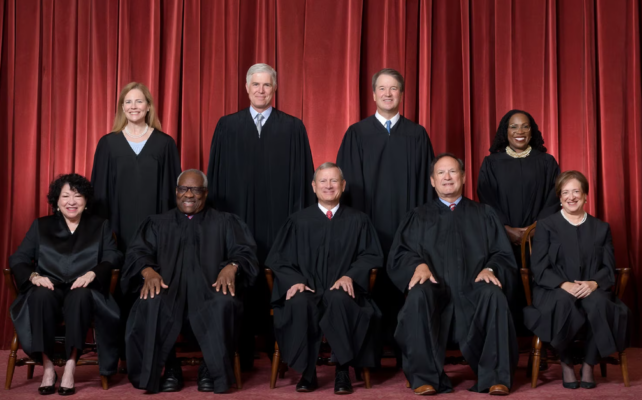
This week the Supreme Court of the United States (SCOTUS) rendered its decision in a critical case. The court’s decision was an embarrassment in the United States versus Texas. Here is why.
We want to thank Marc Abear for this Contribution – Please direct yours to Editor@GraniteGrok.com.
You can review our ‘Op-Ed Guidelines‘ on the FAQ Page.
The Border States argued: The Biden regime’s non-enforcement of existing immigration law harms us. SCOTUS ruled: No, it does not. You cannot sue.
Several states were involved in suing the Biden regime over its policy of nullification of immigration law. The procedure in question relates to the non-enforcement of immigration law. The SCOTUS found the states lacked standing to sue. By deciding based on standing, the court never reaches the question in the case.
So, a five-justice majority of the court held: The states were not harmed in any judicially recognizable way. The decision starts on page 4.
Three justices wrote a concurrence to the majority decision. The minority concurrence found it to be the correct answer for the wrong or at least a different reason. They assert the issue was not lack of injury to the states, which is the crux of the matter. Instead, for them, the problem is a lack of redressability. Their position is: The states were harmed, but the courts lack the power under immigration law to force the government to enforce the law. The concurrence begins on page 18.
Justice Alito alone got it right. He dissented from the opinion. Alito asserts: The states were substantially harmed. Further, the majority ignored legal precedent, which favored the state. The dissent begins on page 43.
Here is a synopsis of the precedents:
During the Bush administration, in Massachusetts v Environmental Protection Agency (EPA), several states sued, saying the administration’s non-enforcement of EPA regulations harmed them. SCOTUS agreed. It allowed the states standing, so the states could sue for nullification of the regulation/law.
During the Trump administration, several states sued in Department of Commerce V. New York, asserting putting a citizenship question on the census might harm them. SCOTUS agreed it allowed the states standing, so the states could sue.
The problem here is SCOTUS is not following its own precedent. Maybe there are reasons why they do not apply. But to not go there, to not clearly explain the differences in the decisions, on substantially the same facts, well, it is more than confusing.
It is obvious, blatant political decision-making. That’s a problem when done by SCOTUS. They are out of their lane without so much as a tip of the hat toward a legal explanation.
If a lawyer behaved in this way in court, it seems likely the lawyer would be sanctioned. Were you an academic and you ignored relevant literature, facts, and opinion in your publishing, you would be discredited.
How is it, SCOTUS can simply ignore precedent, which it does not like? How does SCOTUS defend the charge of political rather than legal decision-making when it does so? This was an important decision. Unfortunately, it was poorly decided.
