

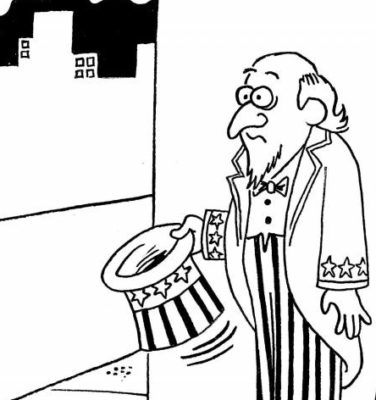
Recently, Reason published an article based on this analogy: ‘If a Walmart doesn’t reopen, families can take their food stamps elsewhere. If a school doesn’t reopen, families should similarly be able to take their education dollars elsewhere.’
Related: School funding: How much is enough?
You have to love the phrase ‘their education dollars’. If those dollars were really theirs, there would be no discussion about this at all.
The discussions happen precisely because the dollars are not theirs. They are taken, by force, from other people, who not unreasonably want there to be some restrictions on how the money is spent, and some oversight to make sure those restrictions aren’t ignored.
If we want to compare school funding to food stamps — which is not unreasonable — there are a few important points that we shouldn’t lose sight of.
First, we don’t give food stamps to families that can already afford to buy food. And we use means-testing to find out who can’t.
Second, if Walmart doesn’t reopen, families can’t take their food stamps to liquor stores, or fast-food restaurants, or amusement parks, or Best Buy. They can only use them to purchase an approved set of items, from an approved set of providers. If Walmart wants to let people buy things with food stamps, it has to jump through hoops set up by the government to prevent misuse of the funds.
So the families can’t use their food stamps at Best Buy. But they also can’t use them to buy food at the local farmer’s market; or from a neighbor who is growing crops or raising animals that are far superior in quality to what is available at Walmart; or from any number of providers that don’t have the resources to navigate the maze of regulations that you have to go through to get reimbursed for food stamps. Nor can the families use their food stamps to buy seeds that they could use to grow their own food. Or for cooking lessons, that would let them prepare more nutritious meals at lower cost. And so on.
The same is necessarily going to be true of ‘school stamps’. To be able to cash them in, private schools — and other providers of education that happen not to be schools — are going to have to jump through hoops that will force them to change the way they operate. And those hoops will increase in number and inanity over time.
I can be the best algebra tutor in the world, but no one is going to be able to pay me with ‘school stamps’ unless I do a few hundred pages of paperwork, demonstrating that I’m basically going to approach the subject like a public school teacher, so I can get ‘certified’ by the agencies that are handing out the stamps. So I either have to become a worse teacher or lie about what I’m doing.
This is one of the reasons that homeschoolers in NH often oppose any proposals to let them spend tax money on their kids. The money would be nice to have, but the parents know that it will be accompanied by more oversight, which will eventually eliminate much of the freedom they now have.
Third, if you use your food stamps at Walmart, you don’t give them the stamps until they give you the food; and if the food turns out to be defective, or poor in quality, you get your money back. Unless education providers who accept ‘school stamps’ are to be held to a similar standard, there’s no reason to expect that they’ll do a better job than government schools are doing.
Supporters of school choice programs often make arguments of this form: ‘Each family can make the relevant cost/benefit decisions for themselves.’
Which is true enough if they are coming up with the money. But if they’re spending my money, they’re making the decisions for me, too. So shouldn’t I get a say in those decisions?
Or to put that another way, if I disagree with the decisions, shouldn’t I be able to withdraw my financial support for them? If not, they’re basically treating me like a farm animal.
So perhaps we could remove taxes from the equation altogether by setting up the equivalent of GoFundMe projects for parents who can’t afford to educate their own kids:
I need $3000 to be able to send my kid to Mount Royal Academy, so he can become a doctor and help people in underserved neighborhoods. His favorite subject is chemistry, he loves the novels of Kurt Vonnegut, and on weekends he helps out as a volunteer at a local assisted living facility. Will you help us?
Why shouldn’t there be choice on both the funding and the spending sides of the transaction?
Of course, once we start down that road, why not use that model to fund all government spending? The government could transform into a giant GoGovernMe project, where people can contribute to the government services they approve of, and let the others wither away for lack of support.
This would be a more accurate reflection of the ‘will of the people’, and a more faithful implementation of ‘government by consent’, than electing representatives could ever be.
