

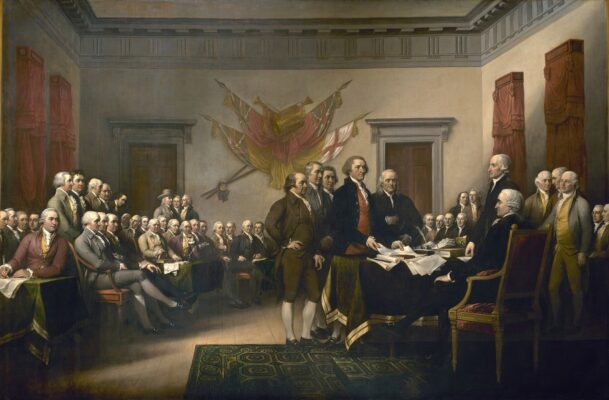
How NH Led America to Independence: a look at the Revolutionary-era history with Rich Girard, Dan Itse, and James Spillane as they explain how the Granite State led the way to American Independence.
Watch on the ‘Grok Rumble Channel if the Embedded Video does not load.
Lightly edited Transcript (generated by a third-party application, so some errors are likely):
Hello, Manchester, and welcome to this special edition of Gerard at Large. I am your celebrating America’s 250th anniversary host, Rich Gerard. Thanks for tuning in. As you know, you can find us online at gerard at large.com and you can find us on Facebook and Twitter, now known as X.
And I still call it Twitter, because I get to invoke my New Hampshire accent when I do it. Also at Gerard Large, where we encourage you to like us and to follow us. Why? Because unlike the city of Manchester, which can’t seem to find a way to do anything to celebrate the 250th anniversary, we are doing something about it. And so we’re pleased to be joined today by two historians and scholars.

One, 9(s) a former state representative from Freedom, New Hampshire, from Fremont. Okay, but there is a Freedom New Hampshire. There is a Freedom New Hampshire, but this has only one because it’s after the general. That’s right. General Fremont of the Civil War, who led the Western well, he was in the Missouri area, if remember correctly. So Fremont, New Hampshire, Dan Itsa, who, by the way, knows more about the state of New Hampshire and its government and our constitution than just about any human being alive. Also, the author of the book States Have Powers. Yes. Which I interviewed him on the radio show about – many years ago. And it’s a fascinating read, which, if it’s still in print,
I would encourage you to get it. States Have Powers by Dan Itsa, I T S E. The Powers of the People. The Powers of the People. Is that another book? No, that’s the subtitle. Nothing like stepping on your tongue to you know to get going on an interview.
And we have Representative James Spillane. Correct. Who is from Deerfield? Deerfield. Do you know my dear friend Harriet Cady? I do indeed. That’s right. Well, you say hello to Harriet Fred. I’ve known her since I was in Raymond and a kid in school. She was back then, way back then, she was still working to try to let the money follow the student. Yes. Well, she was in many ways way ahead of her time in a number of issues, and one of our state’s foremost experts on the right to know law. Absolutely.
So, and she fought so hard for that ombudsman which was eviscerated in the most recent. I’ve heard a lot about it from her. Yes. Yes. Well, to say she’s livid is an understatement. Well, the state and many of its municipalities are hostile to the right to no law, even though it’s enshrined in our New Hampshire constitution. Mm-hmm. So if either of one of you would like to give a bit more of an introduction of yourselves, a little bit of background, so that our viewers know who you are. I moved to New Hampshire in 1991, at the very tail end. And make sure you speak right into these microphones. I got involved in politics rather by accident. We moved into a house that had formerly been the house of the state representative from Fremont.
And went to a an anti-DCYF rally. And at that point they were trying to create a law that would have some ever somebody watching every family in the state. And you can imagine that raised some ire. So I attended this anti-DCYF rally. I was aghast at how much of Massachusetts had leaked up here ahead of me.
And I met Representative Dave Wheeler, from Milford. And so we got to chatting, and he told me that he said Where do you live? I said, Fremont, I live in the ho former House of Representative Bill McCain. He said, You do?
Said, yeah, and I explained the situation. We were now renting the house. Well, it seemed he hadn’t informed the legislature that he no longer lived in Fremont. Oops. And so Representative Wheeler, then Representative Wheeler dimed him out to the speaker. He was politely asked to resign from the House. The bill had become so toxic that nobody would pick it up. And so this DCYF bill died in the cradle for lack of a sponsor. Good. And that was my introduction to New Hampshire politics. Well, there you go. Representative Splaine.
Well, I grew up in Raymond and went to Raymond High School until I was bored out of my mind, and my parents finally ended up paying for me to go to dairy field school up in Manchester. So these were some of my old stomping grounds, right around the mill buildings and everything. We used to refer to that as country day school at West High School, just so you know. It was much better, and now I’m a senior technical writer. I built a house in Deerfield twenty-six years ago, and I’ve been there since. I’ve been in the state house for six terms.
Twelve years, just finishing off my second term as chairman of the Fish and Game Committee. Okay. Senior technical writer by trade, author as well.
What’s your book?
I have a science fiction novel that came out last year called The Sisyphus Project. And I have another short novella that’s about a veteran with PTSD and drug addiction. It’s not a happy one. It’s more of a Steinbeck-style short novella, and that’s the last flight, and they’re both available on Amazon and Barnes and Noble right now. Terrific. I should say I was in the legislature for eighteen years. Eighteen years. And the one thing I guess proud of is I was chairman of the committee on constitutional review during Bill O’Brien’s term. While that was still alive. And to the best of my knowledge, I am the only individual appointed to chair a legislative committee on constitutional review in the twenty-first century in any of the states or the federal government.
Wow.
So well, I suppose that’s a good segue to get us into our topic here because being the two hundred and fiftieth anniversary of our nation’s founding, we’re here to talk about a little history in New Hampshire’s really surprisingly outsized and what’s the word I’m looking for? Like ahead of its time, roll over the tip of the spear. The tip of the spear. Because, you know, a lot of people talk about the pine tree riot.
That took place in Ware in 1775. But really, there were acts of rebellion in New Hampshire against the Crown much, much earlier than that. That’s absolutely true. So which one of you wants to get a study of I’m gonna take that one because I actually lived at the site of the Mast Free Riots in what was then Poplin, New Hampshire. Okay. It became Fremont at some point; I don’t know when. But by the time it became a state, I believe it was well, couldn’t have been Fremont until after the Civil War because of General Fremont, after whom it was named. Right. But I lived in Mastery Estates.
And incidentally, he’s a fascinating figure. He was actually the first Republican candidate for president. For president, yes. Yes. So I lived in Mastery Estates, and at the end of our street was the marker that says site of the pine the mass tree riots in seventeen thirty four. And the reason for that was that the king had reserved all the trees greater than two feet in diameter to be masts for ships for the British Navy. And that’s why we have Mast Road here in Manchester and Goughstown. Well, and the interest, another interesting thing about that whole scenario is that it’s the origin of the term windfall profit.
Because you weren’t allowed to cut down trees on your own property and sell them for lumber that were greater than two feet in diameter unless they came down in a storm. In which case, you could mill them as a windfall profit. I see, because the wind caused them to fall. You didn’t cut them down, but you can’t and so you can’t let it go to waste. So how many of those trees set aside by the king actually suffered storm damage by the people of you had to make sure there were no cut marks around.
Yeah.
Okay, so that was seventeen thirty-four. Way ahead of any other rebellions that happened. Dan, why don’t you tell them exactly what happened in that riot? I’m not actually familiar with what exactly happened in that riot. Wasn’t there something, though, in the late 1600s too? no. The late 1600s were an important period of time. late sixteen hundreds, sixteen eighty eight.
It was when John Locke wrote his treatises on government, the second treatise, the first treatise being a diatribe on the divine right of kings, the second one being a prescription for how government is rightfully created. Okay. And it begins with natural law, and the whole purpose of government is to protect your natural rights, and this is how the legislative functions, et cetera.
And that inspired the Glorious Revolution. King James had gotten at odds with Parliament, fled to France, was building an army to come back and reconquer England, and so they deposed him from the throne in absentia, and they wrote the English Bill of Rights, and they put William of Orange onto the throne on the condition that he agree to the English Bill of Rights. So this is now a government created by the Parliament rather than a purely hereditary monarchy.
Got it. And it’s that document that inspired all of what we have here today as government. Right. Interesting. All right. So then, in 1734, we have the Mast Tree Riots. Right. But then we have what most people, more people in this area, are familiar with: the Pine Tree Riots. So
With the pine tree riots, most Americans know about the Boston Tea Party, but it was a full year before the Boston Tea Party, a year before any tea went into the harbor, that we had our pine tree riot. And at this point, basically, the king was still doing his cut marks, the arrowhead that he would make with three c ax marks on any tree that was reserved for the king, but he reduced the size. It went from two feet down to about one foot or so. I believe it was one foot. And so even more of the lumber was being cut, and it was all white pines.
Perfectly straight. We had beautiful ones. And with the 1700s and the British Navy being the most powerful Navy in the world, they needed a lot of masts. And so this fight that we started, it wasn’t over tea. It basically came down to being over trees. And well, but why, why were trees so important? Why were those trees worth more than gold?
Okay. Because it was hard to find, especially in Britain at this point, because they’ve been harvesting them for so long, any standing white pines that they could use for a mast that were perfectly straight. And they found them here. And that’s why they were cherishing them and fighting over them and willing to basically claim that they had ownership. Now, when the surveyors made their marks, the landowner still was paying taxes on the land; he was still caring for the land, but he had no right to those trees.
And it pissed off a lot of people. And those trees were money because either they couldn’t sell them themselves, or they couldn’t clear them to farm or something like that. Correct. You mean they could, yeah, they couldn’t clear the farmland if the trees were on it. They couldn’t cut them down and mill them for their own income. So they were paying taxes on property that wasn’t theirs. Correct. And so the whole pine tree riot centers around one man, Ebenezer Mudget of Ware? Okay? What a great name.
Mudget had been cutting the trees along with some other people, but he was the one who got fingered and pinched. On April 13th, 1772, Sheriff Benjamin Whiting and Deputy Sheriff John Quigley arrived at Inware and stayed at Quimby’s Inn. Okay. Word spread throughout town that they were in town. Before dawn on April 14th, all the local citizens had gathered around Quimby’s Inn.
We have a graphic of this, I believe. Yeah, actually, you can pop up the graphic showing the pine tree riot and what happened. But before dawn on April fourteenth, the local citizens gathered. They were farmers, tradesmen, veterans, and neighbors. That’s the nope; that’s the wrong one. There we go, that’s the one. So this right there, you can see bent over and being whipped by pine boughs because it was the pine trees that they were coming for. They basically surrounded the inn; they burst inside; they dragged them out of bed.
And then they beat them with pine switches outside, and that wasn’t even the worst of their humiliation. Men were known at the time by the quality of their horses. And what they did was they cropped the tails, shaved the manes, and defaced the horses, and sent them out of town on those horses, humiliated, back to the crown, back down to basically Boston, I believe it was where they went. So what were the repercussions to the townsfolk for this?
What was funny was that it basically signaled that the king had authority only if the people complied. Okay. And there was no repercussion. Ebenezer Mudget, I believe, w when he went to trial, they found him innocent, made him pay a small fine, and let him go. Because they knew that they couldn’t enforce anything anymore. The people had to comply, and not one person in the town would speak up against him would provide witness against him. So the Crown had this accusation with no witnesses and nobody willing to come forward, because everybody stood tight and said, “No.” The message that was sent was absolutely unmistakable, and that was that the king’s authority was being mocked by the people of New Hampshire. We, you have no power here, is basically what they said. And Governor Wentworth and the Crown authorities w when they demanded justice and offered rewards and in and did the investigation, couldn’t get anybody to talk.
Not even with rewards offered or anything. So that whole thing happened a year before the Boston Tea Party. You could almost say that our standing up to the authority of the king and saying, you know, as long as we stand together, you have no authority here gave them the strength to make the Tea Party happen. Huh. So, and was this widely known throughout the colonies, what happened in the whole world spread.
Where, where in the hampshaw you think? Word spread, yes. So word spread. So the dispute was fundamentally about property rights, which is still a dispute today. You know. What can a man do with his property? He’s paying taxes on his property. So, who, where did one of the Supreme Court justices who mortally, not mortally, but seriously wounded property rights come from? Weare, New Hampshire. Yeah. Yes.
And by the way, that pine tree riot was also the inspiration for the pine tree flag that we have had so much discussion about earlier. The one that marks you marks you now as a radical Christian fundamentalist or something like that. Yep, it was associated with American liberty because of the Pine Tree Riot and the ability to stand up to the king in that very first instance, a year before the Boston Tea Party and well before anything happened as far as a real rebellion. But that wasn’t even the end of it. I mean, the government had, at this point, proven that the king had no authority. It made the people feel stronger. And people basically said the government doesn’t own the fruits of your labor; you do. That was a big, heavy statement to make at the time. And I mean, at this point, I’ll turn this over to Dan to talk about Fort William and Mary because that was the next and the actual first direct opposition.
In a confrontation with battle. Well, I was just gonna get to that. Now, why don’t you first let people know what and where Fort William and Mary is? It’s now Fort Constitution, a Coast Guard station at the mouth of Portsmouth Harbor. Okay. Okay. a lot of the stone wall is still standing, although it’s no longer in its former. You can still see the magazine as well. Yeah. So it was the fort that guarded the entrance to Portsmouth Harbor.
And it’s seventeen seventy-four. The colonists paid a heavy tax to, you know, fortify the fort, to buy shot and powder, and to have the fort ready to defend the harbor. And General Gage’s word percolated in Boston that General Gage was going to come up and seize all that shot and powder for the British. And the local Patriots led by John Langdon, who became one of the first presidents of the State in the seventeen eighties.
Yes. John Sullivan, who became And you just kind of glossed over that. What a lot of people don’t know is that before New Hampshire became a State of the United States, it had declared its independence, and it had presidents. We were the first colony to declare independence, and this was Fort William and Mary, left, you know, General John Gage is gonna come up and seize all this shot and powder. So, on December 13th, Paul Revere rides up to New Hampshire and informs the New Hampshire Patriots that General Gage is coming to take the shot and powder. So Paul Revere wasn’t just about the redcoats. No, it was not, and they said, and they said, you know, hey, we just paid for this shot and powder. It’s ours, not theirs. And so John Langdon, John Sullivan, who became a general in the war for independence, and Tom Pickering, all captains in the local militia, gathered about four hundred Patriots in Rye and Newcastle, Portsmouth, and they marched on the fort with farm implements, basically. And they marched up to the fort.
The fort was garrisoned by a handful of regulars. British regulars? British regulars. But these were also their neighbors. These guys lived here. So the British regulars fired over the heads of the Patriots, discharging their firearms. Now, they’ve you know, it takes a while; you know, those don’t reload easily. And so the Patriots then stormed the fort. There was an obligatory hand-to-hand combat, if you will. They disarmed the soldiers. They lowered the British ensign over the fort. And that’s why the British record that as their first defeat in our war for independence.
Really?
In seventeen seventy-four? Seventeen seventy-four. December. So this isn’t taught in the history books. It would seem that the Brits, the Redcoats, were already at war with the colonies that they considered to be their first defeat. Absolutely.
So why did they consider that the first defeat in the war of independence at the time, or was that something? No, at the time. That at the time. They were defeated. Their flag was lowered over their fort. And the colonists, then, on so now it’s December fourteenth, they left with all the shot and powder. And then the next day, on December fifteenth, they thought better of their actions. They went back to the fort, and they took all the small cannons as well. So now the fort had no cannons, no shot, no powder. Okay.
And therefore it was not useful. No. At least to the British. And in the first instance, we spirited all the munitions up the Lamprey River. Right, right, Lamprey River. It was the Lim Lamprey. And then we shared some of that with Massachusetts. It’s thought that part of those munitions were what was in Lexington when Gage marched on Lexington and Concord.
Really, okay. But it was definitely part of those munitions and the cannons that fortified Breed’s Hill and provided the safe escape of the militia in the Battle – General John Stark took half the powder and cannons that we had in New Hampshire down to that battle. And he provided cover for the retreat. Well, I should put up the map of the battle.
So, but he was a colonel back then. He was Colonel Stark. And interestingly enough, while I lived at the site of the mass tree riots for twenty-six years, for the last two years, we’ve been living in the middle of John Stark’s homestead in an apartment complex there. So we have his actual homestead to the south of us and Stark Park to the north of us.
So we’re smack in the middle of his farm. So you’re a Manchester resident now? Yes. I did not know that. Yes. Have been for two years. So if you look up there, you’ll see the red; that’s the British emplacements. You have the kind of in the center, you can see Breeds Hill, and that’s where the main Patriot group was, and then just above that, you’ll see a line, and that’s where
Colonel Stark set up the remainder of the cannons so and it prevented the British from flanking around to the other side of Breeds Hill. They were also able to move those guns and cover the retreat of the Patriots up the neck. Because you can see you know while while Bunker Hill now is in the middle of a landmass at the time it was at the time it was a peninsula.
And you had to see that narrow neck up there to the left? You had to get all of the mi the American Patriots across that neck to escape. Yeah. So, having our cannons there to protect that escape on the north side of the peninsula was the only way they got out. And there were a fair number of New Hampshire men in that battle. yes. You’ll see there are actually two New Hampshire regiments, each about 500 men at the time. The company is about sixty. Yeah, isn’t it interesting, though, to take a look now at how filled in all that water is, yeah. A lot of Boston is built on- you could never build that with today’s environmental laws, could you? Nope. No, you couldn’t.
Now, the interesting thing, I’m gonna transition here to the Governor’s mansion. The other interesting thing was with those cannons that they took from Fort William and Mary, which was just about December of seventeen seventy-four. No, no, in September. September. Was it September? It was September. Okay, so it was months before Lexington and Concord, still at this point. And most Americans have heard of George Washington, but very few have heard of John Wentworth. Now John Wentworth was the governor of New Hampshire. He was appointed by the king.
We had had problems with him over and over again. And in order to try to calm our rebellious nature in New Hampshire, the king did something that he did not do for any other colony, but he said, I’m gonna give you an executive council of five of your people that can sit above my or equal to my governor and approve his actions if you’ll stop rebelling. And that is how we still have an executive council today, and we’re the only state that has one because we liked it and we kept it.
We love the concept of a weak governor because we were poisoned by the acts of John Wentworth who and and the way he treated King and the King. Now, Wentworth, though, I mean, it’s kind of interesting to me because it seems to me that Wentworth was considered sort of a wily, crafty, you know, smooth politician at the time. His father, Governor Wentworth, as well. So this is a fellow who was born and raised in New Hampshire. This is he was not So he was not the first governor Wentworth. He was not the first governor Wentworth, and he was not unfriendly to the idea of American independence, but he was doing one of these, you know. He’s appointed by the king, but he lives here; he grew up here. He knows the people; he loves the people. And he was annoying. You could say that the last thing he wanted to do was go into open conflict with the people. Yes. And so
A lot of his way of handling things was noncommittal. And it basically hit a boiling point when there was a period where, again, Paul Revere wrote north saying that the British reinforcements were coming up our way. So Paul Revere makes two trips to New Hampshire.
There was no that was actually that was the the Four William and Mary when he came up for William and Mary. So that was all part of this leading up to the governor’s situation. Okay. Now, there was a particular British soldier who went to Governor Wentworth and asked him to shelter him. The Patriots wanted him. I don’t know what they wanted him for, and I don’t even know his name, but he figures into this because when the Patriots demanded that the governor turn him over, and the governor said no
They rolled one of the cannons from Fort William and Mary up to his front door of the mansion. And now you can put that other one here. And you can imagine that Governor Wentworth was not happy when he saw this happen. Because he went for the back door real quick. He already knew what the whole situation in Fort William and Mary meant. He I mean his power was going away. and throughout
In the winter and the spring of 1775, as power was slipping away more and more, in New Hampshire, we created committees of correspondence. We commit to creating committees of safety. Now, what’s a committee of correspondence? It is well, first of all, you have to know these are not just yokels off the street. These are not self-constituted. These are subcommittees of the legislature. Okay. Okay, so that’s one of the myths. I mean, so at this time, New Hampshire does have a legislature, yeah. It had had a legislature for a couple of generations. Okay. Okay. And that was subject to the governor and the king. But when there’s a mythological idea of these committees of correspondence and committees of safety, it’s as if the local patriots just gathered themselves up and created them. No, these were committees of the legislature. Okay. So they were actually part of the government, and they, the committees of correspondence, were committees that were set up to write letters
Between the various legislatures communicate. Okay. Committees of safety were actually executive committees, especially as you see them after 1776, and now that we’ve declared our independence, we have our legislatures, and so committees of safety aren’t in session all the time. So when the legislature was out of session, the committee of safety did the business of the legislature. It’s rather like the fiscal committee today. I was just gonna say the fiscal committee. So they weren’t just people acting on their own. People elected legislators, and legislators created the committees of safety and committees of correspondence, all very orderly. Our founding fathers were not men of chaos. But during this whole time, as the governor’s power was weakening and slipping away because of the rebellion from the people
More and more of the militia at the time were taking their orders and looking up to leaders like John Sullivan. And so their power was growing. The militia’s power, and the legislature itself, was acting almost independently of whatever the governor felt like he needed to do or whatever the king thought. So, think about this now, June seventeen seventy-five. So this is when the people roll the cannon up to the … June seventeen seventy-five. When the loyalist officer was seeking protection and the governor refused to turn him over. The armed patriots rolled the cannon up, and they demanded his s surrender. And you can imagine the governor standing there at the front window looking out and seeing artillery directly pointed at his front window.
The king’s authority at this point existed only so long as the people accepted it, and Governor Wentworth was looking out, going, They’re not accepting it anymore.
His safety, he felt, was slipping away. So, did he cough up the guy? He did not. No, but on June thirteenth, seventeen seventy five, after they sent the message and they said turn him over or else, Governor Wentworth packed all his belongings, and he fled down to where was it? He first went north, didn’t he? Yes. No, he went down to Boston first.
And then eventually to Nova Scotia. And then he went to Nova Scotia. So we went to Boston first. And then he sailed up to Nova Scotia. And so there in seventeen seventy five, again, we’ve now removed the governor. That’s the last of the king’s authority in the state. Is anything like this happening in any of the other colonies? No. So it’s just here. So we really are like way ahead of the curve. We’re way ahead of the curve. Where some colonies might say, well, you know, now we don’t have a governor.
I was gonna say we’ll just let people run their own stuff. We didn’t. We organized. Okay. So, so well during the fall, things start to get shaky. Th I mean, there’s no there’s no court system, you know, the dish judicial system is gone. They’re now. Why is the judicial system gone? Because they were the king’s appointees. Okay.
So, no governor, no king, no appointees, so there were no judges. We had, at this point, when we kicked the governor out, we essentially s declared that we are separate from England. And remember, yeah, we threatened the governor, but he left of his own volition. Okay. He abandoned the state. I would say he was persuaded. So, so all of it was. We get to December of seventeen seventy-five. And
The legislature, which is still in existence because it’s organic from the people, it’s not top-down, has this kind of ye gods moment. You know, they said, What did we do? We’re independent. There’s there’s nobody here. It was it was more a realization of independence than a declaration. Okay. So we write our first constitution. The legislature convened on December 21, 1775.
And sat down to write a constitution. And they ratified it. Now, this was not a constitution in the British sense, just like the English Bill of Rights, where it’s created by the legislature, not by the people. Okay. Which is in the end, they, you know, some ten years later they judged rather dangerous because if the legislature creates the constitution, the legislature can change the constitution. But that’s another story. So
We get there on January fifth, seventeen seventy-six, and this is the second paragraph of the of our constitution, the it’s of the preamble. We have a graphic. We can bring the constitution up onto the screen. Well, just just the second paragraph. You wouldn’t want to try to read the whole thing. But I love the way it’s written. The sudden and abrupt departure of His Excellency John Wentworth, Esquire, our late governor, and several of the council.
Leaving us destitute of legislation, and no executive courts being open to punish criminal offenders, whereby the lives and the properties of the honest people of this colony are liable to the mechanations and evil designs of wicked men. Therefore, for the preservation of peace and good order and for the security of the lives and properties of the inhabitants of this colony, we conceive ourselves reduced to the necessity of establishing a form of government. To continue during the happy unprecedented
Present unhappy and unnatural contest with Great Britain. Protesting and declaring that we never sought to throw off our dependence upon Great Britain, but felt ourselves happy under her protection while we could enjoy our constitutional rights and privileges. And we that we shall rejoice if such a reconciliation between us and our parent state, that’s an important thing, our parent state can be affected.
As shall be approved by the Continental Congress in whose prudence and wisdom we confide. Now that’s January fifth. We know that the Continental Congress never did approve a reconciliation. In fact, some nearly six months later, but just short. One day short of six months later, they declared independence. I I but we we found our independence.
On January fifth, seventeen seventy-six, of necessity. I mean, that because it there was lawlessness in the hinterlands and they said we gotta do something, and they created a government, and it was an interesting government. It was an elected legislature, House of Representatives, which then elected an executive council, which elected a president. Okay. But there was no true executive authority because you know what? We didn’t like kings.
And New Hampshire to this day still has a weak governor. A famously weak governor if you compare it to the And so you had the lower house of the legislature, the house of representatives, the upper house of the legislature, the executive council. So there was no Senate. There was no Senate. And in many ways it still does, right? Because it approves governors’ nominations to all or defects of the convention of seventeen ninety two that we didn’t shift that to the legislature. Okay. because the first executive council from seventeen eighty four to seventeen ninety two was comprised of three representatives and two senators elected by the general court in joint session. So they were a subset of the legislature. Got it. When we made them independent of the legislature, we never gave that we never shifted the approval process
To the legislature itself. That was it; it stayed in the hands of the Executive Council, where it sits today. But it’s an interesting quirk of New Hampshire because no other state has an executive council. Well, I don’t know if Maine and Massachusetts have one, but they’re just like ceremonial. They’re ceremonial. They are not functional. Our executive council has real power. Has real power. There is no state commission without approval, you know, judges, military officers,
Agency heads. Large contracts. Okay. Any contract over a thousand dollars, I think, is still the number. Yeah. When I first started in the legislature, it was tw ten thousand. Yeah. But no contract gets approved for over fifty thousand dollars without the consent of the council. Mm-hmm. So it is a real body. Well, every now and then, the council hands the governor something the governor doesn’t want.
That’s the whole point. We did not like consolidated power, we did not like kings, and we did not want to put another one in charge of things. So the Executive Council exists because the king was trying to placate rebellious people who didn’t like his governor. So he gave him five, you know, five appointees as a council to constrain the governor. Yes.
Okay. And so that, I don’t know how much power they had to stop something, but they had a voice, and its origins go back to our rebellious colonial days. Absolutely. Got it. So
Is it John Langton who becomes the first president? He wasn’t actually the first president. I do not recall who the first president was. The first con part of this, okay. New Hampshire, not only were we the first to realize our independence, but we were also the first state, or actually the first body in the history of the world. Okay, we were the first free state in the history of the world created by a written constitution, January fifth, seventeen seventy six.
No king. Then in seventeen eighty-four, I mentioned that the first constitution had been a legislative constitution. It became widely accepted over the course of the war for independence that there was this defect that a constitution created by the legislature could be amended by the legislature. So the mood came to be that the constitution should be approved by the people instead. We were the first
state to have, and I suppose in the history of the world, to have a constitutional convention. We had our constitutional convention, the first one in July of 1779. Massachusetts didn’t have theirs until September. Okay. Okay. Not only were we the first ones to have a constitutional convention, but we are also the only jurisdiction to ever reject a proposed constitution. I think they rejected two of them. They rejected two. That’s right.
Now I will describe the governor and the form of government in the first constitution. The first form of government, first proposed in seventeen seventy-nine, was the same as the revolutionary one. And the people didn’t like it because it was clunky. Well, there’s no executive authority. What happens when you get a bunch of representatives in the room to make a decision?
Well, it’s like anything else. Come up with a committee, and you get a bunch of platypuses. Right. It takes it; it does. It’s not effective for execution. No. It’s herding cats. So, so, and it had a very small Bill of Rights, only seven articles in the Bill of Rights, as I recall. So they go back to the drawing board in seventeen eighty one, and they come up with the Bill of Rights, which is essentially the one we have now, but without the amendments.
And a form of government that looks very much like what we have now. And the people looked at that, and they said, No, it’s way too radical, too liberal. It had, you know, the Executive Council being directly elected, etcetera. And so they went back the third time and had this kind of compromise form of government between, you know, what we have now and
And what was proposed the first time was the same Bill of Rights, which was widely accepted, and people approved that, which is interesting. So it is said that James Madison, who is largely credited as the author of the United States Constitution, borrowed very heavily from the New York City. Absolutely. He borrowed heavily, and not only that, in one of the Federalist papers,
the separation of powers. He said that New Hampshire’s constitution. I apologize, I did not bring a constitution, I should have
We were the only state that correctly articulated the separation of powers. Nice. Because all the other states said there had to be an absolute separation of powers and then described how there wasn’t. And we said the three powers of government, to wit, the legislative, executive, and judicial, ought to be as separate as
as separate and independent as possible as the nature of free government will admit. So they have to have some oversight of each other. Mm-hmm. That’s why the governor has a veto and the legislature can impeach or remove by a bill of impeachment. We c we c only only lower officers can can’t cannot remove the governor by bill of address. But
But that’s why you have these various checks and balances. Each chamber of the legislature has a negative on the other. But the court, which lately has been overstepping its bounds. But, but, well, and realize nothing in the New Hampshire Constitution nor the federal Constitution says anything about the three powers of government being equal. Right. And if you were to read the New Hampshire Constitution, which I have, although it’s been a long time since I’ve really gone through it.
It’s pretty clear to me that the legislature is the preeminent branch of government here in New York. And not only the legislature, but within the legislature, the House is preeminent. Which is why all of the money bills have to start in the House. Something that’s and what is a money bill? Anything that raises or appropriates funding. No, only raises taxes. Ra raises taxes. Anything that raises taxes is a money bill.
And that has to originate in the House. And that the people of New Hampshire want to James Madison get the idea for the federal government because money bills have to originate in the in the House and the Congress. It keeps the taxation closer to the people because the House is the closest of those bodies to the people. Well, it represents so few of them, each member versus every other body. Right. And well, if you think about it, you- it’s- we’ve got four hundred members, but in every state, the House of Representatives is the largest, right? Yeah. So you give the most power to that body in which each member has the least. The smallest constituency. Yes. So you know in the House each of us has one four-hundredth of the power. You go to the Senate, which has a little less power, but they have one twenty fourth. You go to the executive, and the governor has half.
And the Executive Council has it half split between five. So each of them has a tenth. So it gets more concentrated the higher up you go. I have long said that in any situation where you want less corruption, you need more members. And if you look at the New Hampshire House, it’s a good example of that. You can’t come in and bribe four hundred people to get a built.
It’s just that you might be able to get a following. You’re gonna have you’re gonna have a lot more trouble trying to get corruption to a body of four hundred people than you would if there were two hundred people, or if there were, so what were the guideposts for the creation of the New Hampshire constitution? You know, what what what did they draw off of? They drew off the block. If you look at part one, Article one of our constitution, and I should say there’s an important aspect, okay. We we had three tries to get to where we are, right? So our constitution did not get approved until seventeen eighty four, wasn’t proposed until seventeen eighty three.
We not only have the first constitution of the original thirteen, but we also have the last. Okay. Okay. So we had the advantage of looking at that last constitution, of looking back at what everybody else put in their constitution.
Our Constitution, part one, Article One, and I have to do it from memory because I don’t have it with me, is important because no other fundamental document in the world has all three concepts of the locking and social contract in it. It’s the only place that they’re stated together.
All men being born equally free and independent, that means into a state of nature, as much as it may ever exist. All men being born equally free and independent. Therefore, all government of right, all legitimate government, originates in the people, is founded in consent, and instituted for the general good. So the pillars of a Lockean social contract, the basis is natural right. Is natural law.
Natural rights, state of nature. It is originates from the people. So the government is created by the people. All the power in government is delegated to it by the people. Right. You can’t delegate a power you don’t have. And consent to the governed. Okay. And it is founded in consent. Originates in the people, so it has only the power the people have themselves. Is founded in consent and it’s instituted for the general good.
And Locke actually goes so far as to find to define the general good in his chapter on legislative power. No rational creature would consent to be governed by another except that he expected the protection of his life, liberty, and property to be improved. Therefore, the legislative power can go no further than the common good.
Which means that you can’t make any change to the state of any member of the community, you can’t put them below their state of nature. You can’t make anyone any worse off than if there were no government at all. Hmm. This is a lesson that seems to have been lost. That’s the gold standard of legislative creed. Two very interesting points, our constitution as well. Our Second Amendment is much more, much stronger than the federal constitution, because when we did it, we said everybody has a right to keep and bear arms. That’s it. It seems to me that I read something somewhere where it said that in New Hampshire’s ratification message of the federal constitution, it actually complained that the Second Amendment wasn’t strong enough. Correct. Yes.
There was a fellow named Josh Chamberlain who was an auctioneer out of it did estates and stuff. Amherst, who used to be a regular on my show, and he actually brought in those early you know, he has one of the original early copies of the New Hampshire constitution. Nice. So when I was you saw me on my phone earlier, I was trying to see if I could find the pictures of it that we that we put up on the website to show you.
But so yes, New Hampshire was not a fan of the Second Amendment ’cause it wasn’t strong enough. We also have something that they stripped out that we still have, and I think we might be the only state that has it, which is our right to rebellion. Yes. No. Maryland. Okay. Maryland. Maryland. That right to rebellion is a unique quirk, but it comes from the consent to be governed. That’s right. And I would which is one of those part one, Article One And I would make a stronger statement. There’s not a right to rebellion.
It is an obligation of rebellion. Yes. Although it calls itself right to rebel. Do you know that’s not in there? the title was not? The the none of the titles, unl except for anything amended after 1950, none of the titles are in the Constitution. The early ones, okay. No, they’re printed in there. No, they are an editor’s note from the eighteen thirties. Okay. So that obligation to rebel stems from the Lockean principle, the pillar of consent. If you find yourself in situation you are obligated where you’re being treated worse than your state of nature by the government, then you have a an obligation to rebel against that government. And that’s where it comes from. Whenever you read the I as a oddly enough as an engineer, I minored in philosophy. The one thing I walked away from is the definition of the word ought. And ought does not should. Ot is duty.
That which must be done because it is the right thing to do. And so wherever in our constitution you see the word ought, it is a man that’s one that does a h rung above everything else. So when it says government being instituted for the common benefit, general good, common benefit. Government being instituted for the common benefit of the whole community and not for the emolument of any one man or class of men. Therefore, when the government are perverted, public liberty manifested manifestly endangered, the people may and have a right ought to reform the old or establish and there it is. There it is. The doctrine of non-resistance against arbitrary power and oppression is absurd, slavery, and destructive of the good and happiness of mankind. Second sentence. We really need to be able to drive home to people how important New Hampshire was in this two hundred and fiftieth celebration. We have about seven minutes left in the show.
So, picking up on what you just said, Jim, what are some things that you and Dan would like to sort of share in the time that we have left that really underscore how important New Hampshire was to the founding of the country? I mean, I’ll start with that pine tree riot and say that you know what, if we had not stood up, if a whole community of Ware had not sent Ebenezer Mudget and protected him from the king, that may not have given the thought to the others that
This is something that can be done. There may never have been a Boston Division. There may not have been a Tea Party because Pine Tree riots. These men were sent in humiliation with shorn horses, having been whipped by pine boughs, and nothing happened. And that just said the king has no power here. And that happened so much earlier than that trigger moment set in motion. I think everything that was going on before, if we hadn’t marched on Fort William and Mary, there would have been no cannons at the Bunker Hill.
There would probably would not have been a battle of Bunker Hill because there would have been nothing to put behind parts. Had we not sent John North out of his mansion, we would not be looking at having started our own form of government before any other colony. And thus, we wouldn’t have the Constitution that James Madison borrowed very heavily from. Correct. Do you are there are there specifics? I mean we’ve used it sort of
What did Madison really take from the New Hampshire Constitution? I gather from the Separation of Powers. Right, separation of powers. And but Massachusetts Massachusetts had that too. In the Continental Congress of 1776, John Adams was asked to write down what should be in the state constitution.
Maryland and Pennsylvania actually took it to heart, and that’s why theirs look so much like the Massachusetts Constitution, written four years later. His treatise on what a state constitution should be, he wrote the Massachusetts Constitution, and they adopted it without amendment. We took and borrowed heavily from it, but it didn’t have our Article One. And so we were the ones who sat there and said, Well yeah, these are all the Lockean principles that are and they were all woven throughout, but there’s n that says this is a Lockean social contract. One sentence or one pair.
We have another graphic. I don’t know about the Blackstone one? Yeah, well, Blackstone is important because Blackstone wrote a commentary on English law. And it was written because it was a textbook for a college he had been commissioned to create. Would you give me the abbreviated one, big Brendan?
So, you have to understand he wrote this he wrote this and actually no you want the b you want the longer one. Okay. You want the longer one because there are four sentences in it. In his first book, he has an introduction and four chapters. In the fourth chapter of his introduction, which is on common law, he says, But in conquered or ceded countries that already have their laws of their own, the king may indeed alter or change those laws, but till he does actually change them, the ancient laws of the country remain unless such are unless such are against the law, as in the infidel country. Our American plantations are principally of this latter sort, being obtained in the last century either by right of conquest and driving out the natives with what natural justice parentheses with what not natural justice I cannot present inquire, or by treaties. And therefore, the common law of England as such has no allowance or authority there.
They being no part of the mut mother country, but distinct, though dependent dominions. They are, however, to the control of the parliament, though like Ireland, man, and the rest, are not bound by the acts of parliament unless particularly named. So when he wrote that, he deprived the American colonists of English common law, which they had been practicing for the prior 150 years. They believed that was part of the rights. They were also deprived of the Magna Carta, which, of course, being written five years earlier, didn’t mention the colonies.
And it deprived them of the English Bill of Rights. So it set them up to feel like second-class citizens and and didn’t have access to the basic laws that they’d been working under all this time. This is part of what made them so so rebellious. And and it authorized said, okay, he published that in 1764. 1764 is the Stamp Act, taxation without representation. Well, the pr protection against that is in the English Bill of Rights. So when he wrote that, Parliament said, ha ha.
Weakened tax on representation. It also removed the protection against general warrants and against being tried where the crime committed, so they were able to transport them across the ocean. you you think of what’s in English common law man’s home is his castle, possession is nine tenths of the law, innocent unless proven guilty. All that’s out the window. So we got unfortunately we’re coming we’re coming to an end. We have a few seconds left.
Where is there something on the horizon where people can learn more about the New Hampshire constitution and how it works and why it you know it was a model for for Madison? interestingly enough, we were just talking about maybe putting all this together and writing a book about it. Well there you go. But add it to your we do want we we have been doing a series of podcasts that are on available on YouTube. Okay. And where can we find those? if Deb were here she’d tell us. Yeah.
Well, you know what? Well find and we’ll put them up on the website for you, yeah. Yeah. We’ve been doing them we’ve done probably five or six since January. Okay. And we’re gonna kick off some more. We’re gonna kick off some more ’cause one of the things we gotta do is we gotta teach the new legislators the constitution, which is the people’s handcuffs of Yeah, well you gotta teach a lot of legislators about that. gentlemen, I’m sorry we have to close. We’re out of time. We wanna thank you for
Visiting with us here on Girard Large to share about New Hampshire’s outsized role in the founding of our country. Rep former Representative Dan Itsa, now a Manchester resident. Welcome to the jungle. And Representative James Spillane of Deerfield, we want to thank you for joining us here on the Garrett Large Show. We want to thank you for tuning in. Celebrate America 250. It it it is truly a cherished occasion. Gentlemen, until next week. Be good, be well. Don’t do anything we wouldn’t do. Proud to have in the audience. Thanks so much for being there. Good-night.
Authors’ and Speakers’ opinions are their own and may not represent those of Grok Media, LLC, GraniteGrok.com, its sponsors, readers, authors, or advertisers.
Disagree, agree, Got Something to say? We Want to Hear It. Comment or submit Op-Eds to steve@granitegrok.com
Get More Morning Update Here! – Or watch it where you hang out on Spotify, Rumble, YouTube, Instagram/Reels, and Steve’s Substack.
Follow ‘Grok on X – Rumble – Facebook – YouTube – Signal – Telegram
WE ARE READER-FUNDED – PLEASE DONATE
