

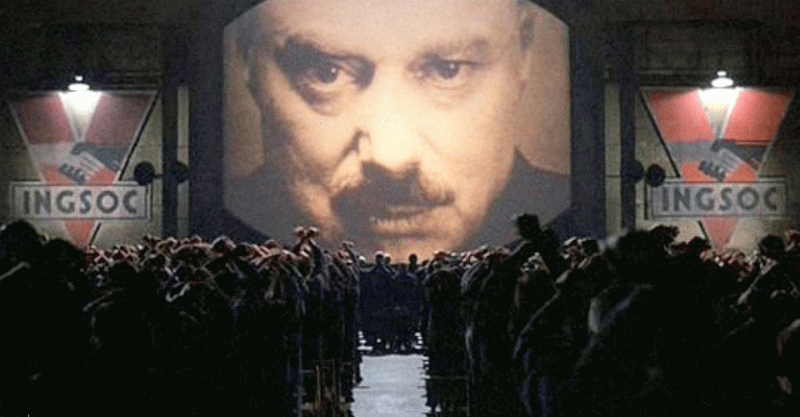
In chapter five of George Orwell’s Animal Farm, the head pig, Napoleon, announces the end of the weekly meetings of the animals: “They were unnecessary, he said, and wasted time. In the future, all questions relating to the working of the farm would be settled by a special committee of pigs, presided over by himself. These would meet in private and afterward communicate their decisions to the others… there would be no more debates.” Orwell’s dystopian work of fiction, like all great dystopian novels, clearly predicts the future. Unfortunately, that future is taking place in public libraries throughout the country, including the one in my hometown—Kimball Library in Atkinson, NH. While these institutions hypocritically promote the American Library Association’s Library Bill of Rights and “intellectual freedom,” many are actually discouraging residents’ freedom of speech and acting in other ways that are reminiscent of Napoleon’s totalitarian regime in Animal Farm.
While New Hampshire law does not require public comment at library trustee meetings, such an opportunity for residents should be offered by any board that appreciates free speech, especially when its own bylaws assert, as they do in Atkinson, that the library “greatly values residents’ input in order to achieve its mission,” and that the director “is welcoming of it.” Until recently, that opportunity was a regular feature of board meetings at Kimball Public Library; in fact, it was required by the bylaws.

I began attending library trustee meetings in December 2024 (click links to see videos of meetings) when I became aware that the majority of the board wanted face masks to be worn during meetings due to one member’s health situation. I felt compelled to speak in opposition to this issue because I highly disagreed with such a mandate, considering that the efficacy of such masks had been proven doubtful following the COVID pandemic. Over the past eighteen months, I have continued to attend most of the Kimball Public Library Board of Trustees’ meetings to express my opposition to various other proposed policies during the public comment period, but it has become increasingly difficult to do so.
I went to the December 2025 meeting to oppose a policy proposed at the previous month’s meeting that actually pertained to public comment itself. This policy change would require residents wishing to comment publicly to request an invitation to do so at least forty-eight hours before a meeting. I wanted to argue that this unnecessary policy would discourage residents from attending meetings and speaking their minds. The trustees had claimed during their November 2025 meeting that the purpose of this policy was to achieve a closer alignment with the policy of the town’s board of selectmen, but that other board-posted policies said nothing about a public comment registration requirement. In fact, I was easily able to comment publicly at the end of the March 2026 selectmen’s meeting with no prior registration. At the December 2025 meeting of the library trustees, I was shocked when told by the board chair that public comment would not be allowed that day, an action that was in direct violation of the board’s own bylaws posted on the library website.
While the policy to request an invitation to be a “guest speaker” forty-eight hours prior to a meeting was passed at the December 2025 meeting, which I was not allowed to speak at, the library website was still not updated to reflect that change the following month, so I asked to make a public comment at the January 2026 meeting. I was initially denied the opportunity to speak and express my opposition to the new policy’s discouragement of free speech, but when I pointed out that this new policy had not yet been publicly posted, I was given three minutes to speak. My comments, as usual, fell on deaf ears.
The bylaws, which provided the details of the new policy (see Article IV: Section 8) – including a link to the official request form and more detailed information – were officially updated on the exact same day as the February 2026 trustee meeting, which prevented me from requesting to speak. I was therefore caught in a “Catch-22” situation and was again denied the opportunity to speak at this meeting.
I made sure that I adhered to the cumbersome new policy the following month (March 2026) and submitted a request two days prior to the scheduled meeting. I included the required description of the topic I wanted to talk about and was “invited” to speak. I was given three minutes to address the problems with the guest speaker policy. By that time, I had attended a select board meeting at which I proved that this other town board, which the trustees claimed they were trying to align with, actually had no policy regarding a forty-eight-hour request to make a public comment.
At this March 2026 meeting, the director implied that I was a “spreader of misinformation”—a reference to my criticism of the library’s budget and staffing while recently campaigning for library trustee myself. She did not mention my name, but it was abundantly clear to all present that she was talking about me. I could not defend myself because I had not been invited to speak – I was effectively silenced and denied the right to rebut this accusation. Consequently, I made sure to request an invitation two days prior to the next meeting (April 2026). Despite my request, I was told that I could not speak due to the nature of the critical comments I wanted to make about the previous month’s director’s report. Therefore, I was unable to tell the board that the sources I used when informing the public about library issues were objective and trustworthy and certainly not misinformation, and that I attained my data directly from the New Hampshire State Library, which collects statistics from public library directors statewide. My only other source of information was the town’s official budget spreadsheet.
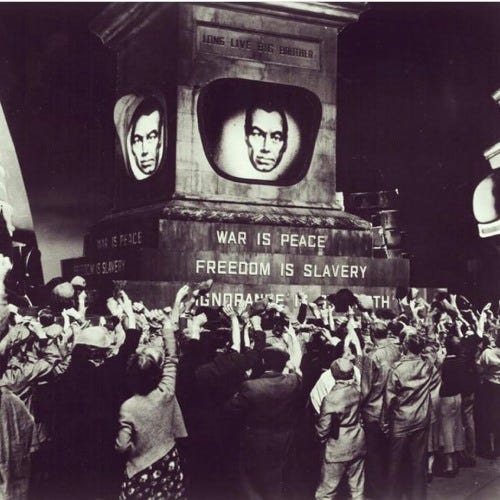
This spreadsheet confirmed that the library budget went up from $656,926 in 2025 to $687,019 in 2026, a 4.58% increase. Just as “The Ministry of Truth” in Orwell’s other classic book, Nineteen Eighty-Four, spreads lies by manipulating language — “war is peace; freedom is slavery; ignorance is strength” — this actual increase continued to be incorrectly referred to as a budget “cut” or “shortfall” because it was not as big an increase as the trustees wanted.
In protest of the budget committee’s allocations, the library trustees had voted at a February 9th “non-public session” (in other words, a private meeting) to close the library on Saturdays to make up for the alleged shortfall. Such sessions are allowed by state law (91-A:3) to protect the reputation of individuals, but the Atkinson trustees call such sessions far too frequently even when no one’s reputation is being discussed. Just like Napoleon in Animal Farm, they prefer private meetings, but in this case, they are likely violating the law.
Due to public outrage over the closure proposal illicitly decided in private, an emergency public meeting was held on March 16th. Attendees were told beforehand that there would be no opportunity for public comment at this meeting, but at the last minute, the chair allowed the public to speak, ensuring that the speakers had no time to prepare their comments and giving an advantage to those board members who had scripted detailed statements.
When it was my turn to speak, I offered the analogy of a child who gets a $10 allowance and then asks his parents for an increase to $20 but ultimately gets $15. This simple metaphor was intended to reflect the manipulation of words such as “cut” and “shortfall” to describe getting less than you wanted. In no way did I intend for my analogy to be taken literally and correspond to specific budget numbers, but this is how it was erroneously interpreted and why I was accused of spreading misinformation, an accusation that I was not allowed to later rebut except in a letter to the editor of the local newspaper, The Eagle-Tribune (**see below this article for the text of that LTE).
Efforts by the majority of the Atkinson Library trustees to change the public comment policy, hold unnecessary private meetings, and gaslight the public by manipulating language are truly Orwellian. These efforts are motivated by a fear of opposing viewpoints and a fear of losing power. What is taking place in Atkinson, New Hampshire, is particularly distressing not just because my beloved public library has become a bit too much like the societies depicted in Animal Farm and Nineteen Eighty-Four, but also because I suspect that my town’s situation is just one unfortunate example of a problem that is growing nationwide. Institutions that were founded to promote learning and truth are succumbing to the infiltration of ignorance and lies. That is extremely sad.
** “Silenced on Library Concerns” (Eagle-Tribune LTE: May 1, 2026)
To the editor:
On April 22, I was denied the opportunity to speak at the monthly meeting of the Kimball Library trustees in Atkinson. I was unable to tell the board that the sources I use when informing the public about library issues are objective and trustworthy. I could not defend myself against what I believe is an implied allegation that I am a spreader of “misinformation.”
I obtain my data directly from the New Hampshire State Library, which collects statistics from library directors and compiles them into spreadsheets providing information about public libraries throughout the state. My only other source of information is the official Atkinson budget. This document confirms that the library budget went from $656,926 in 2025 to $687,019 in 2026, a 4.58% increase. This increase continues to be incorrectly referred to as a budget “cut” or “shortfall.”
I was also unable to explain that an analogy I shared at the emergency March meeting (mentioned in the front-page Eagle-Tribune story “Trustees delay decision on Saturday library closures” on March 18) had been misinterpreted. My purpose in using figurative language – describing a child who gets $10 allowance asking his parents for an increase to $20 but ultimately getting $15 – was intended as a simple metaphor to reflect the misuse of words such as “cut” and “shortfall” to describe getting less funding than you wanted.
In no way did I intend for my analogy to be taken literally and correspond to specific budget numbers, which seems to have been how it was erroneously interpreted.
The stifling of free speech in Atkinson continues to be distressing.
Authors’ and Speakers’ opinions are their own and may not represent those of Grok Media, LLC, GraniteGrok.com, its sponsors, readers, authors, or advertisers.
Disagree, agree, Got Something to say? We Want to Hear It. Comment or submit Op-Eds to steve@granitegrok.com
