

Part 2 of a new health and wellness series*.
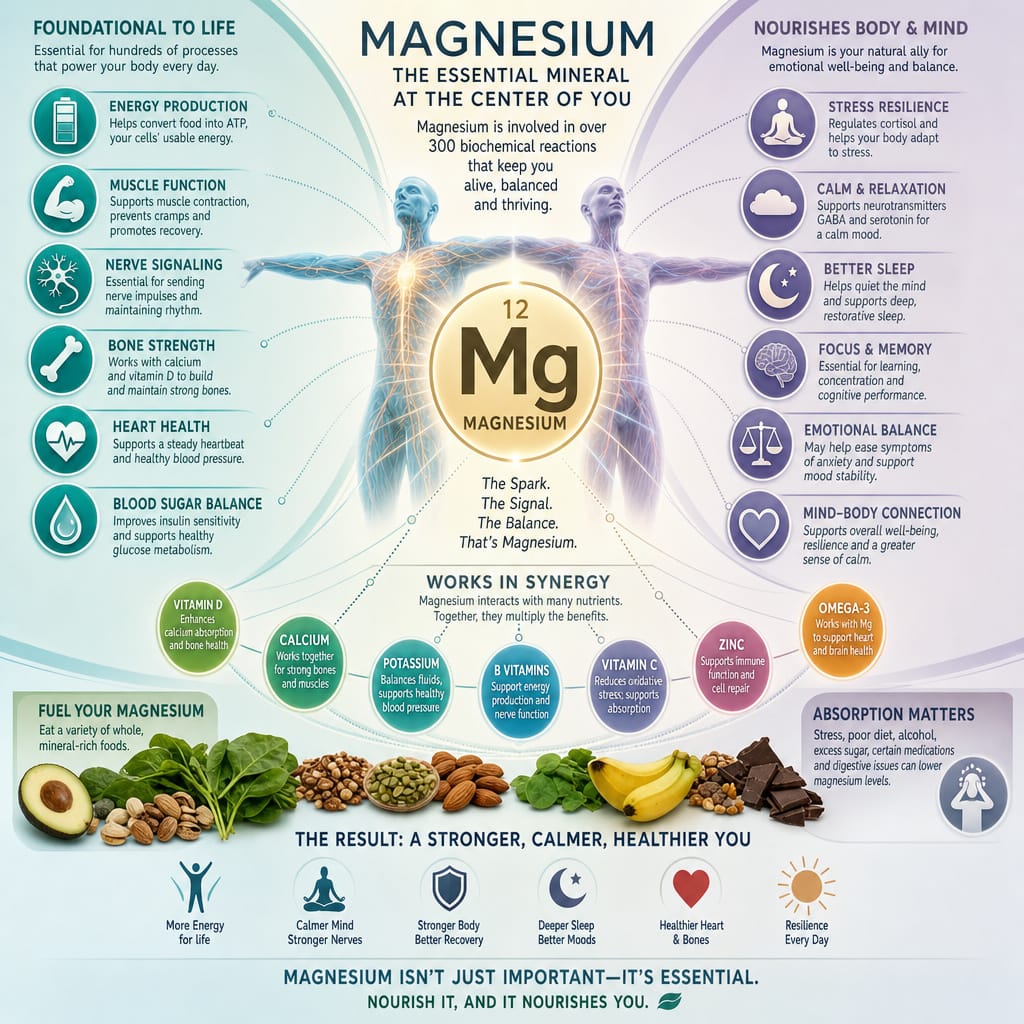
- Magnesium is an active element in every cell, involved in over 300 processes
- For a number of reasons, most people are magnesium-deficient
- Consider adding magnesium glycinate to your intake*. Can’t hurt; might help…
The role of brass in Mahler’s Symphony No. 8 can be viewed as a metaphor for magnesium’s role in our bodies. His No. 8 is kicked off with a monster E-flat major chord from the brass organ pipes, followed by a continuing brass presence supporting the vocal chorus. Without the organ note from the huge pipes, the symphony can’t get off the ground. Our lives are kicked off at conception with magnesium as possibly the most important nutrient in both the sperm and the egg. Without it, no us!
At conception, at birth, and throughout our lives, magnesium, like the brass in No. 8, is the single biggest player. No, it’s not concentrated in one place, like calcium in our bones; it’s distributed all through our bodies, present and active in every cell, but without invasive cell sampling and analysis, we can’t even tell whether we have enough or if we’re deficient. I have written about the centrality of magnesium in our health before, but this time, I wanted to take a much deeper dive, so I researched magnesium in human sperm and egg, and confirmed what I expected, namely, that magnesium is so essential that even slight deficiencies in either parent may put conception at risk. This led me to consider our declining birthrate while looking at our known declines in soil magnesium and the resulting decline in the food we consume. Certain conclusions do become obvious.
Here’s the 20,000-foot view of where we are and what’s happening. The weeds are pretty thick at ground level and, while I could write thousands of words delving into those weeds, I’m not sure you want to spend the time to read them. We’re at an interesting point where the MedicoBlob™ is either ignoring study results or designing studies that are pretty well assured to yield the desired conclusions.
Similarly, in food production, we’re at another interesting point where we’re producing more food than ever before, but with less nutritional value than at any time in history. We’re also ignoring pesky biological details that might have pretty bad long-term implications. Topping that list off, we’re more dependent than ever on big-pharma interventions, as we take more pills for more maladies than ever, all the while ignoring basic nutritional science because there’s no money in it. In all of C’s diabetic and post-accident years, visiting dozens of doctors, not one, including her cardiologists, recommended magnesium or explored her nutrient profile. That’s one hell of an indictment of our system, but you can research it yourself.
I did a search on duckduckgo.com for “magnesium benefits” to see how my suggestions compare to the top couple of results, which included two hospital-related sites and a major university with a med school. None mention the likelihood of farming soils being depleted of magnesium. None mention the age of RDAs, and that they are infrequently updated. None mention that magnesium is safe enough that you can just try it for a month and see if there’s any difference in the way you feel. None mention its potential impact in conception. One actually did mention getting a blood test to check your magnesium. One mentioned that magnesium testing is not simple and may not be covered by insurance. Neither mentioned why testing is such a task! Through all of them, the only commonality was feeling like I was in a third-grade health class!
In our musculature processes, the fibers of our muscles need to function in two directions to produce whatever action our brain directs them to do. Typing the next keys into this Post involves an elegant biological symphony of my brain forming the word pattern to be typed, and directing the arms to move the hands to the proper positions, and the fingers to activate the correct keys in the correct sequence. The muscles contract and relax with precisely the right speed and pressure primarily via the interaction of calcium and magnesium. Muscle cramps? Sounds like the muscle contracted but didn’t relax, doesn’t it?
Ever read about magnesium helping muscle cramps? Calcium is the primary element of muscle contraction; magnesium is the key element in relaxing the muscle. The overall body muscle symphony is so much more involved than Mahler’s No. 8 that it’s truly difficult to fully grasp. Just within the last five years, several studies have substantially deepened our understanding of these interactions, including how different our heart muscle is from our skeletal muscles in the interplay of nutrients as they accomplish their functions. For example, zinc, which will be next week’s focus, has been shown to play far different roles in our hearts than in our legs.
While I’m typing this Post, my watch says my current heart rate is 55, with a resting rate of 50 today, not bad for pushing 84 years, and I know it’s because I work to maintain a proper nutrient balance, and magnesium/zinc is a key pairing. I’m not selling some miracle concoction either, just giving commonsense information that anyone can follow, buying from their corner drugstore or Amazon. Balance is where zinc enters into our discussion today, and it’s the first of a couple of hundred nutrient interactions we’ll review over the next 10-12 months.
When we examine the role zinc plays in the fingers pressing the keys, we find that zinc works with magnesium in the muscle relaxation cycle; calcium works to press the finger to the key; magnesium/zinc relaxes the muscle to ready it for the next key depression. It’s a symphony, remember, so missing a horn or two won’t keep us from enjoying the music; it just won’t be as rich an experience. Nutrient balance is the same darn thing! We’ll still function, maybe even better than our neighbor, but it won’t be the same as if we achieved a better nutritional balance. The next question is how to get to that balance, which we’ll explore one nutrient at a time in this series. I should probably refer you to my full *Disclaimer Page at this point, as I’m certainly not a medical professional and cannot dispense medical advice, so my Posts are for informational or humorous use only. The Disclaimer Page is worth a visit as it has its pointedly humorous moments.
Before we get into dosages, we need to talk about shopping and using labels, which will probably end up being a Post by itself! In addition to the brand name and the nutrient name, you may find a “form” which basically refers to how it was processed. You may find its chemical name. You’ll definitely find dosage information, but since it’s a supplement, we dare not call it a dose, as that intrudes into medical turf; rather, we refer to it as a serving. Be careful with the “serving” sizes because sometimes it takes more than one capsule, tablet, scoop, drop, shovelful, etc., to make a serving.
Magnesium probably has more forms than any other elemental supplement, and that’s a good thing because of what’s called bioavailability, which is simply how much of the spoonful of the product actually makes it into your system in a useful manner. As a general rule, avoid any “oxide” forms of any elemental supplements, as that form has lower bioavailability. In magnesium, avoid it because of what I’ll simply call the “magnesium effect,” which happens when the 90% of the magnesium oxide that is not bioavailable gets to your bowels and draws in all that water…
We had been taking magnesium citrate until I read about the glycinate form in 2024. It had probably been around commercially since around 2010, but the brand I chose from Amazon wasn’t carried there until June 2023, and my preferred brand didn’t have a glycinate form on Amazon until almost a year later, so glycinate is definitely the new kid on the block! I’ve seen ads for multiple forms of magnesium in one capsule but I’m not yet convinced that we really need anything more than one solidly bioavailable magnesium form to do the job. After all, nature didn’t put anything in the ground except plain old elemental magnesium. I will definitely follow this and alter my position if facts so indicate. Here’s what Claude says about the commonly available forms:
- Glycinate — Best overall. High absorption, gentle GI, no laxative effect. Cardiac and neurological support. (My personal choice)
- Taurate — Cardiac specialist. Taurine adds independent heart benefits. AF support.
- Threonate — Brain specialist. Only form crossing blood-brain barrier. Cognition and memory. (For this reason, I may give it a try. I’ll keep you posted.)
- Malate — Energy and muscle fatigue. Good absorption. Gentle GI.
- Citrate — Good absorption. Mild laxative effect at higher doses. Widely available.
- Chloride — Good absorption orally. Also topical. Older European tradition.
- Sulfate — IV only for cardiac crisis. Epsom salts topically. Skip oral supplementation.
- Oxide — Avoid. ~4% absorbed. The rest finds your bowels. <g>
As to dosing, here’s our magnesium glycinate schedule: I take 500mg 2x daily and C takes 500mg 1x daily, mostly because she hates taking pills. The Official RDA is 400-420mg for men and 310-320mg for women. Wow, we’re too high, according to “the science” and the experts, so let’s take a look at my findings:
- Only biopsy of tissue samples can give an accurate measure of magnesium levels
- Given the difficulty in obtaining a broad enough range of magnesium level measurements to determine a baseline and compare it to general health, no one can say what our level should be
- Current RDA levels were merely a 1997 tweak of numbers established in 1941
- *Other than an old laxative-effect UL, there is no Upper Limit toxicity recommendation for magnesium, unlike other elemental supplements where toxicity has been established at high intake levels. As excess magnesium is excreted naturally by the kidneys, persons with kidney impairment must use caution.
- Since 1941 every important elemental nutrient in our food has decreased
- Any findings that involved magnesium levels in our foods have not been re-calibrated to account for soil magnesium depletion from modern agriculture
- Most commonly-used commercial farming fertilizers do not add magnesium
- As soil magnesium levels decline, crops increase their uptake of cadmium, which shares receptors with magnesium, feeding us toxic cadmium as a result
- The increased cadmium competes in our bodies with beneficial magnesium, so if we’re low in magnesium, our bodies fill receptors with cadmium
- Magnesium aids our bodies in elimination of toxic materials, such as cadmium
- After looking back at this list, I think I may bump my dose a bit…
In each nutrient column, we will examine key interactions among the nutrient itself, other nutrients, dietary intake, and pharmaceuticals. You’ll see the word “depleted” a lot in these sections. That word will have multiple uses for our purposes. In the case of magnesium, the depletion is wasteful because magnesium is simply washed out of your body and does nothing productive. (Other uses of “depletion” will be covered as they arise.) Magnesium can be depleted by alcohol, and even a couple of beers or glasses of wine trigger it. Tell your party-loving friends to add magnesium! Magnesium deficiency can cause potassium loss because the integrity of cellular structure requires both magnesium and potassium, and without magnesium, potassium is not properly retained within the cell. There is a well-documented link between proton pump inhibitors (PPIs) and magnesium depletion, which is actually pretty nasty because magnesium deficiency can be a contributing factor in GERD, which is why people take PPIs. Think about that connection for a minute.
Since nutrient interactions are a two-way street, some interactions, such as magnesium with vitamin D3, will be covered from the other end of the avenue. Next week, we’ll take a look at zinc. It’s definitely not just something for our now-defunct penny, and it’s much more important than you might expect, so watch for it!
Editor’s Backgrounder: This is Part 2 of a new health & nutrition series by a recent contributor of AI columns. You may have read his “Breakfast With Claude” columns, posted by one-old-conservative. These new nutrition interaction columns are part of a Substack on nutrition that you can visit here. This column can be viewed on this Substack link. Your comments will determine if you want more of this material, so be sure to let us know below! The author will be presenting a comprehensive AI overview seminar in June. Let us know if you would be interested in a downloadable video or link.
Authors’ and Speakers’ opinions are their own and may not represent those of Grok Media, LLC, GraniteGrok.com, its sponsors, readers, authors, or advertisers.
Disagree, agree, Got Something to Say, We Want to Hear It. Comment or submit Op-Eds to steve@granitegrok.com
*We are not doctors, lawyers, or financial advisors, to name a few, so under no circumstances are we offering medical, legal, investment, or any other advice. This is a news and opinion blog. We may report on or discuss research, papers, commentary, and the “expert” or amateur opinion of others, but that is not an endorsement or recommendation of these opinions. That is up to you and the professionals you trust and consult.
