

That seems like an odd thing to say, I know. But consider what Article 83 of the state constitution says about licensing:
Free and fair competition in the trades and industries is an inherent and essential right of the people and should be protected against all monopolies and conspiracies which tend to hinder or destroy it.
That’s the theory. But how, in practice, does the state offer that protection? By creating laws to enforce occupational and business licensing, laws that do very little except hinder free and fair competition. Similarly for laws favoring unions, which are by definition conspiracies to hinder competition. And don’t even get me started on how the courts have interpreted this article to require the state to set up a monopoly on schooling and then use taxes to support it.
If you support occupational and business licensing, or unions, or public schools, you are supporting the idea that when the state is charged with protecting a right — whether that’s an inherent and essential right like competition, or an ordinary enumerated right like gun ownership, or even an unenumerated right like deciding what you can put into your own body — the proper way to do that is to pass laws to determine who may exercise the right, and how, and after filling out what paperwork and paying which fees and taxes.
It’s really this simple: You can (1) respect a right by protecting its free exercise, and then figure out ways to mitigate whatever problems that causes; or (2) claim that rights are effectively permissions, which can be regulated, reduced, revoked, or even reversed if that seems like it might produce a desirable outcome, or avoid an undesirable one. But once you make the latter decision for one right, the magic of legal precedent means that you’ve made it for all rights, even though it may take some time for those other shoes to drop.
Licensing, unions, and public schools are all examples of the latter approach. And so long as they continue enjoy widespread support from people who really should know better, we continue to slouch towards the day when some draconian gun control measure will be enacted, and someone will challenge it in court, only to be told:
It’s a little late to be arguing that rights are more important than outcomes. We’ll protect the right to keep and bear arms in exactly the same way we’ve protected your other rights. That’s what ‘constitutional right’ means now: The state defines limits on what you can do, and then sets up bureaucracies to administer those limits.
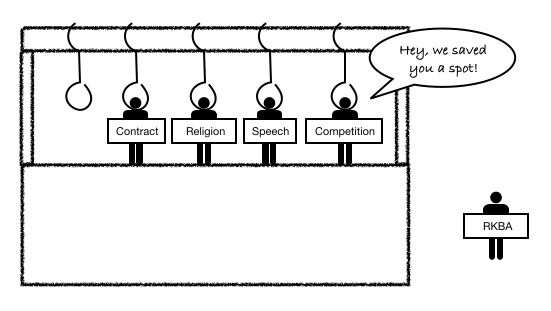
Ben Franklin once said that the founders had to choose between hanging together, or hanging separately. The same is true for rights.
A political party that is serious about claiming constitutional protection for rights like gun ownership, freedom of speech, freedom to worship, and so on, would be working steadily to unwind laws and court decisions that flagrantly violate other rights — starting with the inherent and essential right to competition. Because those laws and decisions define what it means to be ‘constitutionally protected’. Which at the moment means: not protected at all.
