

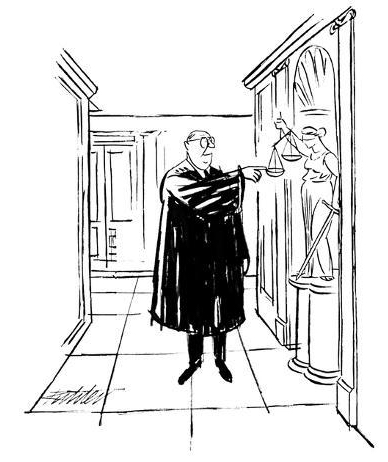
I recently had a conversation with someone in which he claimed that the judiciary is independent of the rest of government, and therefore it’s okay for that part of the government to decide whether other parts of the same government are exceeding their constitutional authority.
But suppose you buy a car made by General Motors. And there is a problem with the car — the brakes aren’t designed properly, which causes you to be severely injured in a car crash. So you want to sue GM.
And suppose you’re required to file your suit in a court that is owned and operated by GM. In particular, the judge and the other officers of the court are employees of GM.
You go to the judge to voice your concern about this. And he tells you: Oh, there’s no conflict of interest, because the court is a separate part of the company. It’s independent.
That’s basically the argument he was making. I don’t buy it. Do you?
He later revised his claim to say that the courts are not an ‘interested party’ to the cases that come before them.
But of course they are an interested party in cases that require them to decide on the limits of government power. How can they not be interested in what happens to the government of which they are a part, which pays their salaries, enforces their decisions, protects them from things they fear, and promotes things they favor?
The only way the courts could avoid being an interested party would be if they literally do not care whether the government is able to do any of those things… which anyone who reads their decisions can see is not the case.
Put simply, the court has an interest in maintaining, and expanding, its own authority. As part of the government, it therefore has an interest in maintaining, and expanding, the authority of the government.
Note that the courts don’t pretend to be disinterested. Justice Scalia in particular was very open about this, characterizing the ‘great judge’ as one who first decides what outcome would be most desirable, and then rationalizes it by picking and choosing precedents to support his decision in a way that convinces a majority of his fellow judges to go along with him. In this view, the most important talent of the great judge is persuasion, not logical reasoning. And the most important attribute of the great judge is the wisdom to know what’s best for the people, not neutrality.
But we don’t need courts to be wise, any more than we need umpires to be wise. We just need them to know what the rules are, and apply them as written. It’s the whole idea that judges are supposed to be wise that encourages and allows them to ignore the rules in order to get whatever outcomes they feel — in their wisdom — would be best.
It’s the idea that judges are supposed to be wise that has allowed the courts to get away with claiming that constitutions, statutes, and regulations mean whatever they want them to mean.
Am I exaggerating? Here’s Chief Justice John Marshall, in 1803: ‘It is emphatically the province and duty of the judicial department to say what the law is.’
Here’s Chief Justice Charles Evans Hughes, more than a century later, stating it even more plainly: ‘We are under a Constitution, but the Constitution is what the judges say it is.’
As long as this idea is accepted, the actual words of the federal constitution, or any state constitution, are irrelevant, except as suggestions to the judiciary. If the document plainly says ‘black’, but the courts claim that is says ‘white’, everyone defers to the court’s ‘interpretation’.
As long as this idea is accepted, there are, literally, no limits on government power except those that the court — which is to say, the government itself — feels like imposing at any given time.
So if you’re one of those people who has lately been wondering how it is that the governor can simply order businesses and schools and even churches to close down, here’s your answer: When his authority to do that was challenged, it had to be challenged in court… which is to say, it was necessary to ask the government to settle the question of whether the government is exceeding its authority.
Can you guess what the government’s answer was?
Note that all but one of the current justices of the New Hampshire Supreme Court are more than 60 years old, and therefore in the group with the highest risk of being killed by COVID-19. Does that sound like a group of people who have no interest in the case before them?
The maxim nemo judex in sua causa — which means, literally, ‘no one is judge in his own cause’ — is one of the most basic concepts in law.
