

Faced with a complicated task, we often turn to experts. We go to doctors, we go to lawyers, we hire electricians and plumbers and car mechanics. We turn our kids over to schools. (Which is usually a mistake, but we do it anyway.)
You know what else is complicated? Voting.
Voting is so complicated that a lot of people seem to have no idea how to go about doing it. But they feel like they should. After all, it’s everyone’s duty to vote, right?
So we end up with the spectacle that I witnessed multiple times during the most recent election. I spent the day standing with a friend outside some polling places, keeping him company as he held signs for candidates he supported. Over and over, I heard people approaching the polling places, saying that they didn’t yet know who they were going to vote for.
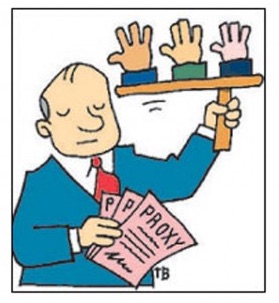
If you own stock, or mutual funds, you’ve no doubt received something in the mail asking you to either vote on some corporate policies that are under consideration, or assign your vote to a proxy (usually the board of directors, or perhaps your financial advisor), who will then cast a vote for you.
You would do this because you don’t really understand the issues being considered, and you don’t have the time to learn about them, and even if you did, you really don’t care all that much. It’s their job to run the company, and your job to profit from the work they do.
If you’re like many people¹, this is pretty much the same boat you find yourself in when an election is approaching. You don’t know who’s running, or — except in some vague sense — what they want to do if they get in office. You don’t really understand the issues that are being discussed, and even if you did, you really don’t care all that much. It’s their job to run the government, and your job to live your life, pay your taxes, let the schools raise your kids, and hope for the best.
It occurred to me recently that there’s no reason why we shouldn’t extend the idea of proxy voting to government elections. After all, modern governments are corporations, so it seems like a natural fit.
How would this work? We already have a mechanism in place that we can use. It’s called an absentee ballot.
That is, you can vote in an election without actually showing up at your assigned polling place on election day. Instead, you can, at your convenience, go to the town or city office where you would register to vote, and fill out an application in which you attest that you will be out of town on election day. When they know who is going to be on the ballot, they’ll mail you your absentee ballot, which can be filled out and turned in prior to election day.
Now, on the one hand, it seems like you’d be lying, right? You’re saying you can’t be there on election day, when what you really mean is that you shouldn’t be there on election day. But in the spirit of judges everywhere, you can just pretend that those two words mean the same thing. (If they can pretend that ‘shall not’ means ‘might be able to’, why can’t you pretend that ‘cannot’ means ‘should not’?)
Once your absentee ballot is in hand, you just need to find someone to fill it out for you. Someone whose judgment you trust, or someone you think is smart, or just someone who you think has your best interests at heart. You sign the ballot, turn it over to that person, and you’re done. He fills it in and puts it in the mail. And you get on with your life, secure in the knowledge that you’ve done your civic duty.
In theory, this is no different from asking someone else who you should vote for, and then voting for that person. And in practice, it’s better than just checking the boxes next to the names you’ve seen most often on lawn signs and heard most often in radio commercials.
You wouldn’t take out your own appendix, would you? Or represent yourself in a criminal trial? Or upgrade your electrical panel from 100 amps to 200 amps? Or replace your head gasket? Or teach your kid calculus? If you’re like most people, you know you can’t do those things competently, so you don’t even try. Voting is exactly the same.
Readers, if you know anyone who feels that he should vote, but who doesn’t have the time or the inclination to do the work required to cast an informed ballot, please ask him to forward his blank, signed absentee ballot to me, care of Granite Grok, and I’ll take care of it for him. If he includes a self-addressed stamped envelope, I’ll even send him an ‘I voted’ sticker that he can wear, to let people know that he did his part to keep our democracy going.
In fact, by next fall I hope to have a web site (LiteVoting.org, ‘All of the credit, none of the work’™) where he can just enter his name and address and scribble his signature with his finger, and let me take care of the whole process for him.
¹ I’m not talking about Grok readers, obviously.
