

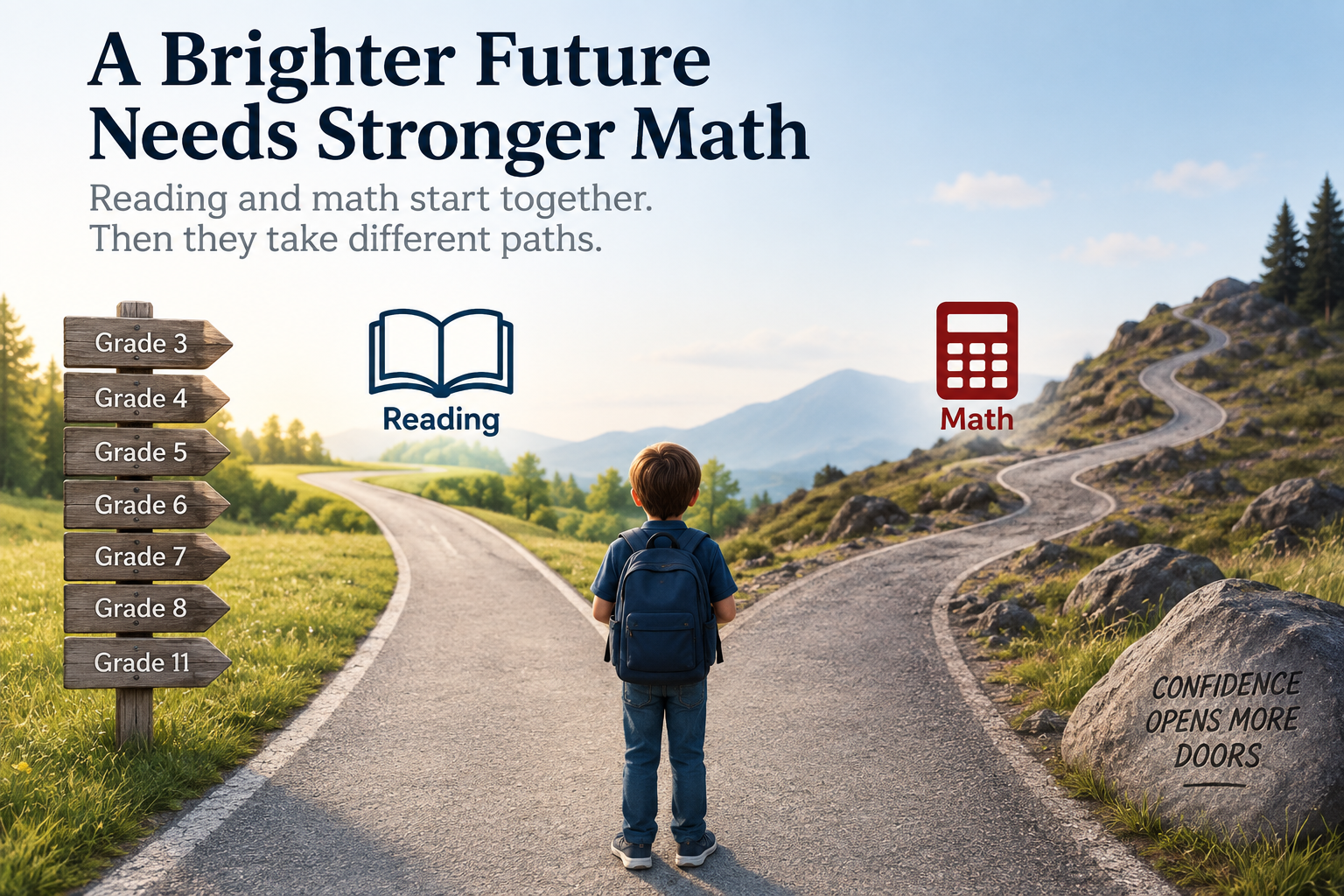
New Hampshire has a math problem.
In 2026, about 62% of New Hampshire’s 11th graders met the state’s proficiency standard in reading. In math, only 30% did.
That gap is hard to ignore.
But high school isn’t where the story begins.
The Gap Begins Earlier
New Hampshire’s statewide assessments tell an interesting story.
In the early elementary grades, students perform about equally well in reading and mathematics. In Grade 3, math proficiency is actually slightly higher than reading. By Grade 4, they’re essentially tied.
Then the two subjects begin to separate.
Beginning around Grade 5, reading proficiency remains relatively steady while math proficiency starts to fall behind. Through middle school, that gap persists. By Grade 11, it has grown dramatically.
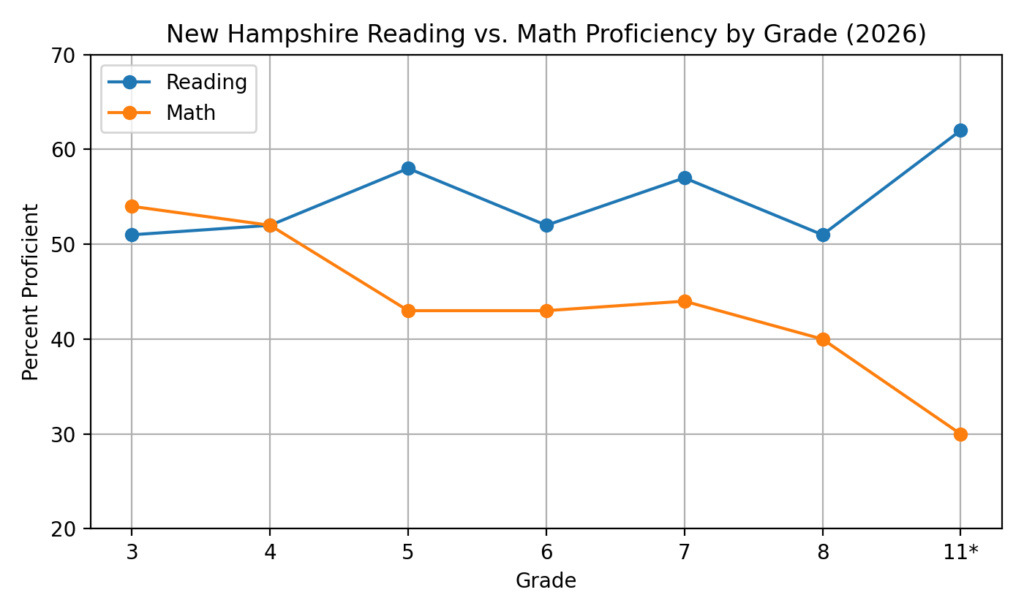
*Grades 3–8 use the NH SAS assessment. Grade 11 uses the SAT. While the assessments differ, the chart illustrates statewide proficiency patterns by grade.
The chart doesn’t tell us why the gap appears.
But it does raise an important question:
Why does mathematics become increasingly difficult for so many students as they move through school?
Mathematics Is Different
One possible explanation comes from the nature of mathematics itself.
Unlike many subjects, mathematics is highly cumulative. Each new concept builds on ideas that came before it.
Learning scientists have long recognized that success in later mathematics depends heavily on mastering earlier concepts. Research has consistently found that a student’s understanding of fractions is one of the strongest predictors of later success in algebra and higher mathematics (Siegler, et al, 2012; National Mathematics Advisory Panel, 2008).
That makes intuitive sense.
Students who never become comfortable with fractions often struggle with ratios. Weaknesses in ratios make algebra more difficult. Gaps in algebra make later topics even harder.
Small misunderstandings can gradually become much larger ones.
Now think about what it means to earn a C in math. If a student demonstrates roughly 70 percent mastery of the year’s material, an obvious question follows:
Which 30 percent didn’t they need before moving on?
In mathematics, that’s a difficult question to answer. The missing concepts may be exactly the ones next year’s course assumes students already understand.
This doesn’t prove that’s why math proficiency declines.
But it is one explanation that is consistent with both the assessment data and decades of research on how students learn mathematics.
A Longer View
The National Assessment of Educational Progress (NAEP) provides another piece of the puzzle.
For more than two decades, New Hampshire students actually improved in mathematics.
Grade 8 math scores rose from 273 in 1990 to 296 in 2013. Grade 4 students followed a similar pattern, also reaching their highest average score around 2013.
Then the trend reversed.
Scores began declining before COVID, fell further during the pandemic, and have recovered only slightly since.
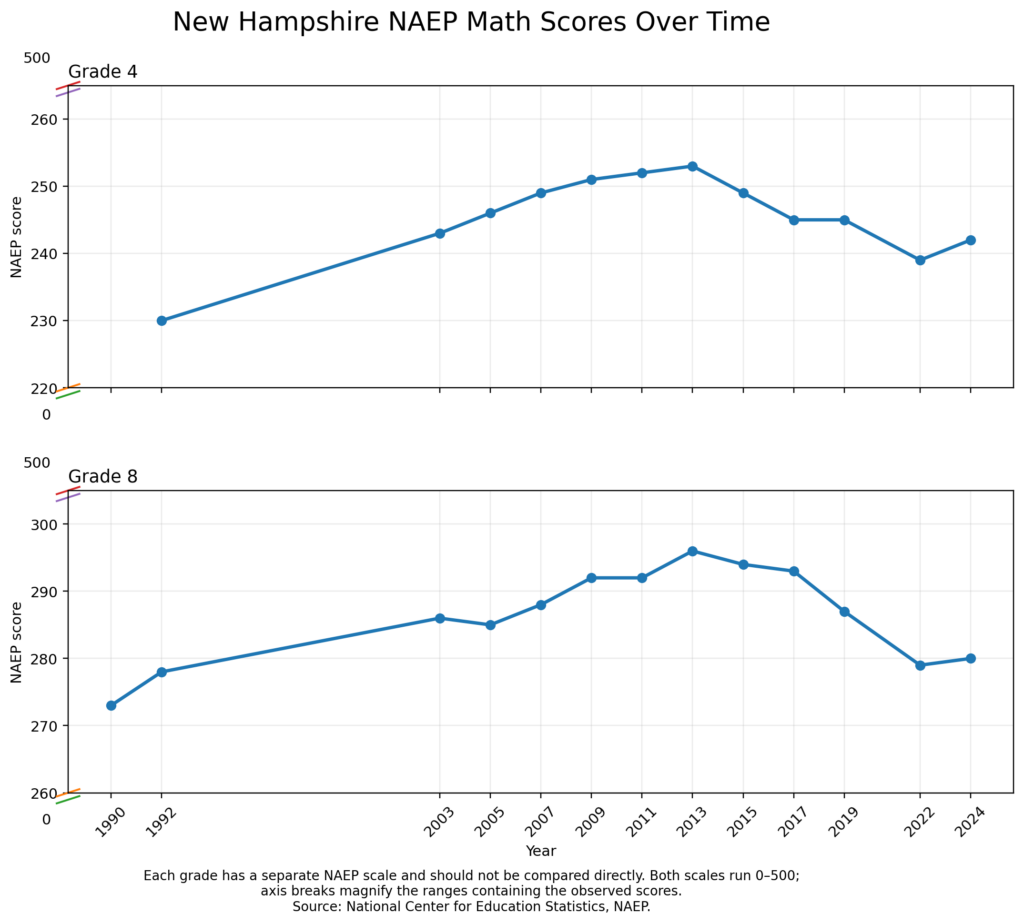
This tells us two things.
First, the recent decline is real.
Second, today’s challenges cannot be explained by the pandemic alone.
More Than a New Hampshire Problem
National NAEP results show much the same pattern. Students across the country improved for years, peaked around 2013, and then began losing ground.
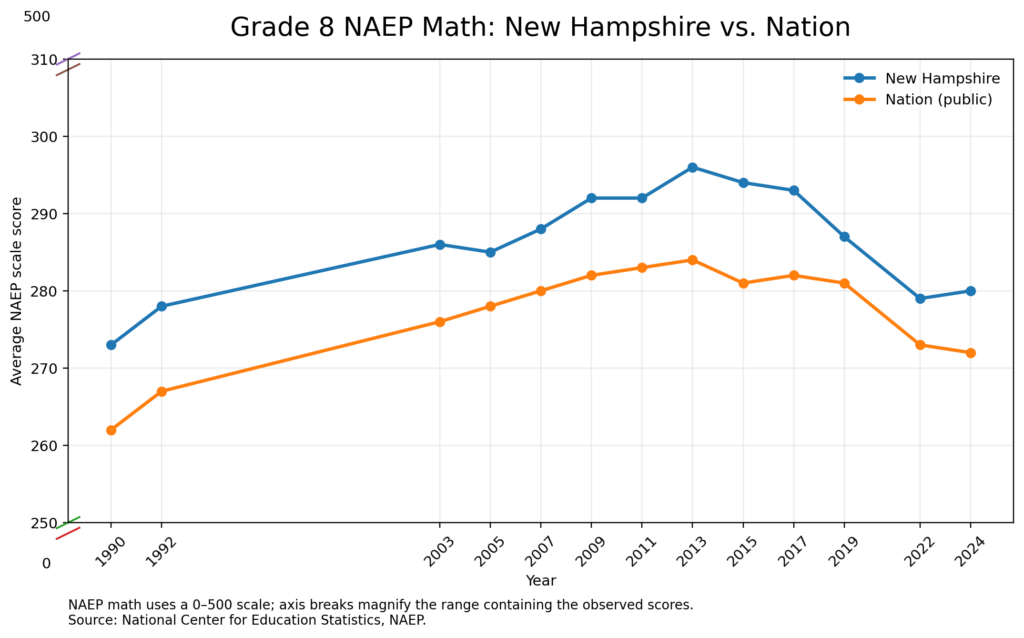
New Hampshire continues to outperform the national average, but rankings can be misleading. A state can rank near the top while still leaving many students without the mathematical skills they’ll need as adults.
What Should Students Know?
Ultimately, test scores matter only if they tell us something meaningful.
Perhaps the better question isn’t why one state ranks above another.
Perhaps it’s this:
What mathematics should every high school graduate know?
- Should graduates confidently work with fractions, percentages, ratios, and basic algebra?
- Should they understand compound interest before taking out a loan?
- Should they be able to interpret graphs, recognize misleading statistics, and understand probability well enough to make informed decisions?
These aren’t advanced mathematical skills. They’re practical tools adults use throughout their lives.
If most graduates can do those things, perhaps we’re worrying too much about test scores.
If they can’t, then being above the national average isn’t especially comforting.
A Different Approach
One advantage of individualized education is that it doesn’t require every student to move forward at the same pace.
Homeschoolers, microschools, and many other mastery-based learning environments can slow down when students need more time and move ahead when they’ve demonstrated genuine understanding.
The goal isn’t to lower expectations.
It’s to build a solid foundation before adding the next layer.
In mathematics, that may matter more than almost anything else.
Whether a student attends a district school, a charter school, a private school, a microschool, or learns at home, perhaps this is the question worth asking:
Are students mastering the mathematics they need for life—or are they simply moving through the curriculum?
[This article originally appeared on EdOpt.org. If you liked this article, subscribe to EdOpt. We send weekly informative newsletters about education and choice in New Hampshire.]
