


By State Representatives Mike Moffett, Jose Cambrils, and Alvin See
A political “flyer” circulated in Canterbury criticized that community’s three State Representatives (us) for voting against HB651 earlier this year. A response is required.
Sponsored by Rep. Dave Luneau (D-Hopkinton), a long-time proponent of higher state spending, HB651 would almost double the state’s education adequacy payments to school districts— from $4100 to $7356 per student. The measure (which was soundly defeated in our House of Representatives) also called for massive increases in the amounts of targeted aid categories as well.
It’s important to point out that our current education funding system involves spending around $23,000 per student per year in N.H., one of the highest school spending rates in the nation, during a time of declining enrollments and declining test scores. Further, the state already provides significant targeted extra assistance to communities experiencing local revenue challenges.
The flyer claimed that if Luneau’s proposal became law, the owner of a $500,000 house in Canterbury would save $712 in local property taxes.
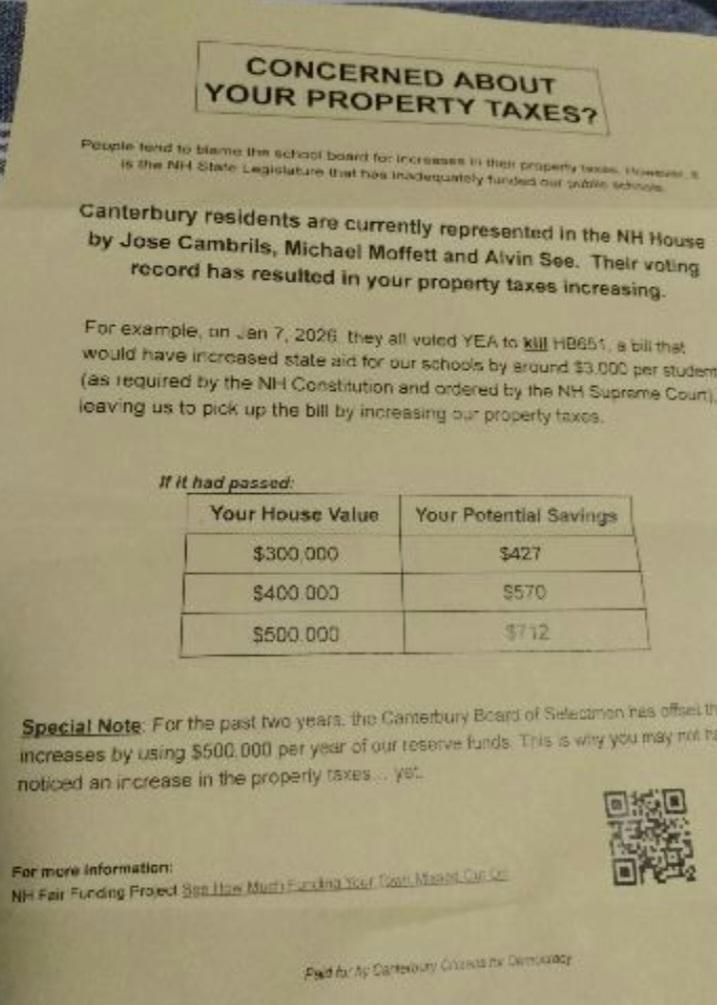
Au contraire.
As HB651 did not designate the revenue-raising mechanisms to be used by the state to pay for all the proposed new spending, the revenues would arguably have to come from raising existing business taxes (BET or BPT) or SWEPT levies (Statewide Education Property Taxes) which would drastically INCREASE local property taxes, as opposed to lowering them, as the flyer’s authors (Canterbury Citizens for Democracy) dubiously claim.
If SWEPT is not the source for Luneau’s extra spending, then where would the money come from? As N.H. does not print or borrow money in the fashion of the federal government, the Granite State would have to raise other existing levies, i.e. Rooms and Meals taxes or lottery percentages—or create new levies, such as income taxes or sales taxes. Some observers feel that the creation of such new taxes is the real goal of many advocates for ever higher school spending, as these new taxes would allow progressives to grow government, hire many more public sector workers, and thus acquire political power in the fashion that occurred with dire consequences in California and many other blue states. Public sector pension liabilities are RUINING these states!
New Hampshire is flourishing under our present system under our current executive and legislative leadership—as evidenced by the Granite State’s stellar rankings in so many national quality-of-life ratings, in contrast to the blue states from which folks are fleeing.
A N.H. legislative Ways and Means Committee member estimated that Luneau’s proposal would require $576 million in new state education spending with no guarantee of lowered property taxes and no designated revenue stream to pay for it. SWEPT currently calls for taking $1.20 per thousand of equalized property valuation. Luneau’s proposal would increase this to $3.00 per thousand for every property owner in the state.
And yet the Canterbury flyer claims his proposal would lower property taxes and blames US for property tax woes! That is nonsensical and thus requires this response.
It is also relevant to point out that the Canterbury flyer did not have any disclosure contact information for its publisher, which may be at odds with state law concerning political signs and campaign literature targeting elected officials by name. This may be of interest to the Attorney General—but we digress.
In this information age, we can only hope that N.H. media will allow elected representatives to respond publicly to progressive disinformation shenanigans and that citizen-voters can accurately process the full picture before voting this fall.
#####
State Representatives Mike Moffett, Jose Cambrils, and Alvin See all live in Loudon. Moffett chairs the House Committee on State-Federal Relations and Veterans Affairs. Cambrils chairs a House Finance Committee. See is a member of the House Election Law Committee.
PHOTO: State Representatives Mike Moffett, Jose Cambrils, and Alvin See
