


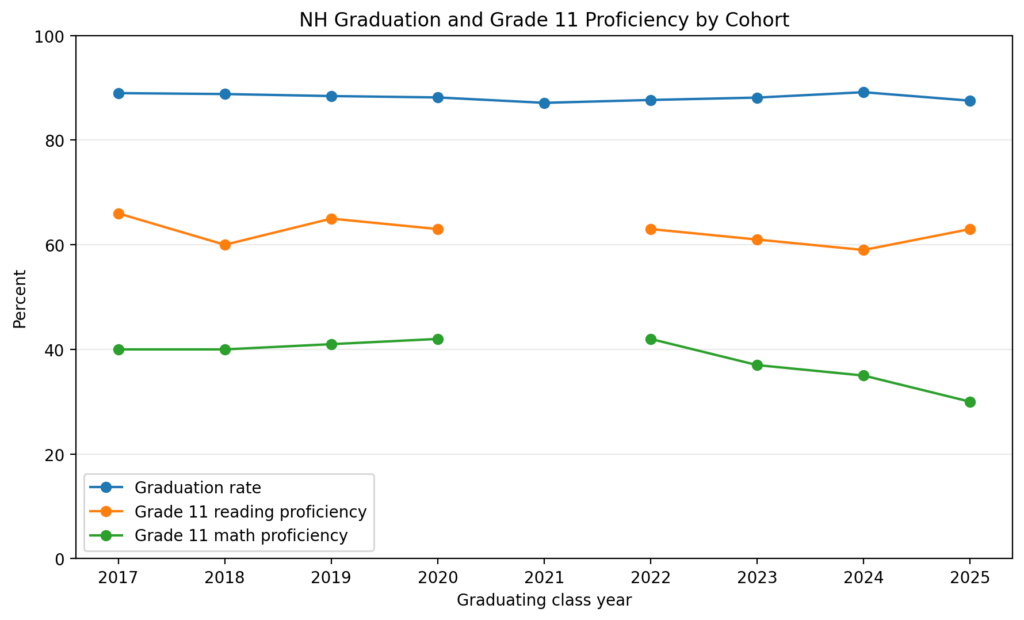
Here’s something you may not have known: About 88% of New Hampshire’s Class of 2025 graduated from high school. But when that same cohort was tested in Grade 11, only 63% demonstrated proficiency in reading and 30% in math.
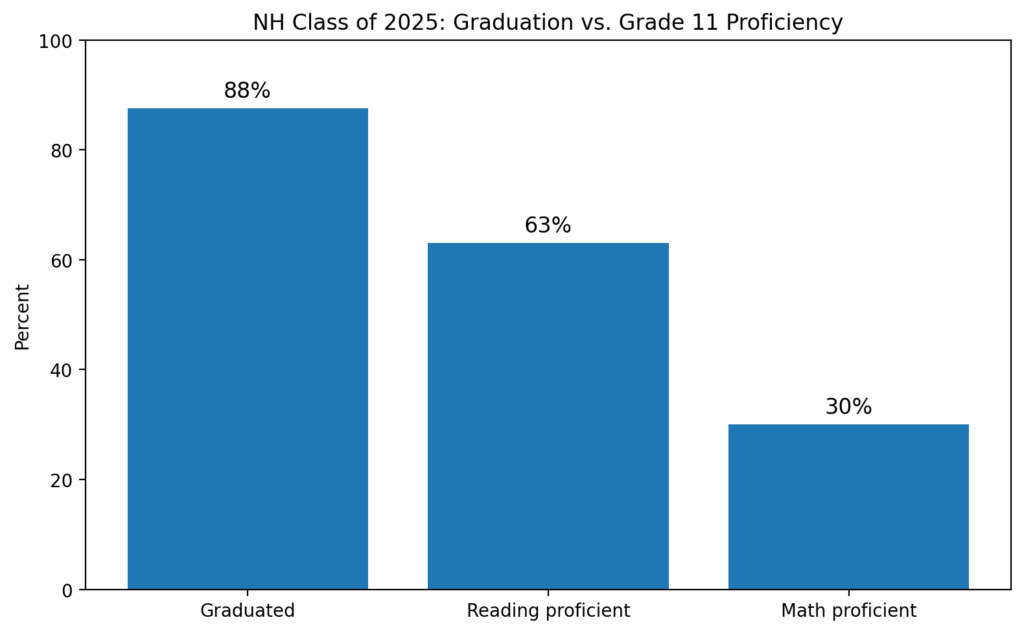
That’s quite a gap.
It made me wonder: How are so many students graduating when so many are not demonstrating proficiency in reading and math?
But then I had another thought: Maybe the kids just aren’t trying
New Hampshire uses the SAT as its statewide Grade 11 assessment. For a college-bound student, an SAT score may matter personally.
But what about a student planning to go directly to work? Or into the military, where the Armed Services Vocational Aptitude Battery (ASVAB) — not the SAT — is used to help determine enlistment eligibility and military job opportunities?
Maybe some students simply don’t care how they perform on the SAT.
Research backs up that idea. Yigal Attali, a former colleague of mine at Education Testing Service, found that students don’t try as hard on low-stakes tests, and their scores improve when they put in more effort. Another study found a strong link between how hard students tried and how well they scored on low-stakes tests.
So I asked another question: What are the SAT scores good for?
What does the SAT actually measure?
One way researchers evaluate a test is to compare it with other tests that measure similar skills. If two independently developed tests are supposed to assess similar skills, we would expect their results to be similar.
The Armed Services Vocational Aptitude Battery (ASVAB) measures these 4 things: Arithmetic Reasoning, Mathematics Knowledge, Paragraph Comprehension, and Word Knowledge.
Those sound rather familiar.
In a 2004 study, researchers compared SAT scores with a general cognitive measure derived from the ASVAB for 917 people who had taken both tests. The correlation was .82. That’s a very strong relationship.
More recent SAT validation research in 2022 for 6,373 high school students found that SAT scores are strongly related to other academic measures, including PSAT and AP exam scores, at around .6. That’s a strong relationship.
But one result caught my attention. SAT scores were much less closely related to high school grades. The correlation between the SAT and high school GPA was only about .4. That’s just a moderate relationship.
That doesn’t mean grades are meaningless. But it does suggest that grades and tests are not measuring exactly the same thing. A student can earn good grades for many reasons, including homework completion, attendance, participation, deadlines, extra credit, persistence, course selection, teacher grading practices, and local grading standards. So a good report card may not answer a very basic question: How well can my child actually read?
What can we conclude? The SAT appears to measure something real, but perhaps not what we first assumed. Research suggests SAT scores are strongly related to general cognitive ability and to scores on academic tests. They are much less closely related to high school grades. That makes me hesitant to use New Hampshire’s SAT proficiency rates as a direct measure of how well students can read or do math.
In other words, the SAT may tell us something important about students. But saying “37% of students can’t read proficiently” based on SAT results alone states more than the test can support.
But that doesn’t settle the question
As stated above, a valid test can still be affected by motivation.
The research does not prove that every New Hampshire junior gives the SAT his or her best effort. Some undoubtedly care more than others.
So we are left with an uncomfortable answer: the low proficiency numbers deserve our attention, but they don’t tell us everything.
And that may be the most important point for parents.
The test still isn’t your child
Even a perfectly valid statewide assessment cannot tell you everything about your child.
- Does your child avoid reading?
- Can she explain what she just read?
- Does he guess at unfamiliar words?
- Can she follow written directions?
- Is reading getting easier — or does it remain hard?
Those are things a parent can notice long before a statewide test score arrives.
One advantage of homeschooling is the short feedback loop. A parent working closely with a child often doesn’t need an annual assessment to discover that the child has difficulty reading. If the struggle is visible today, instruction can change tomorrow.
Parents whose children attend district, charter, private, or even microschools can create that feedback loop too. But they may need to be more intentional about it.
Don’t assume that promotion to the next grade, a good report card, or eventually a diploma answers the question: Can my child read and do math as well as I think they can?
The statewide data are a warning light.
Parents still need to look under the hood.
A Question Worth Asking
Do you know how well your child can actually read?
Not sure how well your child is really doing? You don’t have to figure it out alone. Explore the resources at EdOpt to learn about education options in New Hampshire, or contact us to talk through your family’s particular situation. We can help you ask the right questions and explore the options available to your child.
Jody Underwood, Ph.D.
President, EdOpt
