

Why the Liberal Left Is Closer to Fascism Than Trump or MAGA Ever Was or Will Be
History Makes the Pattern Plain: Why the Modern Left’s Authoritarian Leanings Echo the Past More Than the Right’s.
We’ve all heard the endless claim that Donald Trump, MAGA, and the conservative base supporting this administration are “fascists,” “far-right,” or “literally Hitler.” It’s repeated so often it’s become background noise. But if we do our research, step back, and look at history with common sense, the facts are plainly there for anyone willing to recognize them. The pattern is obvious once acknowledged.
For years, the mainstream media and much of the liberal left have defaulted to a lazy, one-dimensional slur: Donald Trump, MAGA, and American conservatives are “literally Hitler” or “far-right fascists.” This rhetoric peaked during the 2024 campaign and persists today. But the traditional left-right political spectrum is broken. It obscures more than it reveals and enables dangerous historical illiteracy. The old one-dimensional left-right spectrum we’ve been taught is simply inadequate. It collapses too much and lets people slap lazy historical labels on anyone they dislike. A clearer lens comes from examining two real forces that have shaped governments and movements across time: the level of government control over people’s lives and whether politics centers on the nation or on international/global visions.
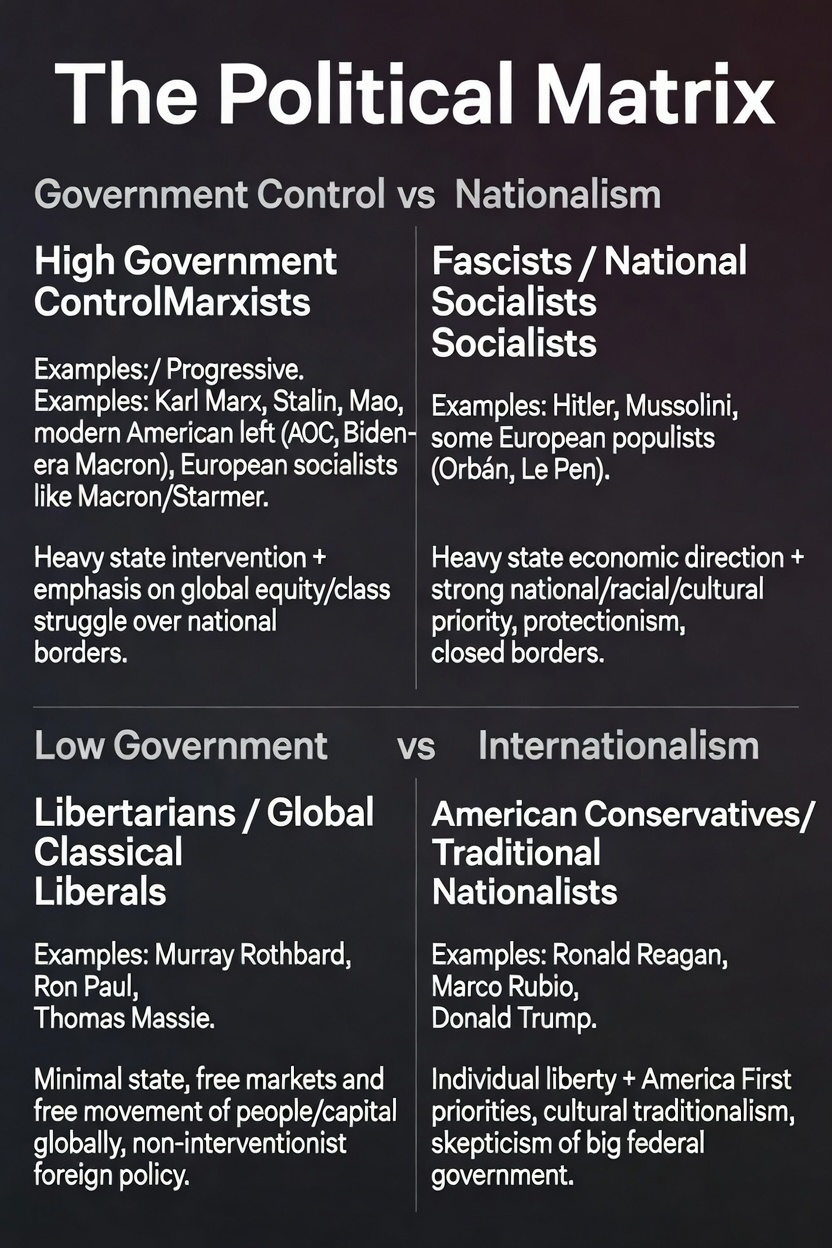
These ideas below offer a far more accurate 2×2 Political Matrix with two axes that actually explain modern politics:
Vertical axis: High government control (top) versus low government control (bottom) — the degree of state intervention in the economy, personal liberty, regulation, and daily life.
Horizontal axis: Internationalism/globalism (left) versus nationalism (right) — whether politics prioritizes universal/global equity and open borders or national sovereignty, borders, and “country first.”
This produces a straightforward framework:
High Government Control
Top-Left (Internationalist): Heavy state power paired with global or universal priorities. Historical Marxists, Stalinists, and modern progressives who push expansive government for equity, regulation, and supranational goals. Top-Left (Internationalist): Marxists / Progressives — Karl Marx, Stalin, Mao, modern figures like AOC and Biden-era policies. Heavy state power + global equity over national interests.
Top-Right (Nationalist): Heavy state power paired with intense national or racial focus. Historical fascists such as Mussolini and Hitler, who centralized the economy and crushed dissent in the name of the nation or volk. Top-Right (Nationalist): Fascists / National Socialists — some European populists. Heavy state economic direction + extreme national/racial priority.
Low Government Control
Bottom-Left (Internationalist): Minimal state intervention with global or cosmopolitan leanings. Libertarians and classical liberals who favor free markets and open cooperation across borders. Low Government Control. Libertarians — Murray Rothbard, Ron Paul. Minimal state, free markets, and free movement globally.
Bottom-Right (Nationalist): Limited government with priority on national sovereignty and cohesion. Traditional American constitutional conservatives who emphasize individual liberty within a framework of borders, rule of law, and “country first.” American Conservatives / Traditional Nationalists — Ronald Reagan, Donald Trump, Ben Shapiro (leaning slightly libertarian). Individual liberty + America First sovereignty.
Trump and MAGA sit firmly in the bottom-right: pro-national interest and cultural cohesion, but deeply skeptical of big federal government, favoring deregulation, energy independence, and constitutional limits. Calling them “far-right” or fascist is historically illiterate. The real “far-right” in this model is the top-right: authoritarian statism married to nationalism.
This framework reveals a horseshoe effect at the top. Far-left Marxists and far-right fascists converge in authoritarian collectivism, centralized power, suppression of dissent, and rejection of liberal individualism. The difference is mainly international class struggle versus national/racial struggle. As historian A. James Gregor documented in The Two Faces of Janus: Marxism and Fascism in the Twentieth Century, fascism and Marxism-Leninism share deep affinities — both “heresies of socialism.” Even Leon Trotsky noted the “symmetrical phenomena” of Stalinism and fascism.
“The Horseshoe at the Top and the Rise of the ‘Woke Right’”
One of the most useful insights this framework reveals is what political observers have long called the horseshoe effect. At the top of the matrix — where government control is highest — the far-left and far-right begin to resemble each other more than either resembles the center. Both Marxist-inspired progressivism and historical fascism embraced heavy state power, collectivism over individualism, suppression of dissent, and the use of centralized authority to reshape society. The main difference was the target of that power: one pursued international class struggle and global equity, while the other pursued radical nationalism and racial or cultural particularism. History shows this pattern clearly in the 20th century, from the shared totalitarian methods of Stalin’s Soviet Union and Hitler’s Germany to the pragmatic alliance of the Molotov-Ribbentrop Pact. When government control expands dramatically, the old left-right labels start to blur.
This same dynamic is visible today in what some have termed the “Woke Right.” Just as the modern left has imported identity politics, grievance culture, and authoritarian instincts into its internationalist framework, a fringe on the right has begun mirroring those same tendencies from a nationalist direction. Certain online voices and movements have drifted away from traditional American conservatism — with its emphasis on limited government, individual liberty, and constitutional principles — toward ethno-nationalism, anti-Western rhetoric, and identity-based grievance. This version of the right can create strange tactical overlaps with far-left anti-Americanism and even antisemitism. Far from strengthening national conservatism, this “Woke Right” risks completing the horseshoe by adopting the same illiberal methods it claims to oppose. It undermines the very liberty-oriented nationalism that has historically distinguished American conservatism from European-style statism.
History shows the extremes of high government control converge in authoritarian tendencies, regardless of whether they brand themselves left or right. The facts are plain for those who research and acknowledge them.
History Shows the Real Convergence
History bears this out. Benito Mussolini, the father of fascism, was not some lifelong right-wing figure. He was a lifelong socialist — a prominent member of the Italian Socialist Party and editor of its newspaper Avanti! He was deeply influenced by revolutionary leftist thought before breaking away and adapting collectivist ideas to a nationalist frame. Fascism did not reject socialism entirely; it reorganized it around the nation instead of class, creating a “third way” that still demanded total state direction of the economy (corporatism), suppression of individual rights, propaganda, and violence against opponents. Many serious historians have noted the shared DNA: As Victor Davis Hanson and other’s have noted, both 20th-century extremes produced totalitarian regimes with cults of personality, secret police, economic planning, mass death in pursuit of ideological purity, and pursued total control over society and the economy. Even some contemporaries on the left, including Trotsky, observed the symmetrical methods of Stalinism and fascism despite their surface differences in branding.
The 1939 Molotov-Ribbentrop Pact — the Nazi-Soviet non-aggression treaty that enabled the invasion of Poland — was no anomaly. It was a pragmatic alliance between supposed opposites who shared methods: centralized power over people. Post-war totalitarianism theory (Hannah Arendt and others) highlighted these parallels: both ideologies subordinated the individual to the collective, whether “the proletariat” or “the Volk.”
Victor Davis Hanson, the eminent classicist and military historian, has repeatedly warned that zealous minorities on both extremes can bully societies toward illiberalism. In recent commentary, he has highlighted how the modern left’s embrace of political violence, identity-based grievance, censorship, and expansive state power mirrors the authoritarian playbook far more than the limited-government conservatism of the American right. Hanson points out that the left’s hysterical labeling of conservatives as “fascist” while ignoring its own tolerance for Antifa-style violence or institutional capture is the real threat to democracy.
This is not abstract theory. It is visible in the historical record if we choose to see it. The 1930s showed regimes on both the internationalist-collectivist and nationalist-collectivist sides using the same tools: secret police, economic direction from above, elimination of dissent, and the subordination of the person to the collective project. Common sense tells us that once government power grows unchecked, the label on the box matters less than the power inside it.
Today the same pattern is recognizable.
Why the Liberal Left Should Look in the Mirror
To my friends on the liberal left: your side is not the bulwark against fascism you believe it to be. In the political matrix, the modern progressive movement, much of the liberal left operates in the high-control internationalist space: — with its push for expansive government control over healthcare, energy, speech, education, and the economy; its globalist emphasis on supranational institutions, open borders, and equity over merit; and its identity politics that treats people as members of grievance collectives rather than individuals — sits squarely in the top-left. That quadrant converges with top-right fascism in its authoritarian tendencies: cancel culture as modern book-burning, regulatory capture of corporations (echoing corporatism), and the belief that the state must remake society by force if necessary.
These tendencies share more structural DNA with the high-control authoritarian experiments of the past than with the limited-government, national-interest conservatism that defines the bottom-right quadrant—where Trump, Reagan-style conservatives, and the broader MAGA base sit. That quadrant favors lower federal overreach, constitutional restraints, energy dominance, border sovereignty, and individual opportunity over state-directed outcomes. These are classically liberal-conservative priorities in the American tradition — the very opposite of the statist collectivism that defined both historical fascism and communism.
The liberal left’s reflexive “Trump = Hitler” rhetoric isn’t just wrong; it distracts from self-examination. When you advocate for ever-larger government, speech codes, DEI mandates that divide by race and identity, or international climate accords that erode national self-determination, you are moving toward the high-control internationalism that historically enabled authoritarian excesses. The horseshoe bends: grievance politics on the left (identity as destiny) can mirror and even ally tactically with grievance politics on a fringe “woke right.”
The liberal left often insists it alone stands against authoritarianism. Yet if we look at the facts without partisan blinders, the push for ever-greater state power, institutional capture, cancellation of dissent, and globalist priorities has more in common with the top of the framework than the bottom-right defense of limited government and national cohesion. History does not lie. When government control expands and dissent is reframed as danger, the direction is the same regardless of the slogans.
#WalkAway veterans understand this from lived experience. Many of us left the modern left precisely because it abandoned classical liberalism for illiberal statism. History informs the present: the bloodiest regimes of the 20th century arose from high-control ideologies, whether internationalist or nationalist.
To those on the liberal left who genuinely oppose authoritarianism and fascism: the evidence is there in the historical record. If we do our research and actually acknowledge what the facts show, it is obvious. The conservative base supporting limited government, individual liberty, and national sovereignty is not the side sliding toward the high-control patterns that produced the worst regimes of the last century. The reflexive labeling of that base as “fascist” distracts from a clearer-eyed look at where expansive state power and collectivist logic actually lead.
The Political matrix isn’t perfect — no heuristic is — but it is vastly superior to the outdated linear spectrum. It forces intellectual honesty. For the liberal left to truly oppose fascism and totalitarianism, it must reject its own drift toward top-left authoritarianism rather than project it onto the bottom-right defenders of limited government and American sovereignty. We do not need new theories to see this. We need only to open the history books, apply common sense, and be willing to recognize what is plainly in front of us. The matrix of government control and national versus international scope makes the continuities visible. Once seen, they are difficult to unsee.
The choice before us is not left versus right on a broken line. It is whether we continue down paths of high centralized control or return to the lower-control, liberty-oriented traditions that built the freest and most prosperous society in history. History has already recorded the results of the former. The facts remain available to anyone honest enough to examine them
The real danger isn’t Trump or MAGA. It’s the failure to learn from history and recognize that authoritarianism wears many masks — red, black, or otherwise.
America’s experiment in liberty depends on all of us choosing the bottom half of the matrix: individual rights, limited government, and accountable national governance over utopian collectivism. See the various images below of the Matrix and the Horseshoe.
