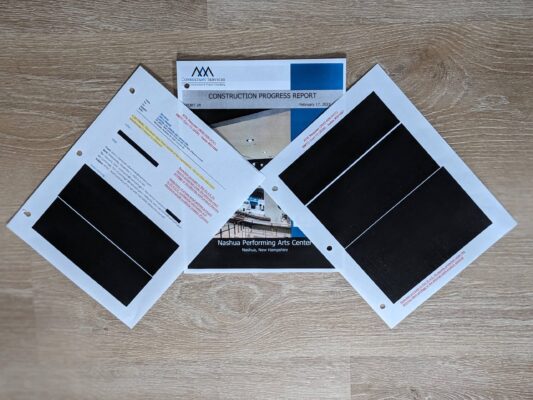
I filed a straightforward Right-to-Know request asking for the invoice supporting a $33,614 payment to McLane Middleton, the law firm hired to defend the three shell corporations created by the City of Nashua to construct and manage the Nashua Performing Arts Center. What I received in response did not look like transparency. It looked like something out of a heavily censored federal indictment file, like the Epstein files. Entire columns (9 pages) were blacked out. Every description of services erased. Hours erased. No lawful exemption or explanation offered. Just solid black rectangles where the public should be able to see what its money purchased.
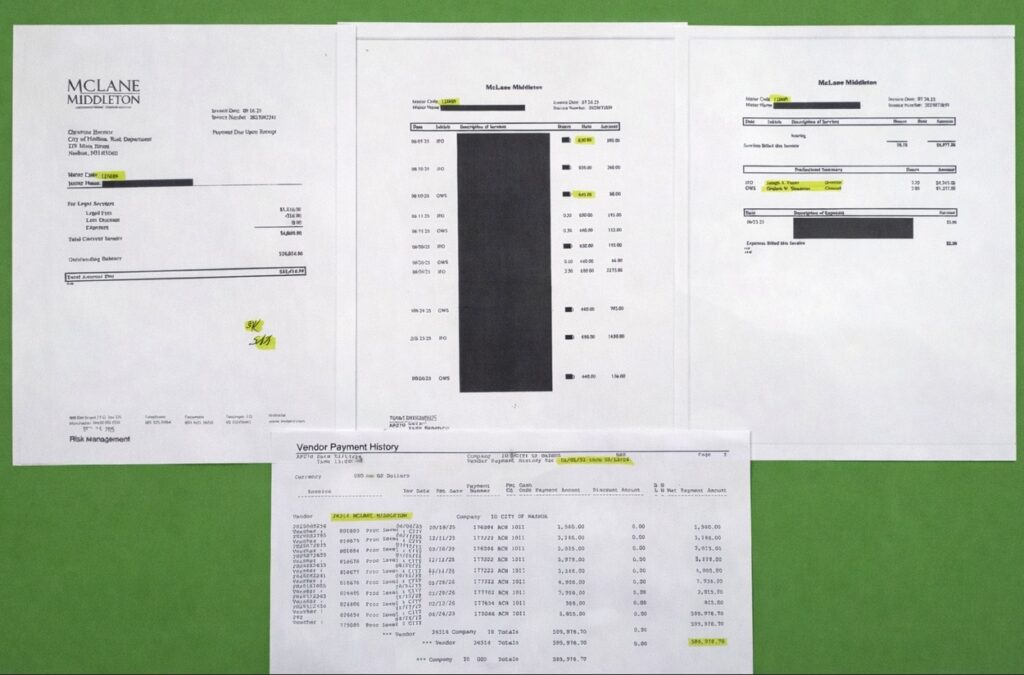
And the City knows I understand the difference. I have reviewed municipal legal invoices for years. I understand how attorney-client privilege is applied. If a sentence reveals a litigation strategy, it may be narrowly redacted. If a phrase contains protected advice, it may be shielded. But lawful redaction does not mean erasing the entire narrative column. It does not mean suppressing every description of work performed. And it certainly does not mean failing to cite a specific exemption under RSA 91-A to justify the concealment. The City’s response letter practices concealment by simply declaring the request “satisfied and closed.”
The larger issue is not just one $33,614 invoice. According to the City’s own ERP vendor payment summary, more than $599,979 has been paid to McLane Middleton in connection with these matters since 2022. Six hundred thousand taxpayer dollars. For what? To defend whether three corporations created by the City, funded with taxpayer bond money and federal tax credits, must comply with the Right-to-Know law? This is not a murder case or complex commercial litigation. This is not about national security. It is a public records request.
The company structure is as troubling as the redactions. The City created three corporations to receive bond and federal money for the Performing Arts Center. When a 2022/23 Right-to-Know lawsuit, based on 2021 records requests, was filed seeking meetings and records, those corporations hired outside counsel at premium rates.
They selected former Attorney General Joe Foster and counsel Graham Steadman of McLane Middleton. A top firm. Top billing rates. The corporations themselves had no meaningful independent revenue stream to fund the defense. So, with the City as the “Master Tenant” renting the building, taxpayers financed, and the City approved, payment of the legal bills. There was no Board of Aldermen vote approving an open-ended engagement. No Finance Committee review of escalating fees, because legal contracts are conveniently excluded from ordinary purchasing thresholds. The public builds the building. The public pays the rent. The public pays the lawyers. And then the public is handed black boxes instead of answers.
The invoices reveal the dates. They contain Nashua’s Corporation Counsel Bolton’s initials of approval. They reveal some of the hours billed. They reveal $650 per hour and $440 per hour rates. They reveal the totals. What they do not reveal, because the City deliberately blacked it out, is the description of the work performed. Were the attorneys drafting motions? Reviewing board minutes? Advising on how to structure the corporations to avoid classification as public bodies? Preparing arguments to resist disclosure? Coordinating with City officials? The public cannot know, because every narrative entry is redacted.
If this were routine, defensible legal work, there would be no need for blanket redaction. If this were ordinary compliance with open government law, the descriptions would not have to be treated as if they were radioactive. Nearly $600,000 in taxpayer money was spent fighting over whether public records must be public. Now, NPAC’s counsel agrees the records are public, yet the City still blacks out the legal work it paid for. That contradiction demands an answer: what are you hiding?
Sunshine Week is approaching. It is meant to celebrate open government. In Nashua, taxpayers are staring at six figures in legal fees and solid black rectangles where explanations should be. The Performing Arts Center was built with public money. The legal defense was paid with public money. The invoices are public records. The blackout redactions are a deliberate choice.
In Nashua, Sunshine Week comes with sunglasses because the glare of accountability is something City Hall clearly wants to avoid.