

Suburbia? Rural? You ARE the problem. You are preventing “Nature” from returning to its “natural” state (no mention that people are part of Nature as well as flora and fauna). Why else would NH Governor Chris Sununu (heh!) side with Democrat CA Gov Gavin Newsom and Democrat NY Gov Kathy Hochul (and lest I forget, the UN as well) that advances higher density living? Oh, they won’t all say the quiet part out loud – it’s always about “workforce / affordable” housing, but it is the same thing.
So what’s the reality about “urban sprawl,” which means we all should be “cityfied”?
Urbanization by State
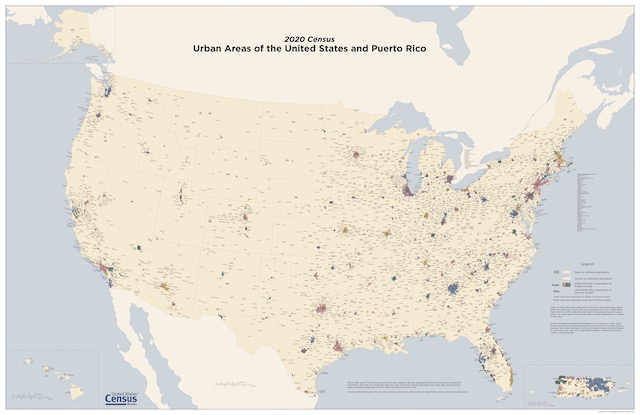
The share of land in the United States that is urbanized grew from 2.90 percent in 2010 to 2.94 percent in 2020, according to data recently released by the Census Bureau showing how many square miles of land in each state was urbanized as of 2020. This can be compared with 2010 data and the total land area of each state to calculate what percentage had been urbanized in each of the two years.
Oh, about that affordability that is supposed to come with higher density? Any Ec-101/102 student should immediately say “Supply and Demand” and “Government is artificially constricting the Supply of Land,” resulting in this:
Thanks to its strict land-use regulation, including urban-growth boundaries that are nearly impossible to adjust, California still has the densest urban areas of any state in the nation. In fact, the state packs more than 94 percent of its population into just 5 percent of its land area, an urban concentration found in no other state.
Despite claims that increasing densities are the solution to housing affordability problems, the states with the densest urban areas tend to be least affordable and their affordability declines as they get denser. California has the least affordable housing in the country, and other states with dense urban populations, including Hawaii, New Jersey, New York, and Oregon, are also among the least affordable. Few if any urban areas whose densities are below 3,000 people per square mile have problems with high housing prices.
There’s a chart at the link with more details.
(H/T: The Antiplanner (Dedicated to the sunset of government planning) )
