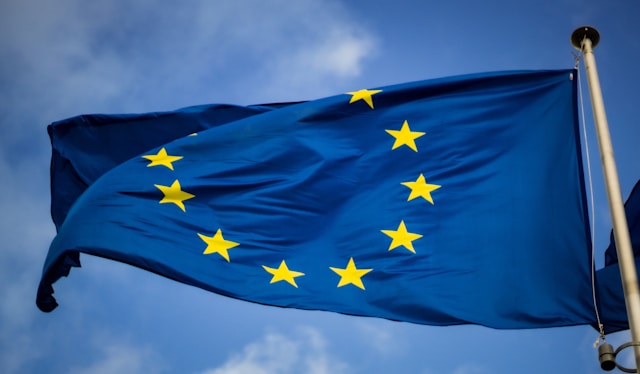
Is our alliance with the EU still good for America?
Since Donald Trump’s election, I have wondered whether (out loud on a few occasions) our alliance with Europe is still good for America. I mean the Brussels crowd. The EU/Davos types. The open-borders, bend the knee to the muslim conqueror types. I have no doubt there are hard-working French, Germans, Brits, and the rest who would be valuable allies and assets, but they’ve got themselves trapped in another political aristocracy. The result is not suitable for America.
There are a few shining moments here and there, but we can’t make alliances with nations while the EU hacks are running roughshod over the continent. We fought two wars to prevent a tyrannical homogeneity, and then a few decades later, they voted for one and forgot to put in guardrails.
Parallel to this idea that Europe is lost and bad for America (and natural human rights), if we are looking forward (unless it shifts gears, priorities, and directions), that leaves a big space to fill. Who on the world stage is prepared to move the world forward? Oddly enough, after all this Ukraine business, could it be Russia?
Calm down.
There is plenty of room for improvement there, but ask yourself this. Which of the two seems more likely to be nudged in the direction of property rights, more individual freedoms, and an economic and scientific path that will herald a better 21st century? It sure as hell isn’t the EU. There are signs of life in a few former Soviet bloc countries. Some individual European nations have promise. But if we are asking who America can encourage through trade and dialogue to pursue free market capitalism, is Europe heading in the right or wrong direction?
It’s a fair question and one that’s not outside the scope of consideration.
A leaked, longer draft of the Trump administration’s National Security Strategy reportedly identifies Austria, Hungary, Italy, and Poland as priority partners Washington should pull away from the European Union while establishing a new five-power forum with China and Russia, according to Defense One and other outlets.
Huh?
Defense One reported the ‘secret’ draft outlined plans to replace the existing G7 group with a “Core Five Forum,” including the United States, China, Russia, India, and Japan— the countries with populations exceeding 100 million. Like the G7, the Core Five “Superpower Club” would hold regular summits on specific themes of world interest, which is what the G7 is supposed to do.
Insiders insist there is no “longer draft” of the NSS, but any focus on America First must include a shake-up of the Globalist World Order, which rests on conventions like the G7. And let’s face it, America needs friends in the West who value Western Civilization and friends around the Globe who value it as well. And while Russia hasn’t always been our best buddy and China is anything but friendly to Western Civ, it thrives off it, and what was that thing about keeping your enemies close?
Nothing is perfect, but co-dependent New Europe is on a suicide mission, and we ought to be able to see that as a sign that the relationship might need something more permanent than “therapy.”
Austria, Hungary, Italy, and Poland reportedly emerge as countries the United States should “work more with… with the goal of pulling them away from the [European Union],” according to Defense One’s account.
The strategy allegedly recommends supporting “parties, movements, and intellectual and cultural figures who seek sovereignty and preservation or restoration of traditional European ways of life,” provided they remain pro-American.
Mass immigration and multiculturalism reportedly provide the justification throughout the document for this proposed realignment. Brussels stands accused of “transforming the continent and creating strife” through migration policies that purportedly undermine national sovereignty and political liberty.
“Work with” will entail a lot more than economics. Austria has some serious issues with free speech that need addressing, if memory serves, and many of these nations take EU money the way US States suck up federal money. Autonomy has a price they can’t yet afford to pay, which is just one of many issues that come with any separation from the EU.
If you could, conceivably, massage a few more from that end of Europe and use that to secure concessions from Russia, which, I must confess, I do not believe is the expansion threat the EU elites claim. It also has gas, oil, and minerals, and offers a more reasonable place to find common ground despite decades of animosity.
I’m not saying we’d be best friends, but Europe is using Ukraine to threaten an expanded war footing and literal war with Russia. I don’t think Russia wants that big picture. I believe it wants security guarantees to a greater degree than Ukraine does, and no one else in the world can do a better job of that than America.
The EU appears to want war with Russia even if it has to pay for it itself. How desperate does that sound?
What if we could use that to shift the world away from the old Cold War, end-of-the-world nuclear winter mindset that has dominated our thinking for more than half a century, and move Russia closer to us and farther from China?
China is a growing problem, and Russia is actually the ally we need. India and Japan are already natural allies on that point. And China, for all its military expansion, is the enemy we need close, surrounded by the world’s economic powers, not pandering EU technocrats. It positions us to battle it out better with BRICS, and maybe saves the dollar as the world’s currency.
I don’t know. I want to see the possibility here. An alignment of powerful nations that see Islam’s uncompromising expansion as the threat it is.
I also see great value in European nations that find a way to break from the woke EU descent into cultural suicide. The post-World War II bipolarism no longer applies to the world we live in. The greatest threat is not Russia, and we will need Russia to address it.
I’m not saying Putin is a good guy or that his people are not overly oppressed. Like China, Russia hides its dirty underbelly, leaving us only with what we think we know. We know China could be an ally against the threat of a global Ummah and the radical intolerance of Islamic radicalism and its hatred of Western ideals. It needs us to buy its goods, but, in my opinion, it is a greater existential and expansionist threat than Russia.
The EU, for its part, appears ready to give up and let itself be conquered by Islam. European Nations that oppose that would still make good allies, as would anyone else willing to oppose it diplomatically, through trade, using leverage over assets in the Arab and Muslim world, or by more kinetic means should it come to that.
It’s not as messy as letting third-world heathens rape and beat your women (any women). That’s the EU, right now, before you decide to defend it. And those moderate Muslims we hear so much about appear more like EU technocrats and woke globalists who look the other way and pretend none of it is happening.
We need allies on all fronts. Trade, peace, and stability, and while not every culture is perfect, and they don’t need to be Western, only Islam tolerates the mistreatment of girls and women on this scale. Anyone who claims to defend women needs to accept that the EU appears to be either choosing Islam or is too afraid of it to be of any use.