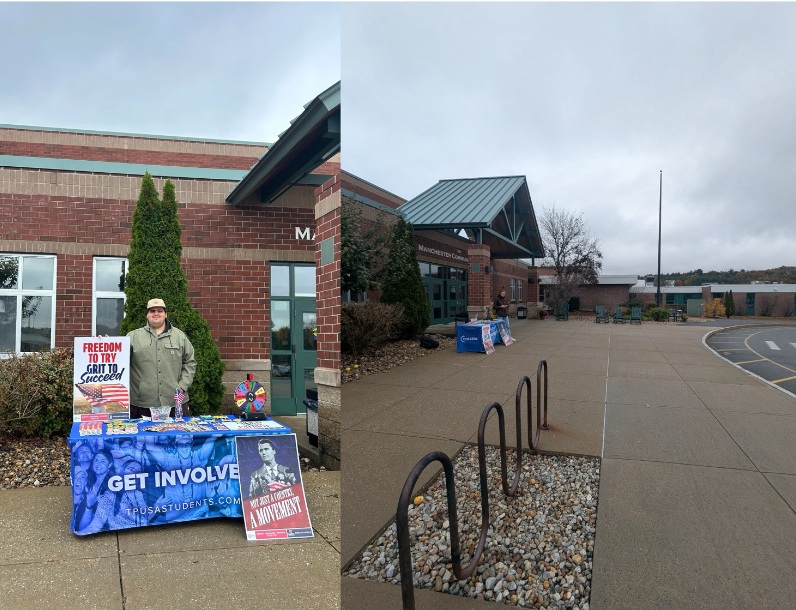
Last fall, Manchester Community College Turning Point USA president Samuel Raiti set up a table outside the schools Main Entrance. I’ve been on that sidewalk myself, and there is tons of room. As you can see from the pictures above, he was in no way obstructing or interfering with pedestrian traffic or access in or out of the building. But he was promoting TPUSA, and that triggered someone.
MCC Director of Communication and Marketing Vicky Jaffe approached and instructed Raiti to relocate because TPUSA is a “political group” that disseminates “political ideas.” Shortly thereafter, Vice President of Student Affairs Megan Conn also approached Raiti, ordering him to relocate to a more isolated area and telling him that the area was not available for expressive activity. Conn cited MCC’s expressive activities policies as the basis for her decision, while acknowledging that the tabling location did not pose a safety concern. She directed Raiti to move to an area inside the school or “the grass area between the row of visitor parking and the next parking lot.” [citations removed]
The Foundation for Individual Rights and Expression (FIRE) had more to say on the matter. In its letter, dated March 18th, FIRE reminded MCC that,
The First Amendment circumscribes MCC’s ability to limit communicative expressive activity in public forums generally. And New Hampshire law makes clear that “[t]he outdoor areas of campuses of public institutions of higher education in this state shall be deemed public forums[.]” Additionally, according to state law, such institutions “shall not create ‘free speech zones’ or other designated areas of campus outside of which expressive activities are prohibited.” MCC policy appears to comply with these mandates: FIRE was unable to locate any policy restricting expression near the entrance, and none was supplied to Raiti.
Indeed, in clear contravention of both law and policy, the evidence suggests that MCC expressly restricted Raiti’s speech because of its political content. After all, there has been expressive activity in that area before. And contrary to Jaffe’s assertion, Raiti’s expression being political did not justify its exclusion from a public forum. In fact, the First Amendment’s protection is “at its zenith” when it comes to “core political speech.”
Nor may MCC cite time, place, and manner restrictions to remove Raiti’s table. Time, place, and manner restrictions may exist in public forums only if they are “justified without reference to the content of the regulated speech,” or else they are presumptively unconstitutional. They must also be “narrowly tailored to serve a significant governmental interest” and “leave open ample alternative channels for communication of the information.” Conn’s directive did not serve a significant government interest since, as indicated by the photos and Conn’s own acknowledgement, Raiti was not obstructing pedestrian traffic or otherwise posing a safety concern. Moreover, the grassy area between the parking lots is not an ample alternative to the front entrance. In a college with more than 3,000 students, a location near a main
entrance to the building clearly offers more potential to reach those students than a particular area between two parking lots, one of which is not even for students.
In other words, you’re busted. FIRE has requested a substantive response and proof that it will affirm students’ rights to expression free from viewpoint discrimination.
We look forward to finding out what they had to say.