

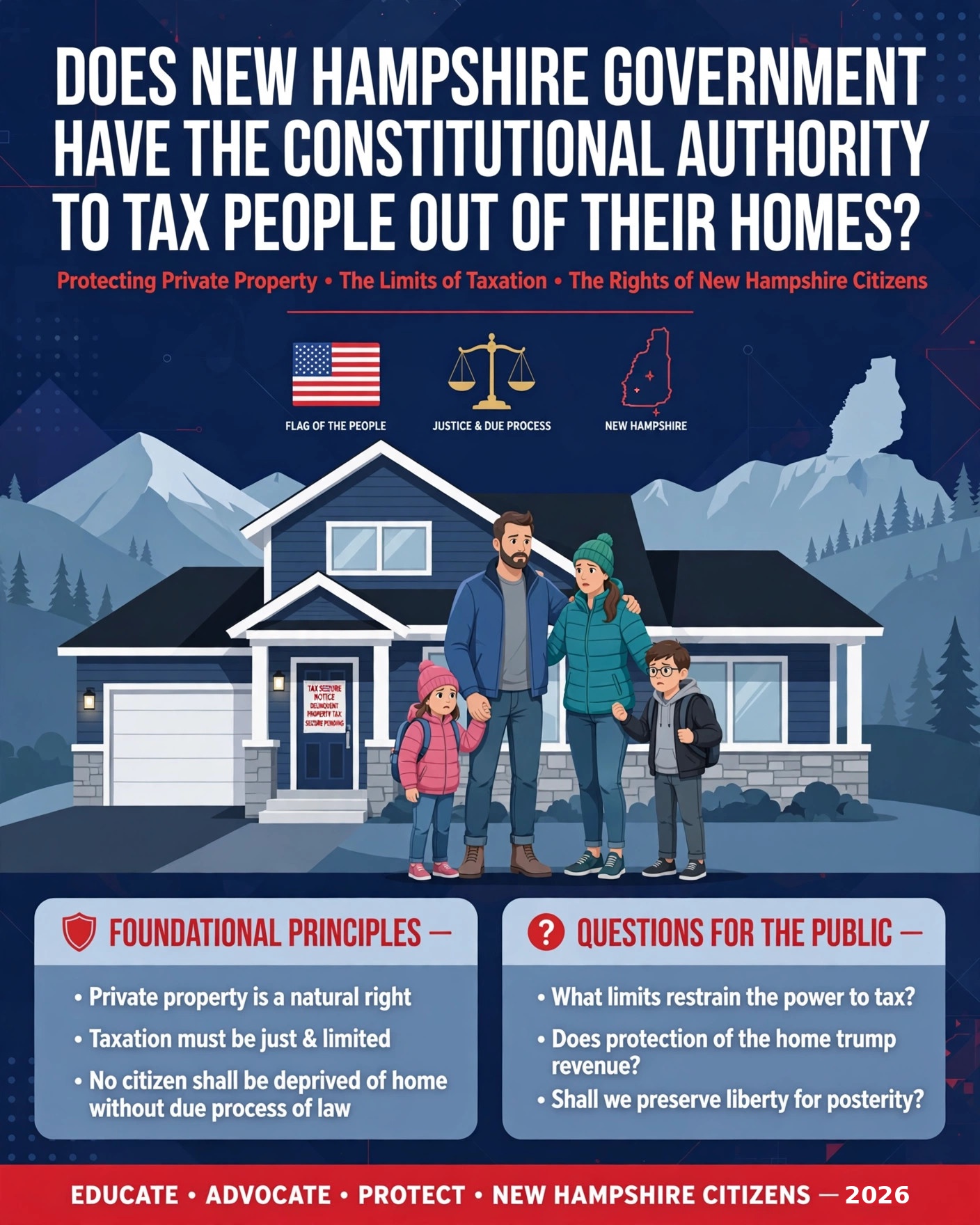
Examining the government’s responsibility to protect private property, the limits of taxation, and New Hampshire citizens’ rights.
Summary:
- Opening Comments and Introduction
- The New Hampshire Constitution places responsibilities on government as well as citizens
- The New Hampshire Constitution places responsibilities on government as well as citizens
- The New Hampshire Supreme Court has already placed limits on property-tax collection
- What happens when taxation itself threatens ownership?
- The difference between fair taxation and affordable taxation
- Why should property owners have to become impoverished before government offers relief?
- Life, Liberty, and the Pursuit of Happiness
- The constitutional argument that deserves examination
- Where should this investigation go next and final thoughts
Hey, New Hampshire,
I’ve been examining New Hampshire’s property tax system, particularly the relationship between the government’s authority to impose property taxes and its constitutional responsibility to protect the property and rights of its citizens.
What I’ve discovered raises some important questions that I believe deserve public discussion.
We often hear that municipalities have the authority to impose property taxes because they need revenue to fund schools, public services, and local government. That authority is generally accepted as a matter of law.
But there is another side to this issue.
Does the New Hampshire Constitution give government unlimited authority to tax private property? And can government fulfill its constitutional responsibility to protect the property of its citizens while imposing taxes that ultimately cause those citizens to lose their homes?
I believe these questions deserve considerably more attention.
1. The New Hampshire Constitution places responsibilities on government as well as citizens
Let’s begin with Part I, Article 12 of the New Hampshire Constitution.
Article 12 states:
“Every member of the community has a right to be protected by it, in the enjoyment of his life, liberty, and property; he is therefore bound to contribute his share in the expense of such protection, and to yield his personal service when necessary.”
It continues:
“But no part of a man’s property shall be taken from him, or applied to public uses, without his own consent, or that of the representative body of the people.”
There are several important principles in this language.
First, government has a responsibility to protect the life, liberty, and property of its citizens.
Second, citizens have an obligation to contribute their fair share toward the expense of providing that protection.
Third, government cannot take or apply private property to public uses without the consent of the individual or the representative body of the people.
This last provision does not mean that every homeowner must personally approve every tax increase. The Legislature and other legally authorized representative bodies can authorize taxation.
However, that authority exists within a constitutional framework. It is not unlimited.
An important question follows:
If government has a constitutional responsibility to protect private property, can it exercise its taxing authority in a manner that makes continued ownership of that property financially impossible?
2. Other constitutional provisions reinforce the responsibility of government
Article 12 is not the only constitutional provision worth examining.
Part I, Article 2 — Natural Rights
Article 2 recognizes the natural, essential, and inherent rights of individuals.
These rights are not simply privileges granted by government. They are rights that government is established to protect.
Part I, Article 8 — Government Officials Are Agents of the People
Article 8 states:
“All power residing originally in, and being derived from, the people, all the magistrates and officers of government are their substitutes and agents, and at all times accountable to them.”
This establishes an important relationship between government and the people.
Government officials are agents entrusted with exercising authority delegated by the people. They are accountable to those people.
Their authority does not give them ownership of the citizens or their property.
Part I, Article 14 — The Right to a Legal Remedy
Article 14 states:
“Every subject of this State is entitled to a certain remedy, by having recourse to the laws, for all injuries he may receive in his person, property, or character.”
This provision recognizes that individuals must have access to legal remedies when their rights are violated.
Part II, Article 5 — Taxation Must Be Proportional and Reasonable
Article 5 grants the Legislature broad taxing authority but requires taxation to be proportional and reasonable.
This is particularly important when examining whether taxation is being administered fairly and whether similarly situated property owners are being treated equally.
Taken together, these provisions establish a constitutional relationship between government and the taxpayer.
Government has taxing authority, but that authority must operate within constitutional limitations.
3. The New Hampshire Supreme Court has already placed limits on property-tax collection
There are two particularly important New Hampshire Supreme Court decisions that deserve attention.
Polonsky v. Town of Bedford (2020)
This case involved a property owner who lost his property through a municipal tax-deed process.
The property was valued at approximately $309,900, while the outstanding tax-related debt was approximately $90,442.
The dispute concerned what happened to the substantial remaining equity after the municipality acquired the property.
The New Hampshire Supreme Court recognized that the government could not simply retain the excess value of the property without respecting the former owner’s constitutional property rights.
The Court upheld the determination that the statutory scheme, as applied, violated Part I, Article 12 of the New Hampshire Constitution.
The important principle is that the government’s authority to collect unpaid property taxes does not eliminate its constitutional responsibility to respect private property.
Thomas Tool Services v. Town of Croydon (1998)
An earlier case involved property worth at least $65,000 that was taken to satisfy a tax delinquency of approximately $370.26.
The Court recognized that taking property worth substantially more than the outstanding tax obligation without compensating the owner for the excess value violated constitutional protections.
These cases establish an important distinction:
Government may have the authority to collect legitimate tax obligations, but it does not have unlimited authority to take private property in the process.
There is, however, an important qualification.
Neither Polonsky nor Thomas Tool established that an otherwise lawful property tax becomes unconstitutional simply because the homeowner cannot afford to pay it.
Their significance is that they demonstrate that constitutional property protections remain applicable even when government is exercising its legitimate tax-collection powers.
4. What happens when taxation itself threatens ownership?
This is where I believe the discussion becomes particularly important.
Consider a retired homeowner who purchased a house decades ago.
The mortgage has been paid off. The homeowner has worked, saved, and invested a lifetime of earnings into the property.
Over the years, property values increase.
Assessments increase, and property tax bills increase accordingly.
However, the homeowner’s retirement income does not increase at the same rate.
Eventually, the homeowner can no longer afford the property taxes.
The municipality places a lien on the property.
If the taxes remain unpaid, the property may ultimately be taken through the tax-collection process.
The homeowner loses the house, despite having spent decades paying for it.
Now consider the constitutional language of Article 12.
Government has a responsibility to protect the property of its citizens.
Citizens have an obligation to contribute their fair share toward the expense of that protection.
But what happens when the government’s own taxation system creates the conditions under which a citizen loses the very property government is constitutionally obligated to protect?
Can government fulfill its constitutional responsibility to protect property while simultaneously exercising its taxing authority in a way that results in the loss of that property?
This is the central question.
5. The difference between fair taxation and affordable taxation
There are two separate issues that should not be confused.
Tax proportionality asks whether property is assessed and taxed fairly relative to other taxable property.
Tax affordability asks whether the resulting tax burden is so great that a property owner cannot reasonably maintain ownership.
New Hampshire’s Constitution expressly addresses proportional and reasonable taxation.
However, whether constitutional protections also extend to a homeowner who faces the loss of a residence because of an otherwise uniformly assessed tax is a more difficult legal question.
A uniform tax rate does not necessarily answer every constitutional question.
It may establish that property owners are being treated equally under the assessment system, but it does not automatically resolve whether the overall taxation scheme is constitutionally reasonable in every circumstance.
This distinction deserves serious legal examination.
6. Why should property owners have to become impoverished before government offers relief?
New Hampshire law recognizes that property taxation can create financial hardship.
RSA 76:16 allows taxpayers to seek property tax abatements under certain circumstances, including poverty and inability to pay.
RSA 72:38-a provides a property tax deferral mechanism for qualifying elderly and disabled homeowners when payment would create undue hardship or possible loss of the property.
These provisions acknowledge that property taxes can become burdensome enough to threaten homeownership.
But I believe there is a fundamental problem with relying on these programs as the answer.
Consider the sequence:
- A homeowner purchases a property with money earned through years of work.
- Government imposes annual property taxes.
- Tax assessments and bills increase beyond what the homeowner can reasonably afford.
- The homeowner experiences financial hardship.
- Government tells the homeowner to apply for an abatement or deferral.
- If relief is unavailable or insufficient, the homeowner remains subject to tax collection and possible loss of the property.
Why should the property owner bear the burden of seeking relief from a financial hardship that the government’s own taxation system may have helped create?
If not for the excessive tax burden, that homeowner might never have been placed in that financial position.
The existence of an abatement process does not, by itself, establish that the underlying taxation is constitutional.
Nor should the availability of limited relief automatically resolve the government’s responsibility to protect private property.
Should constitutional protections require government to prevent unreasonable deprivation rather than simply provide a process for seeking relief after the harm has occurred?
That is a question worth asking.
7. Life, Liberty, and the Pursuit of Happiness
The Declaration of Independence identifies certain unalienable rights, including Life, Liberty, and the pursuit of Happiness.
Although the Declaration is not itself an independent constitutional exemption from taxation, these principles are reflected in the rights recognized by the New Hampshire Constitution.
Part I, Article 2 recognizes inherent rights.
Part I, Article 12 specifically protects life, liberty, and property.
Part I, Article 14 provides a right to seek legal remedies for injuries to property and other protected interests.
A person’s home is more than a financial asset.
It represents security, independence, family stability, accumulated labor, and the ability to live without depending on government assistance.
Losing that home can affect a person’s ability to enjoy the very freedoms and security that government exists to protect.
I believe it is reasonable to question whether a taxation system that threatens these interests is consistent with the constitutional principles upon which New Hampshire government was established.
8. The constitutional argument that deserves examination
I would frame the argument this way:
The New Hampshire Constitution recognizes private property as a fundamental right and places upon government a responsibility to protect that right.
While government possesses the authority to impose property taxes, that authority is not unlimited.
When taxation becomes an unreasonable or disproportionate burden upon a property owner, resulting in the involuntary loss of a primary residence and accumulated lifetime equity, a serious constitutional question arises.
Has government exceeded the limitations placed upon its taxing authority?
Has it failed its reciprocal responsibility under Part I, Article 12?
Can government rely solely upon the uniformity of its tax rates and the availability of abatement applications to defend a system that may ultimately deprive citizens of their homes?
These are arguments to be tested through constitutional analysis and, where appropriate, the courts. They are not established judicial holdings.
But they deserve to be examined.
9. Where should this investigation go next?
There are several areas of New Hampshire law and history that could help establish the original intent and limits of the state’s taxing authority.
I believe the following deserve further investigation:
- The original historical meaning of Part I, Article 12 and the 1784 New Hampshire Constitution.
- The 1854 Briggs’ Petition and its relevance to taxation, poverty, and property-owner protections.
- The New Hampshire Supreme Court decisions in Ansara v. City of Nashua (1978), Smith v. New Hampshire Department of Revenue Administration (1997), Claremont School District v. Governor (1997), Thomas Tool Services v. Town of Croydon (1998), and Polonsky v. Town of Bedford (2020).
- Whether the New Hampshire Supreme Court has considered property taxation as an infringement upon life, liberty, and property, rather than solely as an assessment or collection issue.
- Whether stronger constitutional protections for owner-occupied primary residences would be a legally viable solution.
I would also ask whether a constitutional amendment establishing additional protections for primary residences should be considered.
10. My final thought
Regardless of the taxing powers granted to the Legislature, those powers should never be confused with an unlimited entitlement to the property of the people.
Government exists because the people established it and entrusted it with certain responsibilities.
The people are not the property of government.
Their homes are not the property of government.
And the government’s authority to collect revenue should not be confused with an unlimited right to make continued ownership of private property financially impossible.
If government has a constitutional obligation to protect the life, liberty, and property of its citizens, then that obligation should mean something when those citizens are facing the loss of their homes.
I believe there is a fundamental contradiction that deserves to be addressed:
How can government claim to protect a citizen’s property while imposing a system of taxation that can ultimately cause that citizen to lose it?
And perhaps an even more important question:
Should a government be permitted to create financial hardship through taxation and then require the property owner to prove that they are poor enough to deserve relief?
I believe New Hampshire property owners deserve answers.
This is not simply a discussion about whether property taxes are too high.
It is a discussion about the constitutional relationship between government and the people, the limits of governmental authority, and whether the rights of property owners are being adequately protected.
Government’s authority to tax must never be mistaken for an unlimited right to take.
