

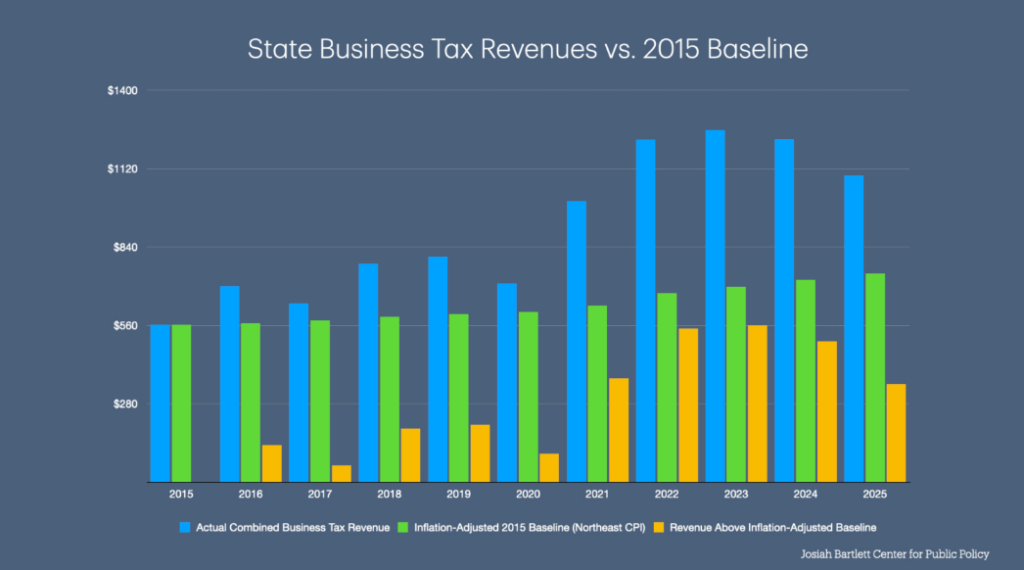
In 2015, the year New Hampshire legislators began a series of business tax cuts, revenues from the state’s two primary business taxes were a combined $561.7 million. In the decade since, business tax revenues grew $3 billion in nominal dollars, or $2.5 billion in real dollars.
From 2016-2025, the state collected $2.5 billion in new business tax revenue above the 2015 baseline, after adjusting for inflation, a Josiah Bartlett Center analysis of state revenue data shows.
That $2.5 billion represents the combined Business Profits Tax and Business Enterprise Tax revenue collected from 2016-2025 after subtracting the baseline $561.7 million, adjusted upward for inflation, from each year’s collections, and adjusting the new revenues for inflation. Inflation was calculated using the Northeast regional Consumer Price Index.
From 2015-2022, legislators cut the Business Profits Tax from 8.5% to 7.5% and the Business Enterprise Tax from 0.75% to 0.55%. The first of those cuts took effect in the 2016 fiscal year.
Before every rate reduction during this time, opponents predicted that the rate cuts would cause business tax revenues to fall in absolute terms. That is, they predicted that business tax collections after the cuts fall below the actual dollar amount collected before the cuts.
Here are but a few examples:
- “Any reduction in the BPT rate would result in a loss of revenue to the state which would make such a reduction impractical for the foreseeable future.”
- “The long-term impact of these unpaid-for corporate tax cuts will create a more than $90 million hole in future budgets, further eroding our ability to encourage economic growth.”
- “We’re going to lose 10 percent of our revenue.”
In state Fiscal Year 2025, combined business tax revenues were $1.096 billion, an increase of 95% over 2015, in nominal dollars. After adjusting for inflation, business tax revenues were $264 million higher in 2025 than in 2015. That is, the state in Fiscal Year 2025 had $264 million more in business tax revenue at its disposal than it did when it began cutting business tax rates in Fiscal Year 2015.
This analysis does not attempt to determine the causes of these revenue increases, but merely to document how business tax revenues changed relative to the 2015 baseline.
Download this policy brief: Business Tax Revenue vs 2015 Brief
Authors’ and Speakers’ opinions are their own and may not represent those of Grok Media, LLC, GraniteGrok.com, its sponsors, readers, authors, or advertisers.
Disagree, agree, Got Something to say? We Want to Hear It. Comment or submit Op-Eds to steve@granitegrok.com
