

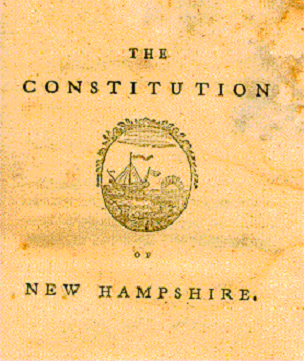
The Bill of Rights in the NH state constitution was written to protect citizens from state establishment of religious values, attitudes, and beliefs. In Part 1, the founders tried to protect Inalienable Rights of Conscience in Art. 4, Religious Freedom in Art. 5, and to tolerate a variety of sects and denominations without compelling anyone to pay towards the public teachers of another denomination in Art. 6.
So, how has our tolerance for the conscientiously held beliefs of others been going?
Not so well.
Towns funded local schools as their population grew. The state legislature mandated property tax rate increases for towns to fund their schools, as authorized by Art. 6. In 1805 the district system was created, but property owners were still allowed to switch districts, or create new ones, rather than be compelled to support ideas or beliefs which were incompatible with their consciences. Their education tax money followed them to their new district. For this reason many towns had multiple school districts, on a much smaller population base than now. Nashua had 11: there were over 3,000 statewide.
In 1885 the state forced all districts in a town to consolidate into a single district to “equalize opportunities.” In 1947, cooperative school districts were established. In 1979, the state offered extra funding to districts that consolidated into School Administrative Units (SAUs). All of this supposedly to save money, which it hasn’t, rather the opposite. The concrete result has been to progressively restrict the people’s voice in public education. This year, we saw a proposal to consolidate the 107 SAUs into 12, one per county plus Manchester and Nashua. The result would be a further concentration of power and the effective elimination of the people’s voice in public education.
In 1968, Art 6 Pt.1 of the state constitution was extensively amended.
The state’s explanation for it was to remove “obsolete sectarian language.” But, the wording of the original version wasn’t on the ballot, so voters to couldn’t review the original text, which was:
| VI. As morality and piety, rightly grounded on evangelical principles, will give the best and greatest security to government, and will lay in the hearts of men the strongest obligations to due subjection: and as the knowledge of these, is most likely to be propagated through a society by the institution of the public worship of the Deity, and of public instruction in morality and religion; therefore, to promote those important purposes, the people of this state have a right to impower, and do hereby fully impower the legislature to authorize from time to time, the several towns, parishes, bodies-corporate, or religious societies within this state, to make adequate provision at their own expence, for the support and maintenance of public protestant teachers of piety, religion and morality: Provided notwithstanding, That the several towns, parishes, bodies-corporate, or religious societies, shall at all times have the exclusive right of electing their own public teachers, and of contracting with them for their support and maintenance. And no portion of any one particular religious sect or denomination, shall ever be compelled to pay towards the support of the teacher or teachers of another persuasion, sect or denomination. And every denomination of christians demeaning themselves quietly, and as good subjects of the state, shall be equally under the protection of the law: and no subordination of any one sect or denomination to another, shall ever be established by law. And nothing herein shall be understood to affect any former contracts made for the support of the ministry; but all such contracts shall remain, and be in the same state as if this constitution had not been made. June 2, 1784 |
The 1968 ballot proposal removed the terms “evangelical,” “christians,” “protestant,” and “Diety”, along with, wait for it, a hundred twenty-seven other words. The result was severe damage to the original intent of Art. 6. It appears to me to have been deliberate.
Here’s the language presented to voters:
| Art. 6th. As morality and piety, rightly grounded on high principles, will give the best and greatest security to government, and will lay, in the hearts of men, the strongest obligations to due subjection; and as the knowledge of these is most likely to be propagated through a society, therefore, the several parishes, bodies corporate, or religious societies shall at all time have the right of electing their own teachers and of contracting with them for their support or maintenance or both. But no person shall ever be compelled to pay towards the support of the schools of any set or denomination. And every person, denomination or sect shall be equally under the protection of the law; and no subordination of any one sect, denomination or persuasion to another shall ever be established. |
There were “mistakes”, such as “bodies-corporate” changed to “bodies, corporate”, even though that extra comma was never on the ballot. A school district is an incorporated body, or a “body-corporate.” That term was certainly not obsolete.
The term “towns” was removed in two places. Towns (and cities) aren’t obsolete.
With “towns” removed and “bodies-corporate” mutilated into an unfathomable “bodies, corporate,” the next “mistake” was to remove the enabling language empowering school districts, i.e., towns, or bodies-corporate, to tax property owners for the support and maintenance of public schools.
The removed language:
“…the people of this state have a right to impower, and do hereby fully impower the legislature to authorize from time to time, the several towns, parishes, bodies-corporate, or religious societies within this state, to make adequate provision at their own expence, for the support and maintenance of public teachers.”
The state’s Voter Guide acknowledged “AT THE PRESENT TIME Article 6 authorizes local public taxation …”, but that language was removed. Since then, it’s been arguably unconstitutional to collect local property taxes to fund public teachers.
“[A]t their own expence” was also removed. It underscored that these were exclusively local, not state, taxes. The state had no power to collect taxes to fund schools. Electing our public teachers was a constitutionally protected right, not a state matter. It meant, no state regulation of public schools, period, full stop.
Property owners had the constitutional right to support public teachers compatible with their values, attitudes and beliefs. That language was essential to the proper implementation of a decentralized public education system.
Only “parishes” and “religious societies” should have been removed from this taxation enabling provision, as they were no longer publicly funded via taxation after the Blaine amendment in 1877. Other than taxing authority, parishes and religious societies are still protected from state interference, just like public schools ought to be.
Another deceptive change was the removal of the term “exclusive.” Our exclusive right became just a “right” to to elect our own teachers and contract with them for their maintenance and support. That right was removed from parishes and religious societies, as well as towns and bodies-corporate. With an “exclusive” right, the state could not interfere, which was the explicit intention of our founders, protecting us from state establishment of values, attitudes and beliefs in public, private and religious schools. But no need for “exclusive,” that would never happen, right?
Even back then, the state required teacher certification and placed other restrictions on local instruction even though towns and bodies-corporate, i.e., school districts, had the exclusive right to elect teachers and control the instruction in their schools. Teacher certification now includes training in competency-based education and other political and social matters, which are implemented in our schools top down via the state.
The 1968 constitutional changes were clearly made with the intention of transforming locally funded and controlled public schools (and perhaps parish and religious schools) into state funded and controlled schools, establishing a state set of values, attitudes and beliefs in direct opposition to the original intent of Art. 6.
How are parents faring with their students in public schools these days?
There are many battles over values, attitudes and beliefs, including political and social norms pushed upon young students against the conscientious beliefs of their parents.
An “exclusive” right doesn’t mean the state or federal government can’t provide funding to public schools. It simply means no strings attached, because locals have the right to refuse to accept state mandates that are incompatible with the values and beliefs of those in a district, who have the right to determine of what their public instruction consists.
Consider student data tracking. NH voters amended the constitution a few years ago to protect the “right to live free from governmental intrusion in private or personal information is natural, essential and inherent.” Yet parents still must fight intrusive non-academic surveys in public schools. The state still uses its multi-million dollar Statewide Longitudinal Data System to track students and share private information with the federal government and others …. without parental consent. Unacceptable.
State funded Universal Education Freedom Accounts (EFAs) force taxpayers to fund sectarian schools which may not be compatible with their conscientious beliefs. Public funds are given to a non-profit organization, which then hands the money out to parents who can individually select and pay for sectarian schools. This is money laundering, pure and simple. Public dollars are used to fund sectarian schools in violation of the constitution.
The acceptance of an EFA transforms a private school student into a “public education student,” according to our former commissioner of education. Obviously, they are state public education students as they are state-funded, but the constitution authorizes no such thing.
Our constitution does not authorize the state to create and fund its own public schools. To do so is a direct violation of Art. 6.
Conclusion
When people were allowed to switch or create new school districts and take their tax money with them, they were able to create strong communities with similar values, attitudes and beliefs. Helen Keller wrote “the highest result of education is tolerance,” but now we’re trapped funding school districts and EFAs which promote values, attitudes, and beliefs that violate our conscientiously held beliefs.
1968 voters were mislead, in my opinion intentionally. Here’s what I think would restore the status quo ante:
| Art. 6th. As morality and piety, rightly grounded on high principles, will give the best and greatest security to government, and will lay, in the hearts of men, the strongest obligations to due subjection; and as the knowledge of these is most likely to be propagated through a society through public instruction; therefore, to promote those important purposes, the people of this state have a right to empower, and do hereby fully empower the legislature to authorize from time to time, the several towns, cities, or school districts within this state, to make adequate provision at their own expense, for the support and maintenance of public teachers: Provided notwithstanding thatthe several towns, cities, school districts, parishes, bodies-corporate, and religious societies shall at all times have the exclusive right of electing their own teachers, and of contracting with them for their support or maintenance, or both. But no person shall ever be compelled to pay towards the support of the schools of any sect or denomination. And every person, denomination or sect shall be equally under the protection of the law; and no subordination of any one sect, denomination or persuasion to another shall ever be established. |
Either we restore balance and tolerance for each other’s inalienable rights of conscience, or our conflicts will escalate to the point where we all lose. In many ways, we’re already there.
………..
NH Supreme Court —– Hale v. Everett, 53 N.H. 9 (1868)
The inalienable right of “the several towns, parishes, bodies corporate, or religious societies” to elect their own public teachers was the issue in Hale v. Everett in 1868. The NH Supreme Court was asked to settle a dispute between various members of the First Unitarian Society of Christians in Dover. The disgruntled minority was opposing the decision of the majority to elect a particular teacher. The Court remarked:
| And the constitution guarantees the political independence of towns no more explicitly or fully than it guarantees the ecclesiastical independence of parishes. This illustration is peculiarly satisfactory, because the towns of New Hampshire were parishes nearly two hundred years, and the independence of the parochial capacity, as it was in provincial custom and law, and as delineated in the constitution of the state, is the same, whether exercised by “towns, parishes, bodies corporate, or religious societies. Hale v. Everett (1868) 53 NH 9, pg. 250 |
Electing one’s teachers and contracting with them is constitutionally recognized as an inalienable right. It is not something in which the State has authority to interfere.
In 1784 the understanding was that public teachers taught that which they saw fit to teach, also based upon their conscience. If the parents in the town or parish didn’t like what a teacher taught, they could elect a new one. The State government had no right to interfere in this contractual arrangement. Art. 6 was written for the explicit purpose of guaranteeing the political independence of towns and parishes from State interference.
| The rights of conscience, which are held not only natural, essential, and inherent (Art. II, bill of rights), but also “unalienable,” not capable of being surrendered voluntarily or of being surrendered voluntarily, or of being taken away or abridged by the government, “because no equivalent can be given or received for them” (Art. IV, bill of rights) … Hale v. Everett (1868) 53 NH 9, pg. 10 |
