


Send this to your school board and Superintendent.
When you look at your school’s proficiency scores in math, you might be surprised that many students have not reached proficiency in mathematics. This might help them figure out where the problems exist.
1)Find your school’s proficiency scores HERE: https://www.education.nh.gov/who-we-are/division-of-educator-and-analytic-resources/iplatform
2) Scroll down and click on IReport
3) Scroll down to: Select a School District, and type in the name of your school district
4) Click View Report
You will access all kinds of useful information on your school district’s proficiency scores.
Take your cursor, and place it over the math proficiency score. You will see that another small screen pops up showing you what the proficiency scores were for the past three years in all three subjects: English, Math and Science.
You can go back to the IReport screen, and check your Elementary, Middle and High School Scores. Often times those scores drop when your child reaches high schools.
Many of the elementary and middle school scores are low too, but some schools report better numbers than others. If your school is doing better than most, you should know that these are dumbed down proficiency scores on the world stage. Remember that the focus should be on world class math in the US, instead of 3rd world math.
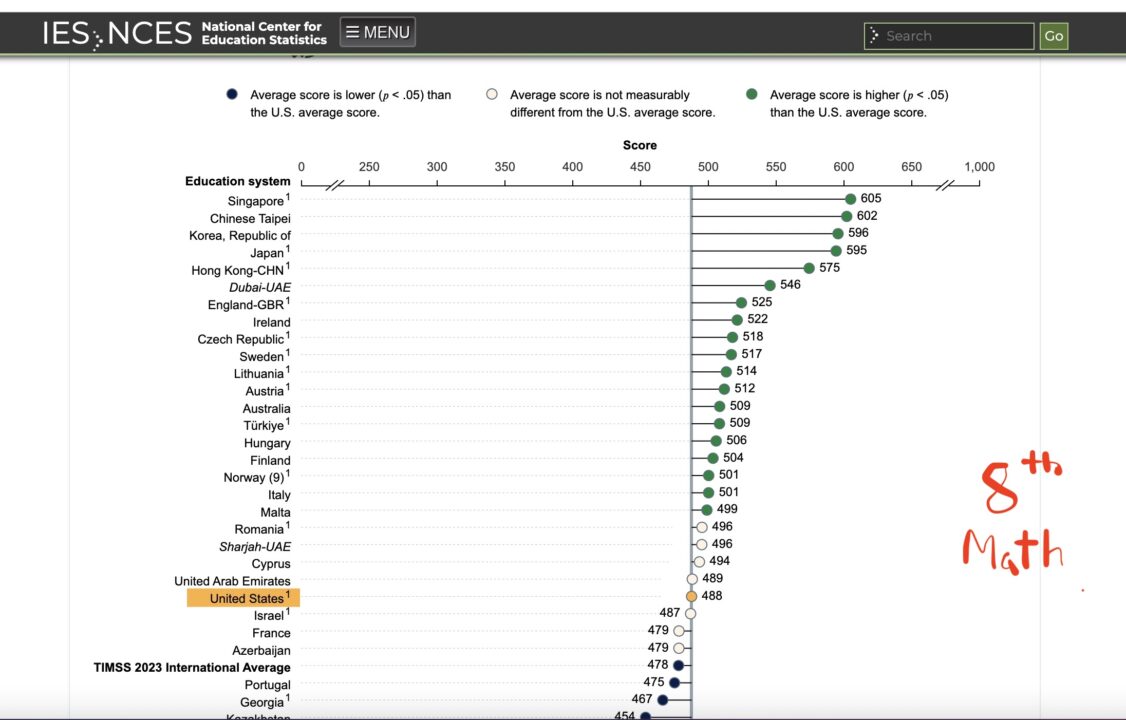
8th grade U.S. students ranked #24 on the TIMSS international test of mathematics:
HOW DID WE GET HERE?
- Common Core Math
You can’t address this problem without looking at the academic standards. In 2010 the NH State Board of Education adopted Common Core Math and English Standards.Since that point, math proficiency has fallen, and in many schools students still struggle to meet English proficiency. After 14 years, we know Common Core math is not working. - Teaching Methods forced on teachers
Math programs, and grants coming into the schools can require teachers to become facilitators in the classroom, instead of instructors. This is a way to marginalize the importance of a teacher teaching the academic content to children. Some students can overcome this deficit by receiving help at home with a parent, or from private tutors. Either way, if your child does not get that direct instruction from a teacher, your children will most likely suffer.
PODCAST: .Episode 41 Supporting student with math difficulties with Sarah Powell - Math Programs that ignore math
Math programs today come with slick marketing campaigns. When you go to their website, the marketing department will tell you how great their math program is for your school. We need critical thinkers to look past this. Curriculum Coordinators are concerned about aligning the curriculum to the Common Core test. Even though the test is based on poor quality standards. You need someone working on finding a world class curriculum, not just a curriculum that aligns to poorly crafted Common Core math standards.
All of these factors contribute to a poor quality math education in schools across America. New Hampshire school administrators aren’t concerned about your child excelling so they can compete with students in the top performing countries. If they really cared, they would be choosing math programs elevate the core curriculum. That may be looking at what is available to students in higher performing countries. Many home-school families use high quality math programs, along with private and charter school. There is no good reason a public school cannot offer the same quality to their students.
Teachers have been marginalized, and brushed aside so kids can collaborate. Then when the classroom becomes chaotic, teachers need paraprofessionals to help manage all of it. Teachers need to be able to teach, and get the support they need from admin. when needed. Disruptive children cannot dominate a classroom.
Many of the math programs focus on Social and Emotional Learning, anti-racism, and even Fine Arts. You might be asking: Where’s The Math? Eureka 2 is in several NH schools right now, and taxpayers may have paid up too $100,000.00 for these poor quality math programs.
I am on a math forum with teachers from New Hampshire and across the country. They come together to find ways to help their students learn math. Two of the biggest factors that contribute to poor math instruction are: poor but expensive math programs based on the failed Common Core, and poor quality teaching methods. The teachers are frustrated, and rightfully so.
They look for math supplemental material to help students learn the basics in math. In the Common Core math programs, fact fluency is not a priority. So kids may learn about math facts, but if there is not enough practice, in school, and from homework, they may never commit math facts to memory. Good teachers will see this, and look for supplemental materials. If students do not commit math facts to memory. They will struggle in high school math. A child may complete the algebra concept flawlessly, but if they miss multiplying properly, it’s still considered wrong.
Teaching children confusing algorithms in addition, subtraction, division and multiplication can be a set up for failure. Parents are right to complain about not knowing how to teach their children math. By the time a student gets to high school, they can struggle with fact fluency. That means they struggle to get through a problem that they should have mastered in middle school. Knowing how to work a long division problem fluently the way we learned it, will set a student up for a success. Unfortunately many are set up to fail. If they’ve learned an alternate way to complete a long division problem, they may not be able to work some of the algebraic problems.
Common core is heavy on communication vs computation. This means students are left to explain why 2+2=4. Not only is this not necessary, but any child struggling with the language or communication skills will certainly struggle. Your English Language Learners will struggle, and so will your Special Ed students. Those children could be brilliant in math, but they’ve been set up to fail. Communication should be taught in an English/Language Arts class.
HOW DO YOU FIX THIS MESS?
Can you rely on your administrators to ignore the poor quality standards, and look at better quality math programs? Probably not but they are not obligated to use this garbage. Sadly, administrators have become fixated on teaching to the Common standards.
Some Charter Schools have figured this out, and improved math education in their schools. Private schools, and home-schoolers tend to use better curriculum too. Walk into those schools, and teachers are still valued as instructors, so students will receive better quality instruction.
Most of this falls on the executive branch in New Hampshire. A positive change will have to come from the Governor. It is up to the Department of Education to revise academic standards. At the direction of Governor Ayotte, New Hampshire schools could offer a better education to students. School administrators can raise the level of learning in your schools, but many will not. We will need the Governor to elevate state standards and tests to get them to move on this.
The teachers on the math forum also point to the poor teaching methods they have to contend with. There is plenty of evidence that explicit or direct instruction works better than when kids are left to discover math. Anyone with common sense can figure that out.
This means watching those grants coming into the school. Are they required to give up control to a grant foundation? What about the math program you purchase? Does the math vendor leave that decision to teachers, and administrators working with parents? Or do the Math Online Vendors dictate the pedagogy?
This isn’t rocket science, it’s basic math. Common Core puts students on a path to Algebra I by 9th grade. That’s two years behind Singapore students who rank #1 in the world. Our kids are so behind that they cannot finish Calculus in high school, and qualify for the best universities in our country.
All of this is fixable in the schools, and by a governor committed to helping students in our public schools. So if you care about public education, or you care about the students in our public schools, share this article with them. Talk to your school board members, and tell them you expect better for these kids.
