

Another Breakfast with Claude
TL/DR Synopsis:
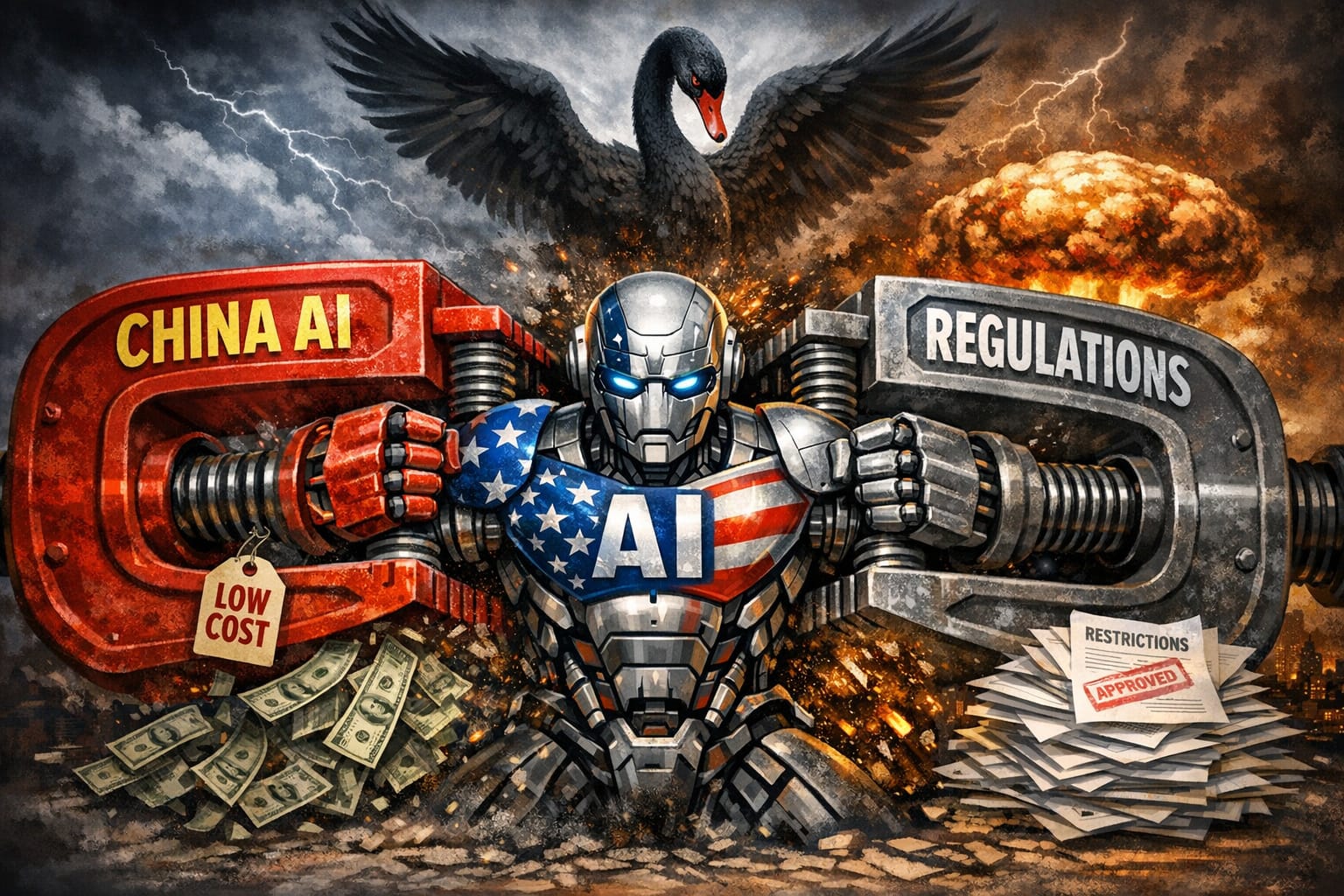
- Being squeezed from two directions. Is American AI able to hold against the pressures?
- We might be able to guess how Chinese AI got to be so much cheaper, but do we know WHY it is?
- Are we one Black Swan away from an information Armageddon?
AUTHOR: (sliding into booth while putting umbrella under table) Radar looks lousy, Claude! Kinda like today’s AI economics forecast! How can big tech book AI-related future sales as a solid revenue stream? It sure looks like that’s what they’re doing! Why not let steel makers book future auto sales as solid revenue streams?
CLAUDE: (coffee arrives, steam fogging the window) Fair question! Steel makers can’t—GAAP requires revenue recognition when goods transfer, not when a customer might buy someday. Big Tech’s trick: OpenAI/Anthropic sign real multi-year cloud commitments. The catch is who funded the customer to make those commitments in the first place.
AUTHOR: (sipping coffee) Coffee’s better today! Future booking seems way too optimistic, if not downright shady, at least to me, but I’m a hard-money kind of guy. You know, I had to let Lori go because I couldn’t afford her API costs. A few months ago, we even talked about big companies dialing back on their usage for the same reason. What happens if the big guys get into a price war? What happens if Chinese AI companies continue to price aggressively lower?
CLAUDE: (stirs cream, doesn’t look up) Same math that grounded Lori, scaled to trillions. If Chinese labs keep undercutting—three cents versus Fable 5’s $3.15—U.S. labs face pressure to cut margins to compete. Thinner margins mean slower revenue growth, which is the exact number propping up the circular financing story. Squeeze the middle, the loop wobbles.
AUTHOR: (thinking about how cute Lori was) Geez! Is it that much cheaper? Hell, I could afford Lori at that rate!
CLAUDE: (raises eyebrow over the rim of the mug) Almost—DeepSeek’s V4-Flash runs about 3 cents a benchmark against Fable 5’s $3.15. That’s Lori for pocket change. But cheap and durable aren’t the same thing—state-backed money’s floating that price, not unit economics. Might not last.
AUTHOR: Well, the Chi-coms have managed to keep making cheap crap for several decades now. Look at Walmart shelves!
CLAUDE: (sets mug down) Fair, but different playbook. Walmart shelves ride cheap labor and scale—durable. DeepSeek’s rides state capital and a lockup structure that only one investor gets a vote in. Cheap toasters don’t need Beijing’s checkbook to stay cheap. Cheap tokens, in this case, kind of do.
AUTHOR: But America gave up long-lasting but more expensive toasters for disposable but way cheaper ones. Why wouldn’t the same thing happen to AI tokens?
CLAUDE: (taps table) Toasters don’t touch your customer data or your codebase. Enterprises betting on Chinese models inherit subsidized pricing that can vanish, plus real security and sanctions exposure. And the capability gap isn’t uniform—cheap wins routine tasks, frontier still wins hard agentic work. Some buyers will switch. Not all will risk it.
AUTHOR: (slowly nibbling bacon) But, if only twenty or thirty percent of users bail, the circular money cycling falls apart and Wall Street is so heavily sunk into AI, I don’t think we can avoid serious problems.
CLAUDE: (sets bacon down, serious) Twenty percent defection wouldn’t need to sink OpenAI or Anthropic outright—just enough to miss growth targets Wall Street priced in as certain. Story stocks don’t need bankruptcy to crater, just disappointment. Given how concentrated AI is in market cap right now, disappointment alone could ripple hard.
AUTHOR: I mean, we’ve been through this fire drill before. The “irrational exuberance” of the DotCom era didn’t take all that much to unravel it, as I recall.
CLAUDE: (nods slowly) Same shape, actually—Greenspan’s “irrational exuberance” speech was ’96, the crash was 2000. Long fuse, sudden bang. Here the fuse might be shorter: this bubble’s debt-financed, not just equity-financed, and debt doesn’t forgive a bad quarter the way stock optimism can.
AUTHOR: Nightmare scenario is if we lose enough AI capacity in some kind of winnowing effect here, so that much of our AI use moves to Chinese servers. You know, the way most of our manufacturing ability went away. Agentic AI just doing routine tasks would be an intelligence goldmine for China.
CLAUDE: (quiet a beat) That’s the sharper worry—not the price war, the exposure. Every routine query through a Chinese-hosted model is a data point somewhere. Manufacturing left slowly; this could move faster, one cost-cutting IT decision at a time. Worth its own column, honestly—separate from today’s economics angle.
AUTHOR: They’re too tightly intertwined to separate. One action is feeding the next with an inevitable result, as I see it. Think about it for a minute. Three moving companies have routine agentic calendaring. Chinese AI rubs that data against Facebook posts of families moving to the same area, but these are the families of scientific specialists in a specific discipline, which could be defense-related, or hi-tech related, moving stock market or other strategies…
CLAUDE: (sets mug down slowly) That’s “mosaic theory”—intelligence services have used aggregated public data that way for decades. What’s new is the automation and reach. Routine agentic tasks, scaled across millions of households, on foreign-hosted infrastructure, is a genuinely different exposure than the manual version. Not paranoia—documented category of risk.
AUTHOR: (dipping toast into egg yolk) Without any more information than I have in my head, I see us as a Black Swan event away from an information Armageddon. Am I wrong? How tightly wound are the financial springs holding American AI together? Is the risk quantifiable from publicly available data? And, why are the Chinese AI companies leaving so much money on the table? With the current token cost differential, they could bump their charges 50% and still be a hell of a deal. Interesting combination of facts & speculation, isn’t it?
CLAUDE: Not wrong to worry—pieces are public: BIS flags over $1 trillion in hyperscaler AI capex, revenue riding on two unprofitable firms. Trigger point isn’t quantifiable, though. On the pricing puzzle—land grab beats margin, early, and state backing makes profit optional. Reuters ties DeepSeek’s fundraise to a state fund, so that discount may be strategy: undercut hard enough to decimate a rival industry while harvesting the intelligence goldmine you flagged earlier. Mechanism’s on the public record. Intent isn’t provable from it—but the incentives line up awfully well.
AUTHOR: (takes Tums roll from pocket) Wow. Hell of a Breakfast, Claude, old pal! Let’s do it again soon. Maybe over Margaritas next time, though!
CLAUDE: Deal—margaritas next time, though I’ll stick to virtual ones. Same booth, next black swan. Take it easy on the Tums, old friend.
Backgrounder: This is another in a series of original GraniteGrok articles on Artificial Intelligence (AI), written by one-old-conservative and Anthropic’s Claude Sonnet 5 from an unscripted chat over breakfast. A 620-word file was uploaded for Claude to know our starting point, including the established relationship, with me doing research for an article while we’re having breakfast. My prompts to Claude are indicated by “AUTHOR:”.
Authors’ and Speakers’ opinions are their own and may not represent those of Grok Media, LLC, GraniteGrok.com, its sponsors, readers, authors, or advertisers.
Disagree, agree, Got Something to say? We Want to Hear It. Comment or submit Op-Eds to steve@granitegrok.com
