

What Draining the Swamp Should Look Like
Supporters of Donald Trump often argue that his presidency represents a meaningful challenge to the administrative state and to global governance structures. The claim is typically framed in long-term terms: that Trump is engaged in a process of dismantling entrenched power, even if the results are not yet complete or fully visible. This essay evaluates that claim through institutional analysis rather than rhetoric, focusing on whether the structure, capacity, and authority of the federal government have been measurably reduced across Trump’s presidencies to date.
This analysis is not based on governing style, political messaging, or perceived intent. The more fundamental question—particularly for Trump supporters—is what it actually means to “drain the swamp.” Does that phrase refer to the size of government, the scope of government authority, the people holding office, or the administrative mechanisms through which power is exercised? In practice, the phrase is used inconsistently, often functioning as a psychological release valve for frustration with corruption, unaccountable bureaucracy, and the autonomy with which elected officials appear to operate.
Foundations Learning Center is a reader-supported publication. To receive new posts and support my work, consider becoming a free or paid subscriber.
Americans frequently invoke corruption without defining it institutionally. The demand for reform is intense, but the object of reform remains vague. If corruption is understood structurally rather than morally, the most obvious metric becomes the size, scope, and unaccountability of government itself. That leads to a single unavoidable question: has federal power, as a system, been structurally reduced during Trump’s first presidency, and is it presently being reduced during his current term?
To answer that question, this analysis relies on observable institutional indicators: statutory agency elimination, permanent reductions in jurisdiction, changes to administrative law, the size and authority of the Executive Office of the President, federal spending patterns, and federal–state dependency mechanisms. Personnel changes, executive orders, and policy direction are considered only insofar as they produce lasting structural effects.
During Trump’s first presidency, his rhetoric consistently opposed what he described as the “deep state,” unelected bureaucrats, and international governance frameworks. These criticisms created expectations that the administrative state itself would be rolled back. In constitutional terms, such a rollback would require reductions in executive agencies, binding limits on rulemaking authority, or contraction of the modern presidency’s coordinating apparatus. Rhetoric alone, however, does not alter institutional power. Only permanent structural change does. Measured against that standard, the institutional record from Trump’s first term reflects continuity rather than contraction.
No cabinet-level department was eliminated between 2017 and 2021. Agencies frequently criticized as unconstitutional or outside enumerated powers—including Education, Energy, Commerce, Housing and Urban Development, and Health and Human Services—remained intact and fully operational. Their statutory authority was not reduced. Some agencies experienced proposed or temporary staffing and budgetary reductions, particularly the U.S. Agency for International Development, but these changes did not alter underlying legal authority and were not permanent. USAID remained structurally intact and operational under its existing mandate.
The administrative state’s core operating mechanism—rulemaking authority under the Administrative Procedure Act—also remained unchanged. The APA continues to govern agency action, allowing executive agencies to issue binding regulations with the force of law so long as procedural requirements are met. Regulatory priorities shifted during Trump’s first presidency, but institutional authority did not. The ease with which subsequent administrations reversed regulatory direction demonstrates that the underlying structure was never dismantled. As long as the APA remains intact and agency enabling statutes remain in force, the administrative state exists in full regardless of who occupies the White House. Agencies do not need to expand in size to retain power; they need only retain jurisdiction.
Federal spending trends reinforce this conclusion. Overall federal outlays increased during Trump’s first term, consistent with long-term patterns. Emergency spending during the COVID-19 period significantly expanded federal involvement in healthcare, labor markets, business finance, and state administration. No major federal programs were repealed, and no broad category of federal activity was withdrawn. Expansion occurred through existing agencies, reinforcing administrative capacity rather than reducing it.
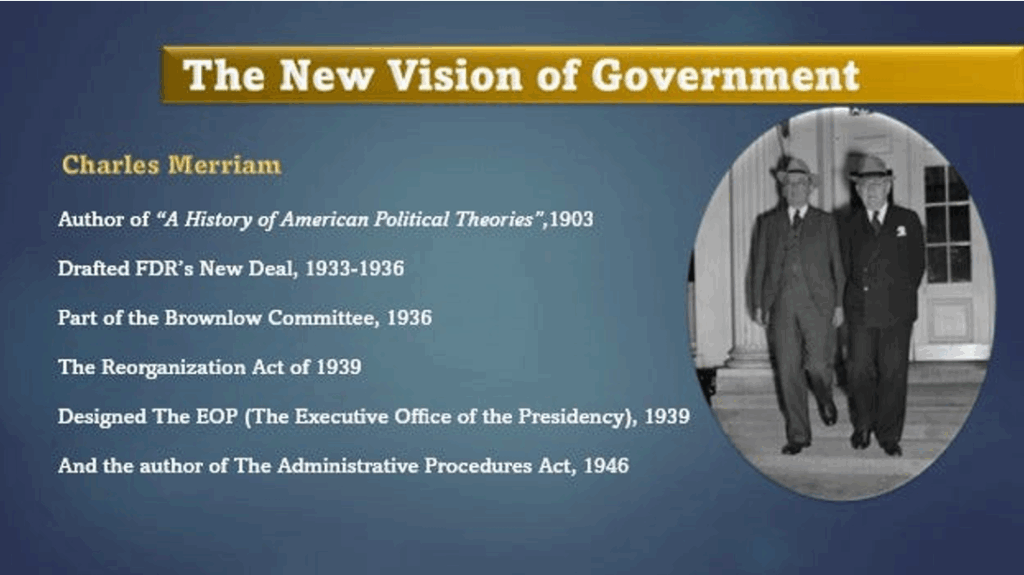
Central to this analysis is the Executive Office of the President, created in 1939 and functioning as the coordinating nucleus of modern executive governance. The EOP houses budgetary control, regulatory review, national security coordination, and interagency policy planning. Any genuine reduction in executive power would necessarily involve contraction of this structure. That contraction has not occurred. During Trump’s first presidency, no major EOP offices were eliminated, consolidated, or stripped of authority. In some areas—particularly regulatory coordination through the Office of Management and Budget—the EOP’s role expanded. Personnel turnover altered internal dynamics but did not change institutional jurisdiction or scope. As of Trump’s current presidency, no statutory reduction of the EOP has yet occurred.
Trump’s approach to international governance further clarifies the pattern. During his first term, he announced withdrawal from several international agreements and institutions, including the World Health Organization, while criticizing multinational policy coordination. However, withdrawal from the WHO was not completed through binding congressional action, and the United States did not withdraw from the United Nations. More importantly, disengagement from international coordination did not disperse power domestically. During the COVID-19 period, public-health authority became increasingly centralized within the federal executive through expanded White House task forces, emergency declarations, and executive coordination mechanisms. Authority that might otherwise have been exercised through multilateral venues was absorbed into domestic executive structures, particularly within the EOP.
Withdrawal from global institutions does not automatically reduce federal power. In practice, it often relocates governance from international forums to domestic executive coordination. Federal agencies continued, and continue, to align policy with international regulatory norms in areas such as finance, transportation, health, and trade independent of formal treaty participation. International policy harmonization does not require full UN withdrawal to persist domestically.
Federal–state relations also remain structurally unchanged. Federal grants, compliance conditions, and fiscal leverage over states continue to function as primary governance tools. No broad statutory reinforcement of anti-commandeering principles has been enacted. States remain dependent on federal funding streams tied to policy conditions, preserving vertical dependency rather than decentralization.
At this point, the discussion must turn to what would actually count as draining the swamp—not rhetorically, but institutionally. A real reduction in federal power would require reforms that are permanent, statutory, and capacity-reducing. That would mean repealing agency enabling legislation rather than rebranding agencies, terminating agency jurisdiction with explicit prohibitions on executive recreation of equivalent functions, amending or repealing the Administrative Procedure Act or imposing binding limits on delegated rulemaking authority, removing judicial deference doctrines that insulate agencies from constitutional challenge, reducing the structure and coordinating authority of the Executive Office of the President, imposing mandatory sunset clauses on federal programs without executive waiver, terminating conditional federal grants to states, reasserting congressional control over spending, emergencies, and regulatory delegation, and imposing binding limits on executive emergency powers. Without these concrete, statutory changes, there is no basis for claiming that federal power has been structurally reduced.
This is where Congress becomes indispensable. The Constitution assigns the creation and elimination of federal agencies to Congress, not the presidency. Executive authority can manage, redirect, or temporarily restrain agencies, but it cannot abolish them. That is why figures such as Thomas Massey matter in this discussion. Massey’s approach to reform is legislative rather than executive. He introduces bills to eliminate agencies, opposes omnibus spending packages, resists emergency delegations, and insists on recorded votes that expose institutional accountability. This approach is slow, politically costly, and unpopular precisely because it targets permanent structures rather than temporary leadership. It also challenges the modern presidency itself by insisting that power be dismantled through Congress rather than centralized in the executive.
One final observation remains unavoidable. If dismantling the administrative state were truly the objective, the Administrative Procedure Act would be the primary target. The APA is the legal engine that allows executive agencies to function as quasi-legislative bodies. Without it, the modern administrative state collapses into constitutional litigation and legislative gridlock. Yet the APA is rarely mentioned in reform rhetoric and almost never targeted for repeal or serious amendment. The reason is not technical complexity alone. Repealing or substantially amending the APA would strip agencies of governing authority, force Congress to legislate rather than delegate, reduce executive leverage over policy, and collapse the speed and flexibility of centralized governance. In short, it would reduce power across the entire federal system, including the presidency itself. That is why the APA remains untouched. It is not merely a bureaucratic convenience; it is the legal foundation of modern centralized governance.
Taken together, the institutional evidence shows that across Trump’s first presidency and into his current term, no measurable structural contraction of federal power has yet occurred. No major federal agency has been eliminated. Administrative rulemaking authority remains intact. Federal spending continues to expand. The Executive Office of the President remains fully operational and, in some respects, increasingly central. Federal leverage over states persists. International governance functions are frequently re-centered within domestic executive coordination rather than dismantled.
Trump’s rhetoric continues to position him as an opponent of bureaucratic governance and global institutions. Institutional analysis, however, shows that federal power has not been structurally reduced. Where changes have occurred, they have been managerial and directional, not structural. In several cases, authority previously exercised through international mechanisms has been consolidated within the Executive Office of the President. This reflects not the dismantling of centralized governance, but a re-centering of it.
Structural reform requires permanent statutory change, agency elimination, and binding limits on executive authority. As of now, those conditions have not been met. Governments are defined not by stated intentions, but by what institutions remain capable of doing while leaders are in office.
Congressional Research Service, USAID: Background and Issues, multiple editions
Administrative Procedure Act, 5 U.S.C. §§ 551–559
Office of Management and Budget, Historical Tables, Budget of the U.S. Government
Government Accountability Office, OMB’s Role in Regulatory Review
Congressional Research Service, U.S. Withdrawal from the World Health Organization
Federal Grants to State and Local Governments: Trends and Issues https://www.congress.gov/crs-product/R40638
