

December 15 marks the 234th anniversary of the Bill of Rights, the first ten amendments to the United States Constitution.
During the Constitutional Convention, some delegates refused to support the proposed Constitution unless it included a Bill of Rights; George Mason and Elbridge Gerry led the way. Delegates James Madison, the Father of the Constitution, was initially against a Bill of Rights, believing that since the U.S. Constitution granted specific powers to the federal government, there was no need for a Bill of Rights.
Mason and Gerry proposed a Bill of Rights on September 12, 1787, a few days before the delegates approved the Constitution. Roger Sherman of Connecticut rightly contended that the proposed federal Constitution lacked authority to repeal the Bills of Rights enshrined in state constitutions. States unanimously rejected it, each having one vote. James Wilson of Pennsylvania warned that by expressly listing rights, those that weren’t listed did not exist. The Ninth and Tenth Amendments addressed this legitimate concern.

James Madison changed his position, and he made the issue of proposing a Bill of Rights a key part of his Congressional campaign. One of the first things Madison did as a member of Congress was to propose a Bill of Rights. On September 25, 1789, Congress agreed to the 12th Amendment and submitted it to the states for ratification, needing 3/4ths for approval. On December 15, 1791, Virginia ratified amendments three to twelve, making them part of the Constitution. The second proposed amendment concerning Congressional pay raises was eventually ratified in 1992.
On December 15 of each year, it is my habit to ask people in my travels what we celebrate today. Very few people have answered correctly. What is even more troubling is that most people who take our ten-question quiz on the U.S. Constitution think that “From each according to his ability–to each according to his needs” is part of the Bill of Rights. One of those persons was a New Hampshire Republican running for a federal office. And who can blame them? Both major political parties accept the welfare state. The voting records of our Congressional delegation are to the left of Lenin, and the majority of voters are okay with it.
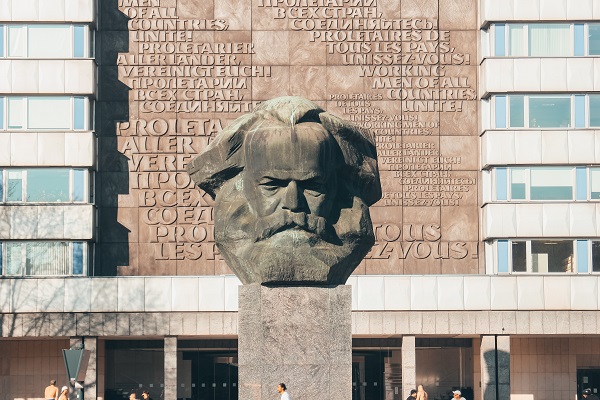
Karl Marx and the Ten Planks of the Communist Manifesto
After the results of elections in New York City, New Jersey, and Virginia, socialism and communism, two evil political and economic systems, are alive and well in our nation. This should come as no surprise. According to my friend Dr. Duke Pesta of Freedom Project Academy and a tenured professor at a state college in Wisconsin, the Communist Manifesto is the most-read book in state universities.
Karl Marx was one of the more loathsome figures in History. He was born in 1818 to an upper-middle-class family in Prussia. According to Pastor Richard Wurmbrand in his book Marx and Satan, Marx embraced Christianity as a young man but rejected the faith and became a satanist. Marx would refer to his writings as “devilish muddle.” Although he came from a Jewish background, Marx was both an anti-Semite and a racist. He authored the book A World Without Jews and would refer to those he disliked, which was almost everyone, as “Jews with Negro blood. He died in 1883 but his evil and deadly legacy lives on.
Back in the early 1990s, a was a guest speaker at a conservative Baptist college. Over lunch, one of the students said that “communism is good in theory, but it hasn’t been run by the right people.” I replied: ‘That is like saying Hell is a good place.” It just needs to be run by the right demons. A reading of Marx’s Manifesto can easily prove my point.
In his manifesto, Marx wrote, “But Communism abolishes eternal truths, it abolishes all religion, and all morality…” He called for the destruction of the family and labeled motherhood and fatherhood “bourgeois claptrap.” He promoted free education for all children run by communist teachers. Here are the ten planks he outlined in his manifesto:
1. Abolition of Property in Land and Application of all Rents of Land to Public Purpose
2. A Heavy Progressive or Graduated Income Tax.
3. Abolition of All Rights of Inheritance
4. Confiscation of the Property of All Emigrants and Rebels.
5. Centralization of Credit in the Hands of the State, by Means of a National Bank with State Capital and an Exclusive Monopoly.
6. Centralization of the Means of Communication and Transport in the Hands of the State.
7. Extension of Factories and Instruments of Production Owned by the State, the Bringing Into Cultivation of Waste Lands, and the Improvement of the Soil Generally in Accordance with a Common Plan.
8. Equal Liability of All to Labor. Establishment of Industrial Armies, Especially for Agriculture.
9. Combination of Agriculture with Manufacturing Industries; Gradual Abolition of the Distinction Between Town and Country by a More Equable Distribution of the Population over the Country.
10. Free Education for All Children in Public Schools. Abolition of Children’s Factory Labor in its Present Form. Combination of Education with Industrial Production.
Most of these plans are either partially or fully implemented in our nation. Plank two became the 16th Amendment to the Constitution.

Contrast Marx to our Bill of Rights
I, Congress shall make no law respecting an establishment of religion or prohibiting the free exercise thereof; or abridging the freedom of speech, or of the press; or the right of the people peaceably to assemble, and to petition the government for a redress of grievances.
II, A well-regulated militia, being necessary to the security of a free state, the right of the people to keep and bear arms, shall not be infringed.
III, No soldier shall, in time of peace be quartered in any house, without the consent of the owner, nor in time of war, but in a manner to be prescribed by law.
IV, The right of the people to be secure in their persons, houses, papers, and effects, against unreasonable searches and seizures, shall not be violated, and no warrants shall issue, but upon probable cause, supported by oath or affirmation, and particularly describing the place to be searched, and the persons or things to be seized.
V. No person shall be held to answer for a capital, or otherwise infamous crime, unless on a presentment or indictment of a grand jury, except in cases arising in the land or naval forces, or in the militia, when in actual service in time of war or public danger; nor shall any person be subject for the same offense to be twice put in jeopardy of life or limb; nor shall be compelled in any criminal case to be a witness against himself, nor be deprived of life, liberty, or property, without due process of law; nor shall private property be taken for public use, without just compensation.
VI. In all criminal prosecutions, the accused shall enjoy the right to a speedy and public trial, by an impartial jury of the state and district wherein the crime shall have been committed, which district shall have been previously ascertained by law, and to be informed of the nature and cause of the accusation; to be confronted with the witnesses against him; to have compulsory process for obtaining witnesses in his favor, and to have the assistance of counsel for his defense.
VII. In suits at common law, where the value in controversy shall exceed twenty dollars, the right of trial by jury shall be preserved, and no fact tried by a jury, shall be otherwise reexamined in any court of the United States, than according to the rules of the common law.
VIII. Excessive bail shall not be required, nor excessive fines imposed, nor cruel and unusual punishments inflicted.
IX. The enumeration in the Constitution of certain rights shall not be construed to deny or disparage others retained by the people.
X. The powers not delegated to the United States by the Constitution, nor prohibited by it to the states, are reserved to the states respectively, or to the people.
The Bill of Rights did not give us rights. We already had them. Rights come from God, and the main purpose of government is to protect these God given rights. Today, most elected officials would laugh in derision at this and declare those who proclaim it as “Christian Nationalists.” The Bill of Rights was a list of restrictions against Congress. On the other hand, the Ten Planks of the Communist Manifesto are a list of rights taken away from people. Our founding fathers left us a legacy of freedom. Marx and his minions left us a legacy of genocide and tyranny.

At the end of the 1787 Constitution Convention, Mrs. Elizabeth Powel asked Benjamin Franklin what kind of government was created at the Convention. He replied, “A republic if you can keep it.” As we go into our 250th birthday, let’s hope that we not only “keep it” but banish communist and its twin socialism into the dust bins of history where they so rightly deserve to be. Readers who would like a pocket copy of the U.S. Constitution may request one from me campconstitution1@gmail.com
Authors’ opinions are their own and may not represent those of Grok Media, LLC, GraniteGrok.com, its sponsors, readers, authors, or advertisers.
Got Something to Say, We Want to Hear It. Comment or submit Op-Eds to steve@granitegrok.com
