


On September 9, the Foundation for Individual Rights and Expression (FIRE) released its 2026 campus free speech rankings, concluding that “America’s colleges get an ‘F’ for poor free speech climate.”
“More students than ever think violence and chaos are acceptable alternatives to peaceful protest,” FIRE Chief Research Advisor Sean Stevens said on the report’s release. “This finding cuts across partisan lines. It is not a liberal or conservative problem — it’s an American problem. Students see speech that they oppose as threatening, and their overblown response contributes to a volatile political climate.”
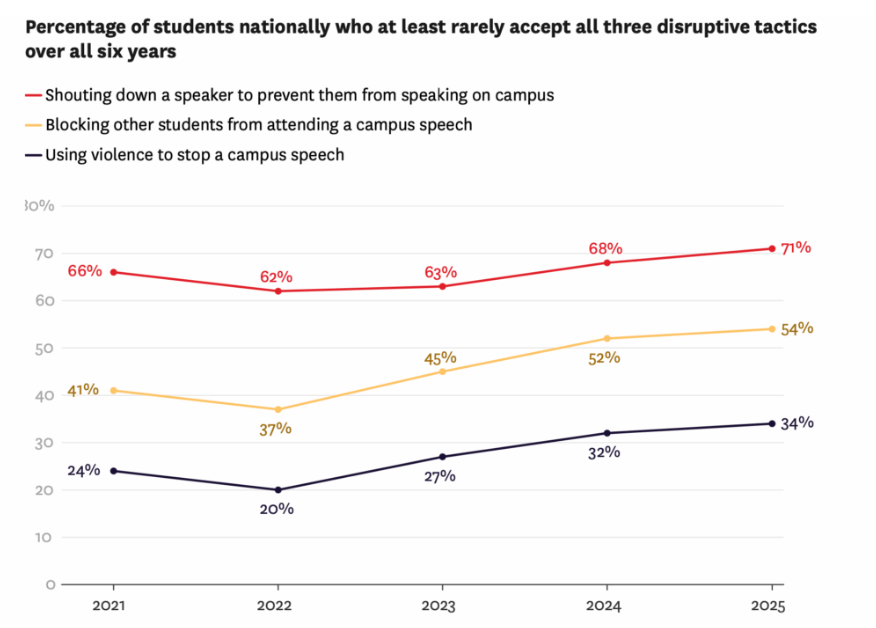
The numbers are stunning. Majorities of American college students think it’s OK to prevent a speech by shouting down a speaker and to prevent fellow students from attending a speech. Fully a third of students (34%) think it’s OK to use violence to stop a campus speech.
(UNH has a green light rating from FIRE, ranking 38th in this year’s report. Dartmouth ranks 35, one of the most improved in this year’s rankings.)
The day after FIRE released these results, Turning Point USA founder Charlie Kirk was shot to death on a college campus while talking with students.
Kirk’s assassination was unsettling for many reasons, not the least of which is that he was a political civilian. Kirk was an extraordinarily effective and influential communicator. But he held no position of power. And that’s an important distinction.
Kirk couldn’t arrest, imprison, tax or use any other lever of power to impose his views on anyone. His only tool was his voice.
He used that voice to explain his beliefs. He’d spend hours on a campus answering college students’ questions. Respectfully.
There’s a word for what Kirk did. It’s “dialogue,” which has its roots in the ancient Greek word “dialecktos.” It was once the foundation of liberal arts education.
To quote Merriam-Webster:
Dialect and dialectic come from dialecktos (“conversation” or “dialect”) and ultimately back to the Greek word dialegesthai, meaning “to converse.”
Conversation or dialogue was indeed at the heart of the “Socratic method,” through which Socrates would ask probing questions which cumulatively revealed his students’ unsupported assumptions and misconceptions.
Kirk’s form of dialogue was not exactly drawn from Plato. It was truncated for a social media audience. But it was still dialogue. And today, merely engaging in dialogue on a college campus can get you shouted down, chased off campus, even killed.
On too many campuses, intolerance has been institutionalized.
“Students are reluctant to speak their minds, especially on controversial political issues,” FIRE reported. “Many report that they self-censor regularly, avoid certain topics entirely, and doubt their administrators would defend free expression if controversy struck.
“The atmosphere isn’t just cautious — it’s hostile. Students continue to show low tolerance for controversial speakers, and troublingly, more believe it’s acceptable to shout down a speaker, block access to events, or even resort to violence to silence campus speech than ever before.”
This has to stop. Americans who believe in the free and open exchange of ideas can no longer leave it to others to halt this decay.
In 2018, the Josiah Bartlett Center launched our Civil Discourses event series, designed to bring Granite Staters together for civil discussions of politics, policy, and culture. Our first speaker was Pulitzer-winning historian Gordon Wood, and our first topic was his book Friends Divided on the friendship of political rivals Thomas Jefferson and John Adams. That set the tone for this series, which we will revive this fall in response to this week’s awful developments.
We started our series with Thomas Jefferson, who feared that younger generations would reject the principles of free speech and open inquiry.
In a 1799 letter, he wrote “that the enthusiasm which characterises youth should lift its parracide hands against freedom & science, would be such a monstrous phaenomenon as I cannot place among possible things in this age & this country.”
To prevent this, he advocated fanatical devotion to these core American principles.
“…to preserve the freedom of the human mind then & freedom of the press, every spirit should be ready to devote itself to martyrdom; for as long as we may think as we will, & speak as we think, the condition of man will proceed in improvement.”
In that spirit, the Josiah Bartlett Center this fall will renew our Civil Discourses event series, with an emphasis on modeling civil discourse and free and open inquiry to young Granite Staters.
If you or someone you know would be interested in sponsoring these events, please contact us at info@jbartlett.org or 603-715-0076.
Dialogue is the very foundation of American self-government. Our institutions—from town councils to Congress, from schools to universities—are designed to find truth and generate agreement through the open exchange of ideas.
Now is the time to re-engage young Granite Staters in this process. If you would like to help us do that, please reach out.
Authors’ opinions are their own and may not represent those of Grok Media, LLC, GraniteGrok.com, its sponsors, readers, authors, or advertisers.
Got Something to Say, We Want to Hear It. Comment or submit Op-Eds to steve@granitegrok.com
