

I’ve been participating in an email thread where the main idea is more or less that ‘special education is ruining everything’ in schools.
The craziness that has evolved around special education is certainly not helping. But I believe the problems we’re seeing in schools are mainly the symptoms of using the wrong tool for the job.
Confucius said that the first step towards wisdom is to call things by their right names, i.e., to use the right words.
I think this is a special case of a more general idea: The first step toward success in any endeavor is to use the right tools.
School is the right tool for one well-defined task: If you have a bunch of people who (regardless of age) are ready to learn the same material (which includes intellectual readiness, behavioral readiness, and motivation), then it can be very efficient to have them synchronously share instruction in that material.
(Having said that, it used to be the case that school was where you could find the highest-quality instruction available in an area. That is no longer the case. In fact, it’s often the opposite — a kid who goes to school has access to lower-quality instruction than he could get at home, over the Internet.)
Here are some tasks for which school is not the right tool:
- Daycare
- Therapy
- Nutrition
- Transportation
- Hobbies
- Social development (SEL)
- Moral and spiritual development
- Political indoctrination (CRT, DEI)
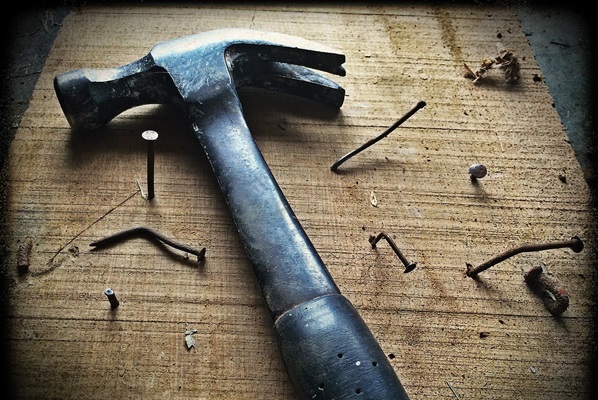
And yet, those are the tasks where schools spend almost all their time and effort (and our money). If a school is a hammer, then what we are doing with that hammer at various times corresponds to
(1) treating everything as a nail, or
(2) assuming that if a hammer is good for driving nails, it must also be good for cutting wood, drilling holes, driving screws, grabbing items firmly, applying paint, tightening bolts, clamping items together, measuring distances and angles, and so on.
All of which is to say, by using schools to do things for which schools are not suited, we
(1) make it inevitable that we will do a terrible job at all the secondary tasks and,
(2) make it impossible to do a competent job at the primary task.
The only winners in this approach are the makers and sellers of the hammers.
But suppose we made ‘public schools’ into public schools, i.e., schools open to all members of the public, who can come to learn what’s being taught if they want to and if they are ready to.
That would free teachers to actually teach students who want to learn. And it would allow all those other needs — like therapy — to be addressed through other more specialized, more efficient, and more competent channels — the right tools for those jobs.
