

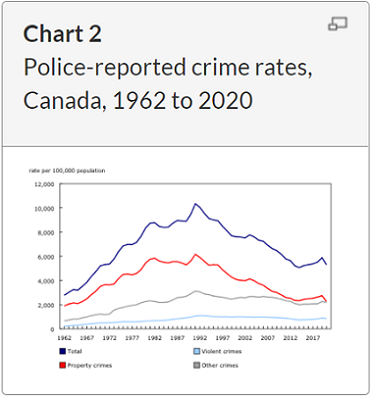
Crime rates have been on the rise lately in Canada, after remaining significantly low throughout 2020. This is a result of several factors, including but not limited to rash decisions and a general lack of sufficient personnel. For example, some of the most dangerous locations in Canada never even had enough police officers to begin with, while others that did previously are now being defunded. There is also the sudden growth of post-pandemic unemployment to consider among other things. Although the reasons may differ, there is no disagreeing with stats and all stats point to the following cities becoming more dangerous by the day.
Peterborough in Ontario, Canada
In a year where crime rates went down in almost every major Canadian city and metropolitan area, the Crime Severity Index (CSI) in Peterborough jumped by 14% in 2020. Peterborough quickly became one of the most violent cities in Canada, with a higher spike in severe crime rates than any other city in all of Canada. Note that the violence in Peterborough was mostly brought on by hate crimes of various nature, including gun violence and attempted shootings.
Greater Sudbury in Ontario, Canada
Greater Sudbury saw more violent crimes than Peterborough by far, although the CSI spike of 7% might mislead you into believing otherwise. Sudbury has been a major seat of crimes in Canada for many years now, which makes every spike in the city’s annual crime rate a lot more significant than it is in a relatively safer city like Peterborough. Homicide rates decreased in Sudbury thankfully, but hate crimes, drug peddling and associated violence, and incidents of criminal firearm possession and use only went up.
Red Deer in Alberta, Canada
The Canadian criminal justice system measures, analyses and estimates both crimes and public opinions using several, complex indexing systems. For example, the probability of being attacked while walking at night in Red Deer, Alberta was deemed to be about 30.64 last year, which means that the chance of getting mugged, assaulted, or worse in Red Deer, Alberta was almost as high as 1 in 3 for anyone walking alone in the city.
As if that alone is not a scary proposition for the locals, more people were murdered in Red Deer than in any other major city. It seems that even the tragic mass shootings at Nova Scotia could not match the body counts seen in Alberta last year.
Montreal in Quebec, Canada
Considered to be one of the safest cities in Northern America, even Montréal was not spared from the boost in crime rates which Canada is experiencing now. According to police reports, criminal use of firearms increased exponentially in all of Quebec, including Montreal. The Montreal Police department is no longer able to keep the city as safe as it used to be previously, because of two primary and interconnected reasons, namely budget cuts and fewer officers.
Mayoral candidate Denis Coderre points out that the present administration’s move to defund the police has already cost 17 female lives in 2021 alone. It should be noted that Mayor Valérie Plante did provide $5.5 million as extra funding to the city’s police department after the Saint-Michel shootout which took place in August 2021. However, after years of being strict with the annual policing budget, neither the community heads that supported the mayor’s previous decisions, nor the Police Brotherhood in Montreal condoned the move as being anything more than a pre-election strategy.
Coderre, on the other hand, has always been a supporter of the forces in Montreal and he stated that bringing back the 84 officers who were let go without due cause will be one of his first steps if he is elected. The mayoral candidate further explained his plans to hire 250 more officers to the Montreal Police Force soon after to curb the growth of crime rates in what was once considered to be the safest city in Quebec.
The Wilfrid Laurier University is offering a policing & criminology degree online that almost anyone can join and become a part of the solution, irrespective of whether they have any prior experience with law enforcement. A criminology degree will also open career paths that lead to other places than just the police precinct. Successful degree holders can later choose to become a housing officer, a policy analyst, part of the city’s child protection services, a victim’s advocate or an addiction counselor to name a few. The point is that more citizens need to step up if they wish to keep their city, as well as the rest of Quebec, safe from being overrun by organised and random crime.
Lethbridge in Alberta, Canada
Due to a booming illegal drug trade, Lethbridge had already become one of the most nefarious cities long before the pandemic. In fact, no other Canadian city comes even close to Lethbridge, as far the CSI is concerned. Just go through the following stats to get a better idea of how serious the situation is in Lethbridge.
- Lethbridge had a CSI of 138.65 in 2020, making it the most crime affected CMA in general
- Lethbridge reported the highest drug related crimes last year, just like every year
- Index stats – B & E/home vandalization: 65.66, assaulted and/or robbed on the streets: 59.16, GTA: 54.765, stealing goods from a car: 71.44
Although the facts don’t look as bad for the country as a whole when we look at stats from 2020, that will change once the 2021 report comes out. Did you know that Thompson in Manitoba has a CSI rate of 366; VCSI of 570? If growing crime rates in safe cities such as Montreal are anything to go by, the lull in 2020 was only the calm before the storm. Unless immediate and proactive moves are taken to curb the situation soon, Canada may see an even more violent year in 2022. Things will feel a lot more dire if we consider the fact that most crimes in non-metropolitan areas are never even reported and the facts presented here only provide a glimpse of how dangerous some places can be in Canada.
*****
From time to time, GraniteGrok accepts content from third parties (posts, or additional links after initial publication) from which we may or may not receive compensation.
