

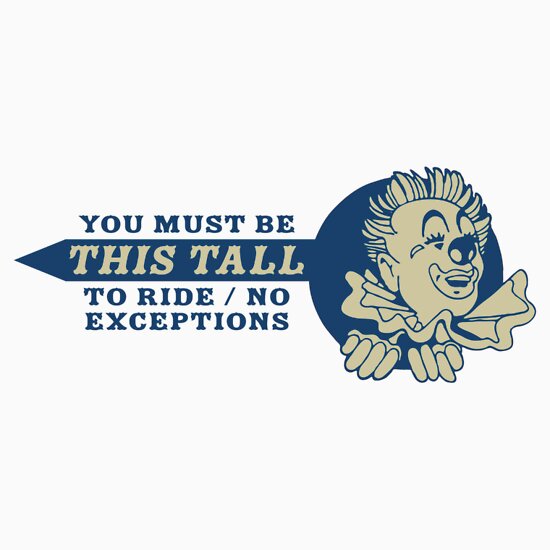
At some amusement parks, you’ll find signs in front of some of the rides telling you that you have to be at least some minimum height or you can’t get on the ride.
There are a couple of things to note about this. First, it has nothing to do with how old you are. A younger kid could be tall enough, while an older kid might be too short. Some adults might not meet the requirement. You’re ready when you’re ready, and you might never be ready.
Second, no one regards this as being discriminatory. If you’re below the minimum height, you’re in danger of falling out of the ride, and that’s all there is to it.
Many people don’t realize this, but a couple of decades ago the state supreme court placed a sign like this inside its Claremont decision, where it declared that an adequate education is one that provides
each educable child an opportunity to acquire the knowledge and learning necessary to participate intelligently in the American political, economic, and social systems of a free government.
Interestingly, the word ‘educable’ seems to appear in no other court decisions, in no RSAs, and in no Department of Education regulations. The sign, having been placed in clear view, has been completely ignored.
Which is too bad, because if it were taken seriously, it could help alleviate some important, and expensive, problems that we have created for ourselves.
For example, suppose that we were to start thinking of ‘public school’ as a ride that you get on, not when you’ve reached some arbitrary age, but when you’ve reached a certain stage of development, as evidenced by your ability to demonstrate certain things — a minimum level of emotional control, the ability to dress yourself, a minimum vocabulary, and so on.
That way, we’d know that kids entering public school, regardless of their chronological ages, would be ready to start working on the same kinds of things. That’s one of the prerequisites for making our traditional assembly-line model of public schooling work properly, and ignoring it is driving us into both fiscal and intellectual bankruptcy.
In addition, this would remove many kids from an institution that is not, and should not be, designed to meet their special needs. Which would allow those needs to be addressed in situations that are designed to meet them — something that for many kids isn’t happening now.
Putting kids who are not educable — whether that’s a temporary condition, or a permanent one — into public schools isn’t good for those kids; it’s not good for the educable kids whose educations are being disrupted in order to accommodate them; it’s not good for the teachers whose time and attention are diverted from educating their students; and it’s not good for the taxpayers who are being forced to foot the bill for the whole mess.
So who is it good for? That’s the question we need to be asking ourselves.
It comes down to this: If public schools are supposed to be about education, then enrollment must be limited to students who are educable. The alternative makes as little sense as forcing insurance companies to provide pregnancy coverage to men, sending COVID relief checks to families making $150 thousand per year, and so on.
As Katherine Dunn noted: ‘The reality we ignore or deny is the one that weakens our most impassioned efforts toward improvement.’ No matter where your sympathies lie on this issue, the inescapable reality is that the harder we try to solve the wrong problems, the farther we get from solving the right ones.
