


The debate over whether to include cursive in the curriculum has flared up again, this time in Nashua. It can be instructive to look at the arguments that people put forth in favor of teaching cursive — but not because it’s important whether cursive is actually taught in schools. (Spoiler: It’s not.) The arguments are instructive because of what they say about the underlying thought processes of the people putting them forward.
But if we don’t teach cursive, kids won’t be able to read original documents!
First, it’s one thing to be able to read cursive (I can), and another to be able to write it (I can’t). So it’s important to at least be clear which of those you’re arguing for.
But more importantly, I don’t believe I know a single person who, if he wanted to look at the Declaration of Independence (or the federal constitution, or the state constitution, or the Magna Carta, or a letter from Thomas Jefferson to James Madison, or any other ‘original document’), would choose to look at the cursive version. I know I wouldn’t, unless I had some reason to believe that, say, the Cato Institute was trying to pull a fast one by changing the wording. Which I don’t.
Also, it’s important to note that ‘cursive’ has changed over the years. Even if you learn modern cursive in school, it’s still difficult to read something like a handwritten copy of the Declaration of Independence, if you don’t already know what it says.
But what’s amazing here is that the people making this argument are claiming that taxes should be used to subsidize teaching children a skill that they might day one be able to use, to do something that those people would never do themselves. What’s going on here?
To paraphrase Lewis Carroll, this seems to be a case of conclusion first, reasons afterwards. Emotionally, they’re attached to the idea of keeping cursive in the curriculum. (My wife suggests that it might be as simple as: ‘Because I had to learn cursive, it must be important.’)
This emotional investment makes them willing to grasp at any idea, no matter how flimsy, that seems to support it. Does this seem familiar? Do you see it happening in other areas of public policy? Like gun control? The war on drugs? Immigration? This is a special case of a very general phenomenon.
But kids won’t be able to sign their names!
I don’t remember the last time I saw a legible signature. (Mine certainly isn’t. It looks more like an EEG tracing than a series of letters.) The key attribute of a signature isn’t that it should be cursive, but that it should be easy for the person to reproduce, hard for someone else to copy, and recognizable when compared against other valid instances.
Properly speaking, it doesn’t even have to contain any letters:
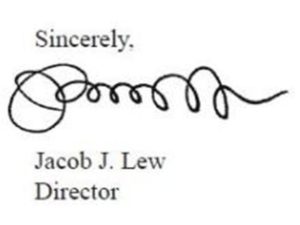
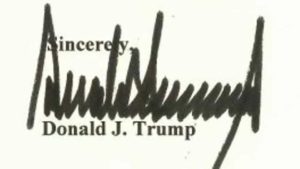
So this appears to be another case of conclusions first, reasons afterward.
But it might be developmentally important for children!
As one cursive advocate put it: ‘Even if they choose not to use it as adults, aside from to sign their names, it certainly does not hurt their fine motor skills to learn it.’
Is this even an argument, really? If our goal is to help kids enhance their fine motor skills, there are lots of better ways of doing that.
But it provides a nice illustration of the modern framework for deciding what taxpayers should have to subsidize in schools: If children would be better off learning something — or might be better off — or, in this case, if it wouldn’t hurt them — let’s include it in the curriculum!
But this is emphatically not a justification for requiring taxpayers to subsidize the teaching of that subject. There’s no subject, no skill, about which you couldn’t make that argument.
Would kids be better off if they could make their own pastries from scratch? Or if they could replace the brake lines on their own cars? Or if they could extemporize eloquently on the symbolism of Shakespeare’s plays? Or if they could contemplate the finer points of gravitational singularities? Or if they could order in French at a French restaurant? Of course they would. Does that mean taxpayers should subsidize courses in those things? Of course not.
We always have to return to the basic fact that school districts are violating everyone’s right to property in order to pay for a program from which most do not directly benefit. This is only justified if they can show, very clearly, how the violation of that right is in service of the protection of their other rights. (That’s in Article 3 of the state constitution.)
I don’t think you can make an argument that my rights are in danger if many, or most, or even all kids grow up without learning to read and write in cursive.
And if I’m right, then here’s the million-dollar question: How much of the rest of the state’s laundry-list definition of an ‘adequate education’ fails exactly the same test?
But I can’t teach my kids cursive, so I expect the schools to do it!
If you don’t know cursive yourself, for $35 you can purchase the CursiveLogic course, which breaks things down into mastering four basic shapes, allowing you and your kid to master cursive together in four easy lessons. The pages are write-and-erase, so you could share the cost of a single copy with other parents who are in the same boat as you.
Or you could go to YouTube and search for ‘cursive tutorial’, and marvel at the number of people who have put in significant time and effort just for the pleasure of sharing what they know with other people.
Or you might consider all the other options that are available to most people, such as enlisting the help of friends, older siblings, other relatives, and volunteer organizations, to name just a few.
In short, parents don’t need to be able teach their kids cursive. They just need to motivate the kids to learn it (which is their job, and not the school’s ), and then help them get started with one of the thirty zillion or so free or low-cost resources that are available.
And while cursive itself is a minor subject, we can use it to make a major point, because we’re in the same situation with just about any subject that parents think their kids can learn only in school.
Outside of school, you have access to some of the best, most creative teachers in the world, often for free, or for some nominal cost. Inside school, you have access to a handful of teachers who happen to live near you.
Outside of school, you have control over the order and pace of instruction. Inside school, your kid has to try to move at whatever pace the teacher feels will work best for a whole classroom full of students.
Outside of school, you can wait until your kid is developmentally ready to take on any task, whether it’s learning to form cursive letters, or anything else. Inside school, you have to rely on the astrological model currently favored by public schools. (‘By looking at the date of your child’s birth, we know what he should be learning this week.’) For a kid who’s ready, learning cursive is the work of a weekend, or less. For a kid who isn’t ready, it can turn into weeks or months of struggle.
And having said all that, if you do know cursive yourself, what stands in the way of teaching it to your kids? It’s not rocket science. It’s mostly just demonstration and practice. If you can do it, they can learn it the same way they learned a thousand other things from watching you: observation, trial, and correction.
Even with the ubiquity of cell phones, a surprising number of people have managed to remain blissfully unaware that they live in an ocean of high-quality, low-cost, instantly-accessible pedagogical resources. In fact, there are really only a handful of places that you can go to get away from all those people who are lined up to help you learn anything you want to know, e.g., out of cell tower range, in prison, in court, or in school.
This is crucial, because as long as parents hold on to the idea that school is the only place, or the best place, or even a good place, for their kids to be learning things, significant improvement in education simply isn’t possible. Because at this point, the ever-expanding mismatch between school and the rest of society makes school more an opportunity cost than an opportunity.
