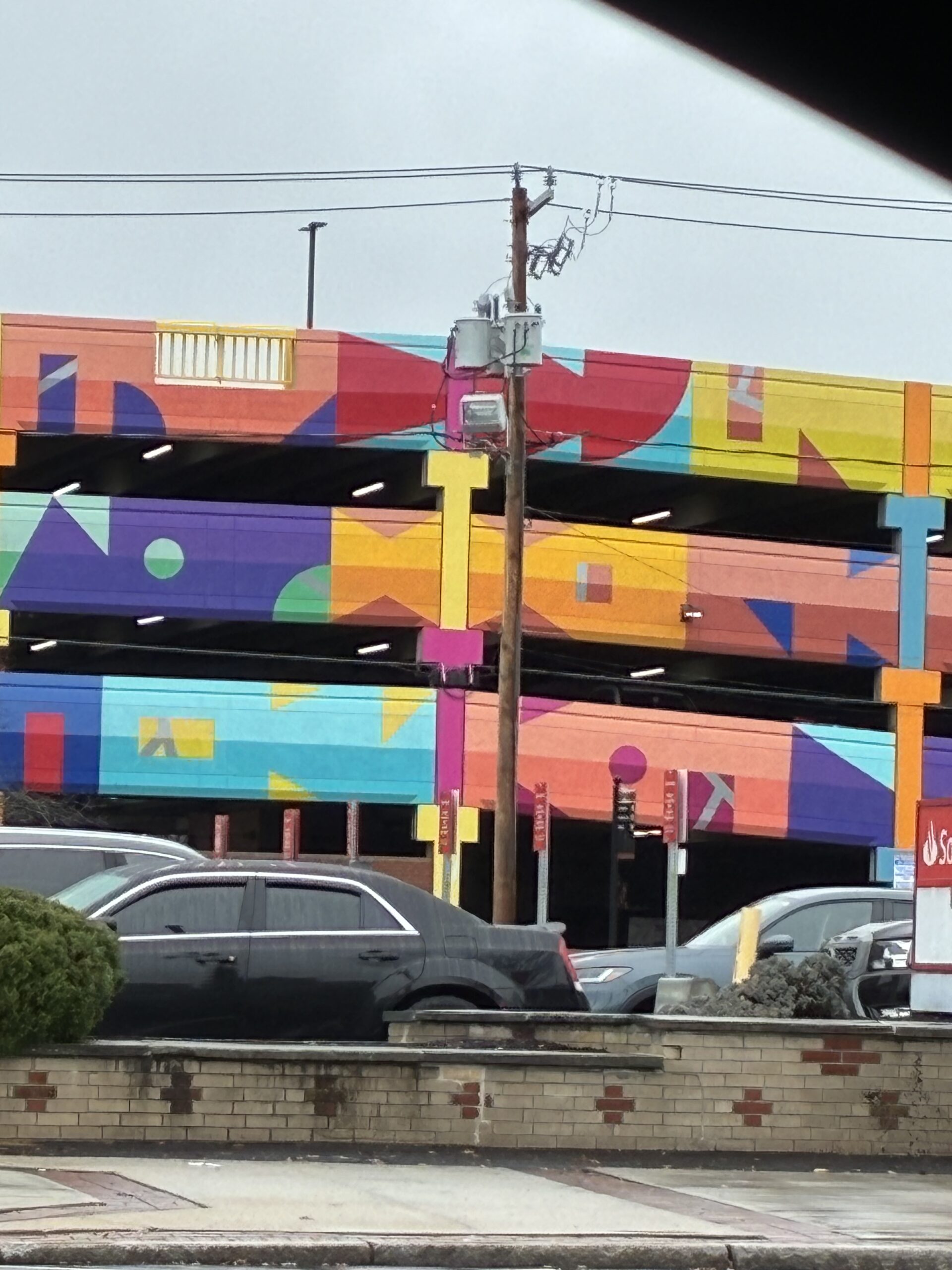
Drive past Nashua’s downtown parking garages, and you can’t miss them. Bright blocks of orange, purple, turquoise, yellow, and pink now cover the faces of the structures. Whether you like it is beside the point. The issue is how roughly $1.1 million in public money was committed to a paint job that the governing documents never once call a paint job, and how it was done without a vote of the full Board of Aldermen.
I obtained the contracts through a Right-to-Know request (NextRequest 26-965), and I compared them against the City’s own Purchasing Manual and ordinances. Here is what the records show.
Two contracts, one project
The City hired Beyond Walls, a Lynn, Massachusetts firm, under two separate “professional services” contracts:
$155,904 for design. The Finance Committee approved it in June 2025, and the Mayor signed it June 20, 2025. Its scope is titled the “Beautification of Nashua Garages project.”
$944,035 for implementation. The Finance Committee approved it May 6, 2026, and the Mayor signed it the next day. Its scope calls the work “the next phase” of “a comprehensive visual enhancement initiative,” building on the design contract.
Together: $1,099,939.
That number matters. Under Nashua Revised Ordinance § 5-90, the Finance Committee can approve contracts up to $1,000,000. A contract over $1,000,000 “shall be submitted to the full Board of Aldermen at its next regularly scheduled meeting for final approval prior to award.” Each Beyond Walls contract came in under the line. The project as a whole did not. The full Board never voted on either one.
The ordinances also say that “no contract or purchase shall be subdivided to avoid the requirements” of the purchasing rules (§ 5-78(K)). The City’s Purchasing Manual adds that purchases “shall not be divided specifically to circumvent” its thresholds. Whether two contracts for one project, from one vendor, under one solicitation, paid from one bond, should have been counted together is exactly the kind of question the full Board exists to answer. It was never asked to.
The word that never appears: “paint”
Read both contracts, both City memos, and both scopes of work. You will not find the word “paint.” You will not find “mural.”
The Finance Committee was told about “Parking Garage Façade Improvement” and “Implementation of wayfinding and façade improvements.” The first memo described the work as part of “the overall repair project.” Anyone reading the memo would reasonably think of repairs.
The $944,035 scope is a single page. It lists “Project Staffing & Management $325,000,” “Materials & Hardware $488,000,” and “Equipment & Logistics $131,035.” It has no quantities, no materials list, no design, and no unit prices. It also called for 60% ($566,421) due upon acceptance of this agreement, before any work began. The contract itself says the City pays monthly “for work satisfactorily completed.” Which terms the City actually followed, the records released to me do not say.
“Community input” that the decision-makers never saw
When the design contract came forward, the public was told this would be a community-driven project. The City paid for that. Phase 3 of the design contract, at $32,539, called for two on-site town halls, renderings, feedback forms, and a written “Community Insight Report summarizing feedback and selected designs.”
When the Finance Committee voted on the $944,035 implementation contract on April 6, 2026, its packet contained a purchasing memo, a two-paragraph letter, and the contract. It contained no designs, no Community Insight Report, and no summary of what residents said they wanted. At that meeting, committee members were told the design concepts could be sent to the Board afterward so members could see the paint ideas.
That is backward. The time to see the design, and the public’s reaction to it, is before committing nearly a million dollars, not after.
A 20-year bond for a 10-to-15-year paint job
This work is being paid for from the parking garage bond under Resolution R-24-106, which taxpayers will be paying off for 20 years.
Outdoor murals on concrete, even with good paint and protective clear coats, typically last about 10 to 15 years before fading and peeling require major repainting. Parking garages are especially hard on paint because of road salt, freeze-thaw cycles, and moisture moving through the concrete. Bright reds, oranges and purples like these fade fastest.
A basic rule of public finance is that you don’t borrow for longer than the thing you’re buying will last. Taxpayers may well still be paying for this paint job after it has faded away, and then paying again to redo it.
The design contract even offered a “Brief report on long-term maintenance suggestions for art elements.” It was listed as optional. Has anyone on the Board seen it? Has anyone asked what upkeep will cost each year?
What the Purchasing Manual requires, and what the Committee received
The City’s own rules say the Finance Committee should receive:
a summary of “the prices offered” by competing firms (§ 5-90(B)); for professional services, the written solicitation and the firm’s response (§ 5-83(C)); a documented recommendation with the justification and the “process followed in arriving at recommended supplier” (Purchasing Manual § 6.12);
“a detailed description of the project” (Purchasing Manual § 10.3).
The City did run a competitive solicitation, a Request for Qualifications in October 2024. Four firms responded, including two from Nashua. But the memos list no prices from any of them. The same October 2024 solicitation was then relied on to award the $944,035 implementation contract a year and a half later, to the same firm that drew the designs.
Two aldermen, each members of the Finance Committee, saw enough to vote no: Alderman Gouveia on the design contract and Alderman Sullivan on the implementation contract. Their colleagues on the full Board never got a vote at all.
The Board’s job is fiduciary, not ceremonial
The Board of Aldermen holds the City’s purse in trust for the people who fill it. That fiduciary duty doesn’t end because a project is broken into pieces, labeled “professional services,” or described in pleasant words like “beautification” and “visual enhancement.” When a single project crosses $1 million, residents should be able to count on their full Board to look at it, ask questions in public, and vote on the record.
The Board should:
- Count projects, not paperwork. Adopt a clear rule that related design and implementation contracts with the same vendor are added together for the $1 million threshold.
- Require the deliverables before the next dollar. No implementation contract should go forward until the paid-for design and community reports are in members’ hands and posted publicly.
- Insist on plain language. If the City is buying a mural, the contract and the memo should say “mural” and “paint,” with quantities and a cost breakdown. Get rid of the word-salad.
- Match the borrowing to the asset. Don’t finance short-lived cosmetic work on a 20year bond without a public maintenance and replacement plan.
- Stop paying up front. No 60% payments before work begins on public contracts.
Ask your alderman
Did you ever see the design before the City signed?
Did you ever see the contractor’s “Community Insight Report” on what the public wanted?
Did you ever see the “report on long-term maintenance suggestions for art elements” telling us how long this paint will last and what it will cost to keep up?
Why did a $1.1 million project never come before the full Board?
Nashua taxpayers deserve answers, and a Board willing to ask the questions before the paint dries.
Sources: City of Nashua NextRequest 26-965 (Beyond Walls contracts and Purchasing Memos #25-203 and #26-162); City of Nashua Purchasing Manual (January 2019), including Nashua Revised Ordinances §§ 5-69 to 5-92; Finance Committee minutes and agenda packets, June 18, 2025 and April 6, 2026.