

TL/DR Synopsis:
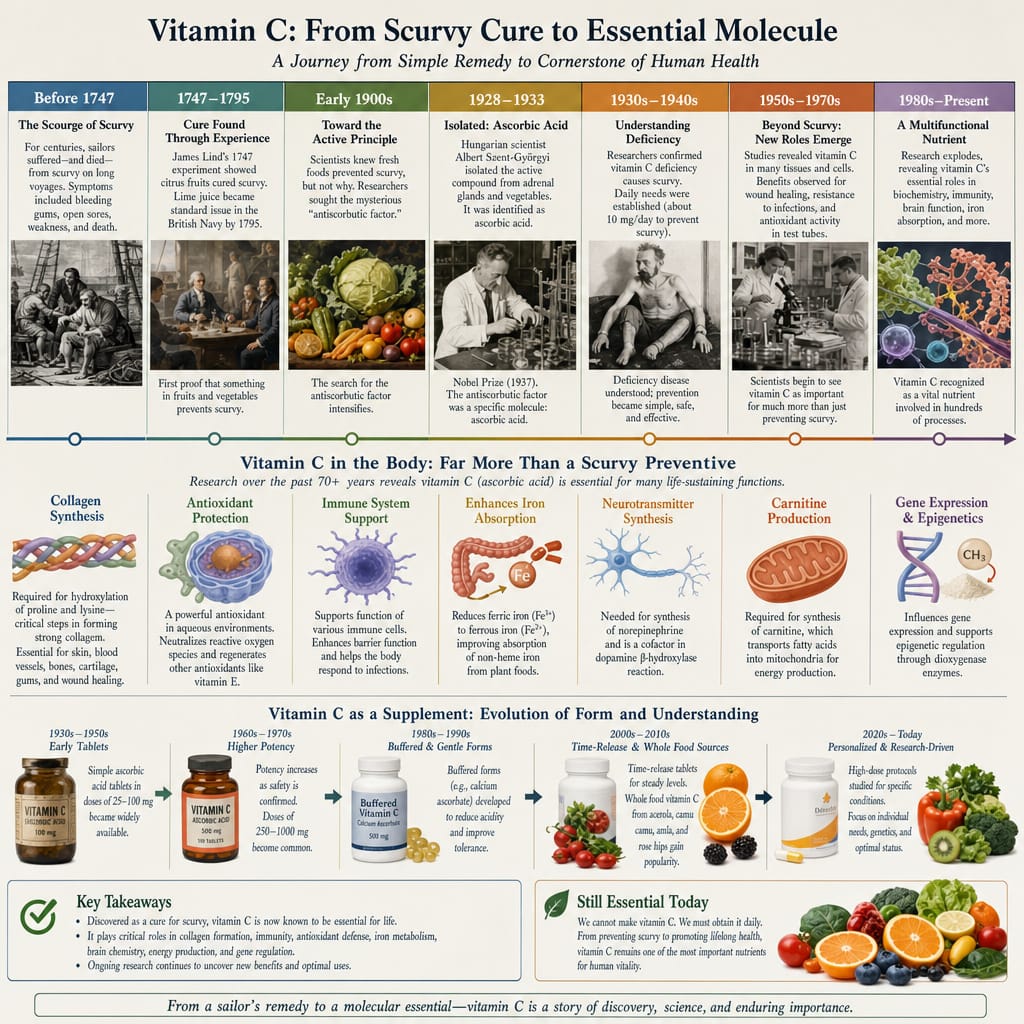
- Isolated and identified in 1928 as a scurvy preventive, it was the first vitamin to be sold
- In our body’s symphony, Vitamin C works with more than a half-dozen nutrients
- Just this month we learned about the importance of Vitamin C to brain health
Back in 1934, there was money to be made in simple vitamins because it was new technology in a new market, and Hoffmann-La Roche Inc., an American subsidiary of a European company, acquired the patent rights to synthesize the very first vitamin manufactured-from-scratch in a factory. It was Vitamin C, first sold in pretty low doses compared to today. In 1928, it had been isolated and identified as a scurvy preventative, and it didn’t really take much of the stuff to get that job done.
The actual molecule, ascorbic acid, gets us into some interesting naming conventions. Here we have something with such a natural-sounding name as Vitamin C, but the pills, ascorbic acid, sound so industrial, so all my life, I figured I was taking some kind of cheaper substitute for a natural product! Nope, same molecule! It was what was packaged in 1934 as Redoxon® and it was simply ascorbic acid…
A molecule is a molecule is a molecule, as I agonizingly, sans calculators, learned in chemistry class, with precise, and calculable, values. In a way, this is good because it permits us to readily compensate for deficiencies in foods by popping a simple little pill. It may not solve the underlying problem, namely the need to keep food affordable for billions of people, but it lets us keep ourselves healthy if we keep up with research and add the necessary supplements and vitamins to our daily regimen.
Remember the symphony analogy from magnesium! You simply cannot take one in isolation because a very informative column you read somewhere convinced you. The column may be very correct in the importance of any given supplement but any supplement can’t be taken in isolation. If you take away only one recommendation from my Substacks, take with you the fact that our bodies are very similar to the most intricate symphonies, in that one missing instrument, or nutrient, will cause, even if modest, harm to the final output.
While the molecule itself might not change form, its interaction with other elements in your body is where the rubber meets the road, so you must be sure to give each nutrient the additional nutritional elements needed for your body’s symphony to be the Beethoven or Mozart it was intended to be.
If we take a look at how Vitamin C works with other common supplements, we see these interactions. Most are beneficial and don’t need us to make any adjustments to either intake.
Synergistic (SYN):
Iron — C dramatically enhances non-heme iron absorption. Iron is one of the rare nutrients you don’t have to guess about because you can get it tested before you adjust anything. Unlike most of what’s in this series, you really can know your actual number.
Zinc — C enhances immune effects of zinc, and in the zinc Post, I mentioned that zinc had kept me from seasonal flu bugs, but the zinc was doubtless enhanced by my ascorbic acid intake!
Selenium — antioxidant synergy, with the two working quietly together
CoQ10 — C recycles CoQ10 in mitochondria, an excellent example of the symphony in our bodies!
Glutathione — C recycles oxidized glutathione back to active form. Yes, it’s not a once & done! Elements recirculate.
C15:0 — shared ferroptosis/oxidative stress territory
Antagonistic (ANT):
Copper — high C reduces copper absorption, which is why I bumped my copper supplementation to 3mg 2x daily. Copper is also used in interactions with zinc!
Dependent (DEP):
NAC — NAC is upstream; glutathione recycling connects them
At the opening of this Post, I said we’re still learning about good old Vitamin C, and I wasn’t kidding. The other day I read about a significant grey matter study in Japan that showed a higher concentration of Vitamin C in the bloodstreams of older adults correlated directly with more brain mass. We’ve come a long way from low dose Vitamin C preventing scurvy, haven’t we?
The human body is a truly fascinating symphony in motion that we still have much to learn about. I’ll follow the news and keep you abreast of the latest.
Next week, we’ll dig a bit deeper into Vitamin C because it deserves the attention, and the segments are different enough that we need the time to carefully consider our supplementation alternatives.
Authors’ and Speakers’ opinions are their own and may not represent those of Grok Media, LLC, GraniteGrok.com, its sponsors, readers, authors, or advertisers.
Disagree, agree, Got Something to say? We Want to Hear It. Comment or submit Op-Eds to steve@granitegrok.com
