

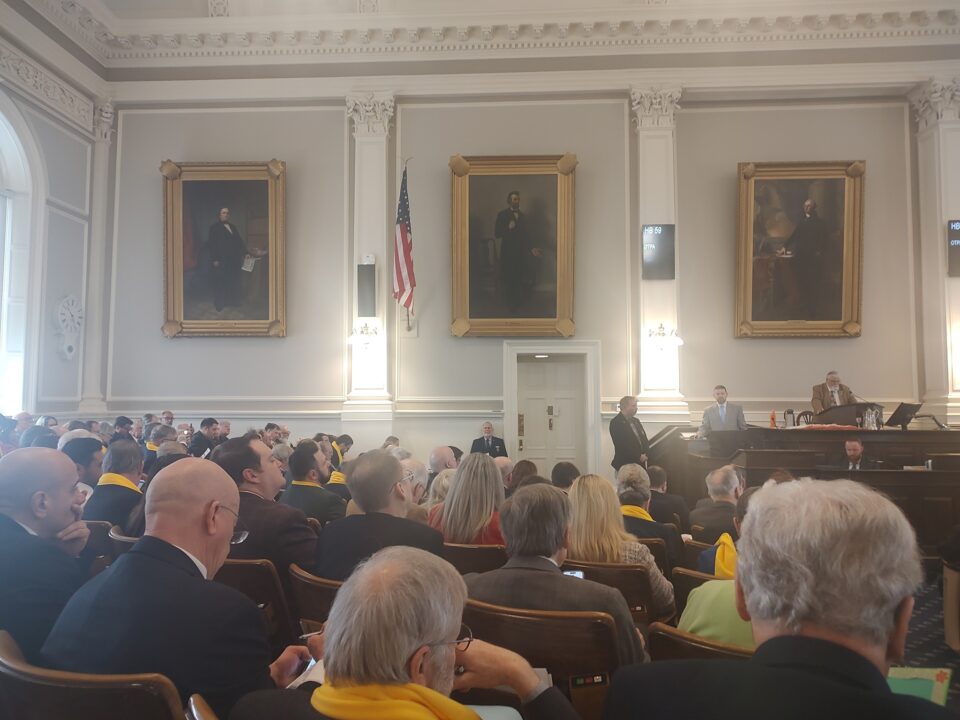
We learned it was another long day in the NH House as we dealt with 41 bills. In attendance were roughly 204 Republicans and 171 Democrats in the House. Our docket of bills included some that supported the Republican pledge to voters in the “Contract with New Hampshire” (https://www.nhhousegop.com/press-releases/contract/) and you will likely see more of these bills as we continue to have bills come to the House floor . Of course, throughout the day, Rep. Wendy Thomas (D-Merrimack), held up a black fan with white lettering spelling out the word, “SHAME”. How cute that she thought she was emulating the Democrat loons in Congress, with their little round black and white signs during President Trump’s State of the Union speech, as we were voting on various bills in House chambers. This is what we have to deal with.
We learned that one such bill aligned with the contract with NH was HB59, which supports our first responders. We passed this bill OTP/A with a roll call vote of 196Y-179N. This bill makes the crime of knowingly assaulting an emergency worker and causing serious bodily injury, a first degree assault. The same assault causing bodily injury would be 2nd degree assault. This bill does not make assaulting an emergency worker more serious than anyone else, but codifies it as a distinct crime of its own. This is important for several reasons. If a person assaults a police officer and causes serious bodily injury (we heard one guy had his finger bitten off!), it is important for future reference that the crime state with specificity that the victim was a law enforcement officer. If the defendant commits another assault on an emergency worker in the future, the court should know right away that the person has done it before. It is also relevant for bail purposes. A person willing to assault and seriously injure an armed law enforcement officer should probably not be treated the same as someone who was engaged in a bar room brawl. We want to make it clear that assaulting first responders should be taken seriously by our criminal justice system, especially as judges in the past have dismissed charges saying, “It’s part of their job”. No… being assaulted should not be part of anyone’s job… unless you are a boxer or a wrestler working for WWE.
We learned that HB87 passed 234Y-144N. This bill protects private property rights by preventing individuals from posting on land that they do not have a legal right to, and establishes penalties for doing so. Some “crazy anti-hunting Eco Warriors” have a penchant for putting up posted signs on land they don’t own, and now if they get caught doing so (and there are cameras about) they can and will be punished for it.
We also learned that HB159, another version of “Red Flag Laws” got Tabled with a division vote of 193Y-187N. After lunchtime there was an attempt to remove it from the Table and that failed with a roll call vote of 174Y-198N. The bill, along with the committee amendment, would have added citizens who have committed no crimes to the National Instant Criminal Background Check System (NICS). This action effectively, permanently, strips law abiding citizens who have been involuntarily committed of their constitutionally protected rights. Additionally, the bill and amendment deleted a section of a law that currently mandates that before sending in any names into NICS, there be a dedicated hearing in which the person or their attorney was physically present. The amendment left in place the possibility that someone can petition the court under RSA 135-C:35 to have a separate individual involuntarily committed to a mental institution. There was much wrong with the bill and its amendment, and there was overwhelming testimony both at the hearing of the bill, and online, opposing this bill. This bill was yet another response to the murder of a security guard last year at the New Hampshire Hospital by an unstable person. That guard should have been allowed to be armed and was not. The majority of people believe that a bill aimed at fixing the current support network for those experiencing mental health crises would be a much better solution than taking away 2nd amendment rights from people who have done nothing wrong.
We learned that HB592, the Bail Reform Bill, passed OTP/A 204Y-175N. That was another bill we passed today that was on our “to do” list with “the contract with NH”. There was massive bi-partisan support from mayors of cities in NH who, along with Governor Ayotte, were begging the legislature to pass this reform bill. Rep. Buzz Scherr (D- Portsmouth) said in his floor speech that current bail system was working and we don’t need to fix it. Perhaps he should take a ride with some of Manchester’s law enforcement and see that after someone is arrested for horrible crimes, they are back on the street before the police fill out their paperwork. It is just amazing how some of these House Democrats are totally out of touch with reality… or perhaps they want these criminals to be roaming around.
We further learned that HB115, another item on our NH contract “to do” list, passed on a roll call vote 198Y-180N. This was the universal EFA funding bill. Research demonstrates that by expanding educational choice availability to children, learning improves, including for those who prefer traditional public schools, while saving taxpayers money. New Hampshire’s Education Freedom Account (EFA) program, a successful choice opportunity, is currently restricted to families that make no more than 350% of the federal poverty level. That’s $90,370 for a family of three and $112,525 for a family of four. This bill, as amended, increases the income eligibility level to no more than 400% for FY26, the first year of the biennium. That’s $128,600 for a family of four. After June 30, 2026, no income threshold needs to be met in subsequent years for a K-12 student to enroll in the EFA program provided the student otherwise qualifies. This will make the state’s popular Education Freedom Accounts available to every student in the Granite State regardless of family income by the end of the upcoming biennium. The Josiah Bartlett Center for Public Policy has a great article about EFA’s ( https://jbartlett.org/2025/01/universal-access-to-efas-would-benefit-all-students/ ) if you want to learn more about it. Of course Rep. David Luneau (D-Hopkinton) and his fellow “Luneau-tics” were all upset with this bill. Someone ought to tell them about how we are already using taxpayer money to fund private schools! Through the town tuitioning program, approved in 2017, New Hampshire already pays for students of any income level to attend a private school if their local district does not offer a public school in their grade span, or offer services that they need. Taxpayer funds are also used for private services in Pell grants and Medicaid, so the concept is nothing new. Oh, and what about using taxpayer funds to pay off kids student loans? That’s OK with the House Democrats. The fact of the matter is that EFA’s offer another education option to our kids, the program is very successful, and we ought to be offering that choice to everyone who wants it.
We learned that there was another school funding bill of interest. That was HB319 which passed with a roll call vote of OTP/A 204Y-171N. This bill relieves schools of the requirement to provide transportation for kids in half-day kindergarten and leaves it up to the school board to decide whether or not to offer transportation. For students in half-day kindergarten, mid-day bus rides for these small groups of kids can be very long and costly because “the wheels on the bus go round and round all over town”.
Additionally, we learned that HB675 passed OTP/A with a roll call vote of 190Y-185N. Also part of the contract with NH to lower taxes by limiting growth in school operating budgets. The committee’s amendment simplified the bill to just be the spending cap. The bill allows operating budgets to increase with student population and they are never required to shrink. The limitations can be overridden with a two-thirds vote of the voters in the school district, and there is a mechanism to get emergency funding if necessary. School budgets, and thus property taxes, have been growing way out of proportion. Over the last 30 years, while the public school student population in the state has declined 11%, the number of school staff has increased 55% (primarily non-teachers). Over the last ten years, spending per pupil is up 58%, easily topping the 35% inflation. This bill, as amended, is a modest bill to let property taxpayers catch their breath while giving school districts that really want to increase spending an avenue to do so. Interesting to note that if you go here: https://edunomicslab.org/new-hampshire-roi-over-time/ you will see that throwing more money at education does not yield better outcomes. The opposition, Rep. Luneau, et al., of course whined that spending caps were defeated all across the state on Town Meeting Day… however, when one considers that only 15% come out to vote, it ends up being the minority that determines those horrendous tax increases for the rest of us. Something clearly has to be done to rein in the spending spree. Even the Democrat crying baby objected to higher taxes.
We learned that next up on education funding was HB703. That bill was ITL’d with a roll call vote of 202Y-173N. Apparently, there is $2.5 million debt for unpaid school lunches in our state. Supporters of the bill want the taxpayers of NH to assume that debt. This bill requires school districts with meal programs approved to operate through the United States Department of Agriculture (USDA) to adopt school meal policies that do not deny or stigmatize students with unpaid meal balances. It also requires the NH Department of Education to pay for school meal debts accrued by students participating in the USDA National School Lunch program. By allowing meal debt to go unchecked and eliminating any and all forms of collection by the school, this puts a burden on the local taxpayer to pick up the cost of the program. Rep. Hope Damon (D-Croydon) said we should, “Reach deeply for kindness and empathy”, however, school districts already set up mechanisms for people in their community to donate to pay off school meal debt. What if all kids decide not to pay for breakfast or lunch? Should we pick up the tab entirely? While we all agree that no student should be denied a meal for any reason, it is unfair, and unreasonable to expect taxpayers to pay the bill and for school districts to be denied options at the local level to handle the meal debt issue. This bill further authorizes the school to complete the application for free meals, a right that should stay with the parent or guardian. Thus, we bagged this lunch bill.
We learned that HB739 was OTP/A on a roll called vote 246Y-128N. This bill ends the practice of allowing towns to keep the statewide property tax (SWEPT) payments they collect when those payments exceed the adequate education money that the state owes them. This would bring back so-called “donor” towns. This was the main subject of the Rand lawsuit, which the state lost. The way SWEPT is now collected, it is not a tax that is applied equally and in fact is unconstitutional as a result.The effect of current law, which allows a municipality to retain excess SWEPT, is to create effectively unequal rates of taxation of a state tax as applied across different municipalities, as has recently been held unconstitutional in the Rand case, now pending appeal before the NH Supreme Court. This bill resolves that constitutional issue by requiring that the municipality pay the excess portion only to the Department of Revenue Administration (DRA) for deposit in the Education Trust Fund (ETF). Two otherwise identical properties in different parts of the state can be charged a very different state tax based on characteristics of their school population and town assessment. This bill is about making state-level taxes uniform throughout the state. It is a very taxing problem. Maybe we should get rid of the SWEPT tax altogether and figure out something else.
Additionally we learned that HB667 passed OTP/A 189Y-180N. This amended bill relates to health and sex education in our schools. It mandates that the curriculum is age appropriate and medically accurate, while promoting abstinence and adoption. It also requires a video showing the development of a baby from fertilization. Of course, based on the sexually explicit materials in our school libraries, House Democrats only want kids exposed to HOW babies are made and not what they look like as they are developing in the mother’s womb. Heaven forbid they understand what it is they are being told is perfectly OK to abort.
We learned that HB365 passed OTP 200Y-169N. This bill establishes a necessary and responsible process for verifying voter citizenship while ensuring that indigent voters are not disenfranchised due to financial hardship. Our House Democrat friends felt that this bill provides a flawed procedure for election officials and the Secretary of State (SOS) to verify the citizenship of a voter who does not have documentary proof of citizenship and that it creates a smoke and mirrors solution to a problem that no one has proven exists. They still do not want to admit that illegal aliens can and do vote in NH, nor do they want to make sure that the right to vote is reserved only for people who are US citizens. These are the people who keep whining about how Republicans, in general, are a threat to democracy.
Speaking of which, we also ITL’d via roll called vote HB521 202Y-169N, a bill which would have allowed online voter registration, for which there is no documented need. Implementing this bill would require at least 12 months and cost taxpayers between $1 million and $2.5 million in start-up expenses from the general fund. Then there is the ongoing maintenance costs. New Hampshire’s existing voter registration process remains secure, accessible, and effective without the need for costly and unnecessary online expansion. However, House Democrats would just love to spend money on a process we don’t need which would be open to hackers and fraud in our election system… for “Democracy” of course.
We learned that the House Tabled HB536 with a vote of 185Y-177N. This bill would have granted everyone who has been retired for five years a cost of living increase of up to $750. It funds this by downshifting the cost to the property taxpayers, a total of $6.6 million over 20 years. While this bill was offered as a way to help state retirees deal with increased property taxes, this would ultimately increase property taxes and create a vicious circle where state retirees seek cost of living increases to offset increased property taxes which ultimately increase property taxes. A special fund established in the past to provide cost of living increases led to increased accrued liabilities and higher property taxes. The House in its wisdom thought that it would be a continuous spiral of payouts and tax increases to pay those payouts. Maybe in order to help these retirees, local taxes should be managed better as in HB675, school spending cap (see above).
We further learned that the Prescription Drug Affordability Board (PDAB) was eliminated with an OTP/A vote of 205Y-168N after a tabling motion failed 207N-167Y. The PDAB seeks to lower the cost of drugs in New Hampshire, which is a worthy goal. Unfortunately, this task has proven challenging not just for the PDAB but also for Pharmaceutical Benefits Managers, another entity created to lower the cost of prescription drugs. The legislature already has the ability to lower prescription drug costs through expanded access to biosimilars with HB117, as the PDAB report shows three of the 10 drugs with the highest spending in the state have biosimilars available, and two more will have biosimilars in the future. Of note, the other five most costly drugs to the state are diabetes and weight loss drugs, 4 of 10, and the blood thinner Eliquis. Given that the legislature already has the power to lower drug costs, and the focus on policy concerns of the PDAB are beyond the scope of the NH Legislature, the majority believed that the PDAB should be repealed by passing this bill with the amendment. Rep. Jess Edwards (R-Auburn), who sits on this board, told the House that in the 4 years he’s been involved, the PDAB has not done anything worthwhile and that there is no actionable business case to justify the money being spent to continue this board that has a $250,000 budget. We agreed with his assessment. Of course, House Democrats were extremely concerned, while Rep. Wendy Thomas was waving her fan of “Shame”, and they all claim that drugs are now going to be more expensive in NH, and the sky will fall, and people will die in the streets.
We learned that we have a new House Speaker Pro Tempore, and that is Rep. Jim Kofalt (R-Wilton), He led proceedings for a while, starting with HB149 which was ITL’d 244Y-112N. This bill would have allowed that if citizen petition warrant articles are amended, both the original and the modified warrant articles would be included on the ballot for citizens to vote on. The intent was for people who did not attend deliberative sessions to have a chance to vote on various iterations of a warrant article during town meeting day/elections. The House felt that would be very confusing for voters to vote on many different versions of warrant articles. How long do they want these voter ballots to be?
Two Science and Technology energy bills of note were considered. HB219 was OTP/A with a roll called vote of 189Y-173N. This bill’s amendment saves ratepayers $5.7M in Renewable Portfolio Standards charges. It: 1) eliminates Renewable Energy Certificates (RECs) for wind energy projects mandated by government (e.g. by MA); 2) eliminates Class II RECs for new solar; 3) reduces the REC obligation from 2.2% to 1.7% for useful thermal energy and 4) establishes lower Alternative Compliance Payments (ACP) prices consistent with other NE states. These reforms will drive more REC sales in NH and are just better policy.
The other bill was a bill about prohibiting weather modification and geo-engineering in our skies. HB764 was Tabled 205Y-158N and an attempt to get it off the Table failed 114Y-231N. The Republican Platform includes the wording, “We believe dumping toxic chemicals into the air in order to mitigate the supposed threat of global warming by blocking the sun is insane and dangerous, that geoengineering in all its forms must be opposed in order to preserve the beauty and environment of New Hampshire.” That being said, although the bill prohibits any spraying of anything in our skies, it is unworkable as to how to enforce it or be able to identify who is up in a plane and what they are spraying. The amendment also had problems. What is enforceable in the bill? Since the amendment cites unknown effects on human health, how can they be identified in a 14-day environmental review? Who conducts the environmental review? Since the amendment (and the underlying bill) prohibits the intentional release of polluting emissions from sky, would all aviation over New Hampshire be prohibited? The bill brought up many questions. At least it got the conversation started about this issue that many people seem to think is just tin foil hat stuff. I hope to see some workable version of this kind of legislation return, or at least hope something can be done federally to stop whatever, if anything, is being sprayed in our skies.
HB264, relative to delegates to an Article V convention, was Tabled on a voice vote. This bill establishes that a Class B felony status be applied to any “faithless delegate” who approves or proposes amendments that were not included in the original application to the convention, as well as by any related state decree. Opponents to the bill state that Article V gives no power unto states to control rules for delegates, so a “faithless delegate” bill is unconstitutional. I have no faith in this “faithless delegate” bill, so I am glad it was Tabled.
Then we learned that HB452 passed with a roll called vote of 198Y-162N. This bill mandated that a driver’s license issued to a nonresident alien shall not be considered valid identification of identity or residence for state voter registration or any other purpose related to local, state, or federal voting. Of course House Democrats want these nonresident aliens to obtain this ID – you know, to “make sure they passed the test to drive on our roads safely” when they go to vote.
Lastly, we learned that HB123 was pulled off consent. The bill title is “enabling municipalities to tax standing wood and timber on land used for carbon sequestration”. There was a big controversy over this bill. On one hand, many considered it to be a new tax. On the other hand, people believed it to be fair to assess a tax on a forest being used to sequester carbon that has a carbon sequestration contract on it. Municipalities in the North country, in particular, are losing revenue with forests being tied up, and not being cut, through carbon sequestration contracts, which can last for 100 years. We have thousands of acres of timber affected by this activity in NH. In any case, the bill passed on a roll call for OTP/A 197Y-158N. the Ways and Means Committee has waived it onto the Senate, so the next hearing will be there. It’s a conundrum… tax the trees if you cut them down and tax the trees if you leave them standing… plus pay property tax… plus pay BET and BPT taxes on lumber you sell… just too many taxes. It’s another taxing problem for sure.
We learned there were 6 (yes, 6) Unanimous Consent speeches. The best one, though, was Rep. Kevin Verville (R-Deerfield), who took us down memory lane back to March 12-13, 2020. That was our last session in House chambers before COVID shut everything down, and we stayed till the wee hours of the morning on March 13 to finish all of our House bills. It was a lovely trip through time injected with humor and historical fact, and reprimanded House members for not attending sexual harassment training. Good times.
So kids… another Thursday House Session in the books. We’ll be back next week as House Republicans continue to deliver on the Contract with NH. No doubt, Rep. Wendy Thomas will be back with her “Fan of Shame” and the Democrat baby will cry because like many of our current bad policies in our RSA’s, they both need changing.
