

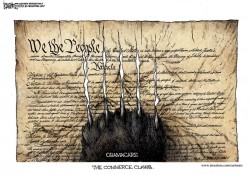
 I just read this piece by Myron Magnet at National Review – a short history of why self-government was so important to our Founders. What struck me after reading is how fragile our Liberty is even with the SO high of an expense with which it has been bought through the centuries. Yes, we consider it our birthright – but even with payments already, it demands even more. These are the most salient ‘graphs from the post (emphasis mine):
The Founders believed that the purpose of government was to protect life, liberty, and property from what they called the depravity of human nature— from man’s innate capacity to do the kinds of violence that slave-owners, to take just one example, did every day. But government, they recognized, is a double-edged sword. You arm officials with the power to protect you; but those officials have the same fallen human nature as everyone else, so who is to say that they won’t use that power to oppress you, as European governments had oppressed the colonists’ forebears? From Pharaoh to Nero to the Stuart kings, history teems with examples of such despotic governments. Even the democratic republic the Founders created had to be run by imperfect men, and thus even it could turn into what Richard Henry Lee called an elective despotism. So the second great Founding idea is this: The mere fact that you elect representatives to govern you is no sure-fire guarantee of liberty. Or, as Madison saw it in Federalist No. 10: Taxation with representation can be tyranny.
Even if it is done with the “best of intentions” – elective despotism is still tyranny if it oversteps it bounds in “helping people” by taking away others’ freedoms.
This danger worried the Founders constantly,
and they struggled to protect their new government from it. Their first experiment was to make that government too weak to oppress them. But it was also, they found, too weak to do its chief job of protecting them against violence. The Revolutionary War proved longer and harder than it need have been, since the central government lacked authority to tax in order to pay soldiers or buy arms. But when the Founders set out to write a new Constitution to give the federal government powers sufficient to its purpose, they did so with their hearts in their mouths. They strictly limited those powers to what they deemed absolutely essential, and they carefully spelled out what those powers were. They divided and subdivided power, and made each branch of government a check on the others, to guard against overreaching. They required frequent elections, gave the president a veto, and in turn made him and other officials subject to impeachment.
Madison, the Constitution’s chief designer, constructed his exquisitely balanced mechanism to work by the power of ambition countering ambition, and interest countering interest. A realist about human nature, like most of the Founders, he devised a government for ordinary men as they really were, not for prodigies of virtue. Even so, he conceded, there had to be at least a smidgen of virtue somewhere. If “there is not sufficient virtue among men for self-government,” he wrote, then only “the chains of despotism can restrain them from destroying and devouring each other.”
And many of us now wonder – where is that virtue? Where has that spark gone that says “this far but no further” in doing things for “the common good” such that government would not violate the original intent? Or did it flicker out decades ago even as we talk about freedom? Are we simply fooling ourselves, yakking at the surface level while the rot continues at our foundations?
Washington was even more explicit about this, the third of the great Founding ideas: A democratic republic requires a special kind of culture, one that nurtures self-reliance and a love of liberty. Constitutions are all very well, the Founders often observed, but they are only “parchment barriers,” easily breached if demagogues subvert the “spirit and letter” of the document. They can do this dramatically, in one revolutionary putsch, or they can inflict a death by a thousand cuts, gradually persuading citizens that the Constitution doesn’t mean what it says but should be interpreted to mean something different, or even something opposite.
We see this happening now under the guises of “welfare”, safety and security” and “the common good”. We see the Left attacking those that wrote the Constitution as old rich white slave owners – thereby impugning by association anything of their work. Including their greatest achievement. It used to be bit by bit – now it is a raging river trying to sweep it away.
The ultimate safeguard against such usurpation is the vitality of America’s culture of liberty. In his first State of the Union speech, Washington stressed this point, emphasizing a view universal among the Founders. The “security of a free Constitution,” he said, depends on “teaching the people themselves to know and to value their own rights; to discern and provide against invasions of them; to distinguish between oppression and the necessary exercise of lawful authority; . . . to discriminate the spirit of liberty from that of licentiousness,” and to unite “a speedy, but temperate vigilance against encroachments, with an inviolable respect for the laws.” If citizens start to take liberty for granted, if their culture — molded by journalists and writers, preachers and teachers — starts to hold other values in higher esteem, then the spirit that gives life to the Constitution will flicker out. Americans, Washington wrote on another occasion, should guard against “listlessness for the preservation of natural and unalienable rights,” for “no mound of parchm[en]t can be so formed as to stand against the sweeping torrent of boundless ambition on the one side, aided by the sapping current of corrupted morals on the other.”
As I type this post, I and TMEW are watching “American Sniper”; the story of Chris Kyle. A man that our Founders would have welcomed to themselves. No, not for his skill but for his love of country and love of freedom and his willingness to put himself; all that he had, he was willing to risk. All.
For the concept of Liberty. Are we that culture of virtue, of liberty? Parents, do you ask your children what they learned today? What virtues are being inculcated into them by our education system, by our culture?
I would suggest that you all go read the entire post – revisit our history AND the philosophy behind it that it not often taught or gets short shrift these days.
