

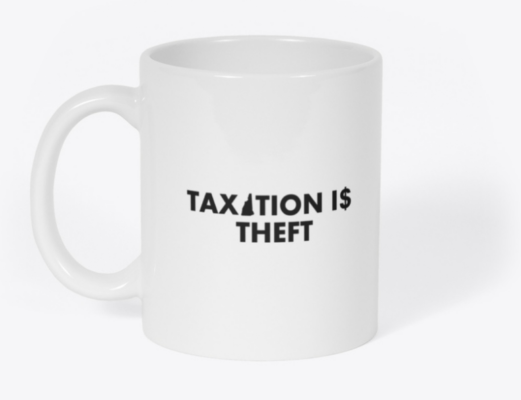
Whenever I hear that someone needs to pay his “fair share” in taxes, it always means “more.” Nobody ever says, “You are actually paying more than your fair share–you deserve a tax break!” Similarly, nobody I know ever pays more than the amount demanded by the town government. How can this be?
Are those people’s “fair share” exactly the right amount every year?
Really, compulsory taxes are never fair, just, or neutral [1]. Some people are net beneficiaries, and others are net payers. The only fair thing to do, short of making taxation completely voluntary, is to reduce town budgets and reduce the dollar amount of an individual’s net tax burden.
Town budgets, however, never seem to go down. Ask your local selectmen if there is any property tax, either a rate or an absolute dollar value that is objectively inappropriately high for town government tax collectors to demand. In most cases, you’ll get radio silence or a string of words about fairness without any direct answer.
The reason is that there is no limit to the town budget, so there can be no limit to tax collection. The best they can do is to spread around the increasing tax burden, either across the residents or during multiple years, via debt financing.
In the interest of fairness, I have a modest proposal: a new property tax credit. Households with no children in the local school system, which consumes the lion’s share of our tax money, receive a tax credit of $500 for the year. (Those people who disagree are free to cut a check to their town whenever they wish.) This is a small way for the beneficiaries of the tax money to acknowledge that some households are already paying far more than their fair share.
[1] M.N. Rothbard. Man, Economy, and State, with Power and Market, 2nd ed. (LvM Institute 2009) pp.1149-1252.
