For Immediate Release
January 22, 2019
Contact: 603-722-0501
House Testimony on Constitutional Amendment Regarding Protection of Information from Warrantless Searches.
CONCORD – House Republican Josh Yokela (R-Fremont) issued the following statement before the House Judiciary Committee hears testimony on CACR15, a constitutional amendment to protect information from warrantless searches:
“A foundational principle of limited government is that law enforcement must produce a warrant, based on probable cause and particularized suspicion, before accessing your private information. And yet the law of the United States, for the last few decades, has said that the government can get any information about you that it wants, without a warrant, so long as you have shared that information with a so-called ‘third party.’ That means innocent citizens lose the protection of the warrant requirement, simply because they’ve shared information for a limited purpose, such as obtaining goods and services that enhance their lives.
“While we don’t have the power to solve this problem at a national level, we do have the power to ensure that the private information of New Hampshire citizens is, once again, protected from the government’s prying eyes. The amendment I’ve introduced legalizes privacy–it allows contracts limiting the use of your information to be fully enforceable again, thereby reinstating the protections our nation’s Founders enshrined in the Constitution.”
******************
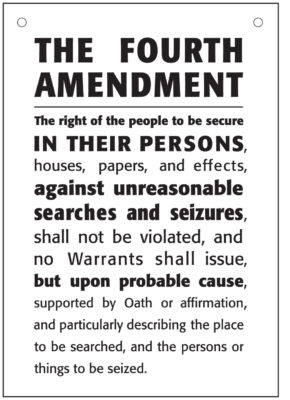
Why do we need another constitutional amendment to protect ourselves from warrantless searches? The government has redefined language to give itself power it wants but is limited by the constitution. The government has declared information you share with businesses many times a day is no longer your private possessions and therefore protections in the constitution to protect your private possessions and information from warrantless searches are no longer applicable unless the government says it does. This principle is called the Third Party Doctrine and it has been eroding your 4th Amendment rights at the Federal level for years and our New Hampshire Supreme Court has given deference to that interpretation when applying our Part First Article 19 of the New Hampshire Constitution.
Part 1 Article 19 states:
“Every subject hath a right to be secure from all unreasonable searches and seizures of his person, his houses, his papers, and all his possessions.“
Possessions are defined as an item of property but can be also defined as the state of having, owning, or controlling something. In the digital age, things from diaries and love notes to family photos are kept remotely so they can never be lost. When we contract with a company to keep that information confidential we are asserting our right of ownership on that data. We retain control of this digital property by contracts with companies. The companies that try to protect your data the most like Epic Privacy Browser and Telegram Messenger try to know as little as they can so there is little to no data to be had by court order or lost to data breaches. Companies that don’t want to know anything about you to protect you have some feature limitations which might be offered by some companies if their contract to keep the information private would be honored by the government.
Article 2-b reads:
An individual’s right to live free from governmental intrusion in private or personal information is natural, essential, and inherent.
However, that right is usually understood in the law as being subject to “reasonable” limitations, as determined by judges. And, since the 1970s, judges in our country have decided that it isn’t “reasonable” for you to expect the information you share with another. When the government redefines so much of our information as not being personal or private because we shared that information with someone else, even if that information was only to be used for a limited purpose and we still retain the control of what can legally be done with that information, it does not protect all we intended to protect.
There is proposed legislation, HB1236, which seeks to list what the government will deem private information. This is just a list of protections the government is willing to grant you until 51% of legislators decide to pass another law and strip those protections away. When the government creates lists of protected things instead of a principle of protecting all of your property and information which you have not relinquished all control over its use, we are letting the government grant us the privacy they are willing to give us instead of demanding they respecting the legal contracts we create to keep our information private.
We must not let the government decide when to respect our right to be secure from warrantless searches. The best way to do that is to enshrine in our constitution the respect for a legal contract to keep the information confidential which our government has tried to undermine.
Representative Josh Yokela
Rockingham 33 (Fremont, Danville, and Brentwood)