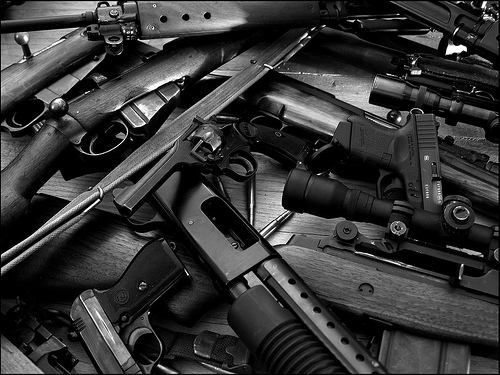
When the One Big Beautiful Bill nullified a handful of transfer taxes under the 1934 National Firearms Act, it set something wonderful in motion. A lawsuit challenging the registration requirement for “suppressors, short-barreled rifles, and short-barreled shotguns.”
Absent the taxes, there is no statutory or regulatory vehicle for the registration process.
“In 2025, Congress eliminated the NFA’s [National Firearms Act] transfer and making taxes for four categories of firearms: short-barreled shotguns, short-barreled rifles, silencers, and a final, defined group of miscellaneous firearms,” wrote [ U.S. District Judge James ] Hendrix.
“Because today’s NFA does not generate any revenue from untaxed firearms, its regulatory provisions cannot be upheld under the taxing power,” Hendrix added. “And there is no sign in the NFA’s text, structure, or statutory history that Congress invoked any other power in crafting the NFA provisions at issue. Thus, the regulatory provisions must be enjoined as unconstitutional because they exceed Congress’s enumerated powers.”
You don’t need permission, nor is registration for these firearms required. At least as far as one U.S. District Court judge from Texas can reach, and that’s a good question.
The court determined that Congress enacted the National Firearms Act in 1934 under its taxing power, and that its requirements were constitutionally permissible only because they aided the collection of National Firearms Act taxes.
No taxes, no regulation.
And while the Feds defended the rules- yes, Trump’s DOJ fought the lawsuit to end the registration process-a Trump-appointed judge tossed them out anyway. So, while we applaud the decision of one district court judge, on a result of which we approve, could we, in all seriousness, applaud a one-judge nationwide repeal of the requirement?
The other good news for guns, at least in America, is that there is plenty of research on the ineffectiveness of anti-gun laws in other countries.
Research into the “criminal misuse of guns in Canada” found, “There is no convincing empirical research supporting the proposition that restricting general civilian access to firearms acts to reduce homicide rates.” And, put concisely, “triggers have not been found to pull fingers. The general availability of firearms does not stimulate criminal violence.”
As I reported in Canadians aren’t that nice, “Canada has more than one-third the population of the US and nearly 300% more violent crime (absent the rape and sexual assault data, so who knows if it’s more than that).”
When looking at firearms, you need to consider all crimes because the crimes deterred matter. “Australia, for instance, has vastly higher rates of assaults, robbery, rape, and break-ins than the United States.“
A review of international evidence surrounding firearm bans and murder and suicide reductions found that “Norway has far and away Western Europe’s highest household gun ownership (32%), but also its lowest murder rate.” Meanwhile, Holland has the lowest gun ownership in Western Europe (1.9%), and Sweden lies midway between (15.1). Yet the Dutch murder rate is half again higher than the Norwegian, and the Swedish rate is even higher yet, though only slightly.”
[R]esearch found that “the NFA [National Firearms Agreement] only temporarily reduced the total number of guns in civilian hands; within 20 years imports of new guns cancelled out the subtractions from the gun stock produced by buybacks and gun destruction programs.”
Additionally, separate research conducted a few years after NFA’s passage found, “In the four years after NFA, robberies rose by 51 percent, unarmed robberies by 37 percent, assaults by 24 percent, and kidnappings by 43 percent. And although murders did decline by 3 percent, manslaughter rose by 16 percent.”
Our gun-loving lefties (government’s hands, not ours) never stop looking for ways to disarm civilians so they can have their way with them. But the usual international suspects in their narrative war fail repeatedly to deliver on the promises of increased public safety, while places with more guns, Norway and New Hampshire, actually deliver on the promise.
More guns in civilian hands means fewer crimes, more public safety, and the actual purpose of the Second Amendment, a government that can’t guarantee itself a force majority.