


State Auditor Doug Hoffer’s latest newsletter called out a remarkable statistic about Vermont’s homeless crisis. In less than a decade, we have spent over $800 million to “fix” homelessness. Nearly $100 million on the motel voucher program in 2023 alone. But that’s not the really remarkable part. The truly remarkable part is that, despite the influx of cash, the number of homeless people in Vermont has roughly tripled from between 1,000 and 1,300 in the years leading up to COVID to around 3,400 today. So much for fixing the problem!
I call this remarkable, but it’s not really. If you subsidize something – anything – you get more of it, be it electric vehicles, solar panels, or homeless people. And we’ve been subsiding the bejesus out of the homeless lifestyle. Ergo, we have more of it.
Hoffer comes off as shocked, “that important policy decisions would be made without sufficient data or analysis.” He shouldn’t be as a guy who’s spent years in Montpelier. It’s modus operandi. The important thing for the politicians is that they pass something that gives the appearance that they’re doing something, and the more expensive it is, the greater that illusion. For the bureaucrats brought in to run the programs ostensibly designed to help the situation, their priority is to spend as much money as possible and expand their programs. They don’t want the homeless, in this case, to go away because then there’d be no justification for their job. The more homeless, the better!
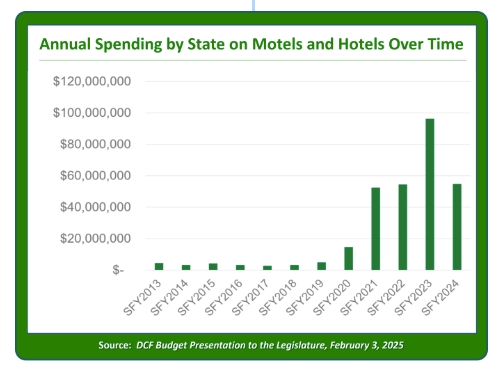
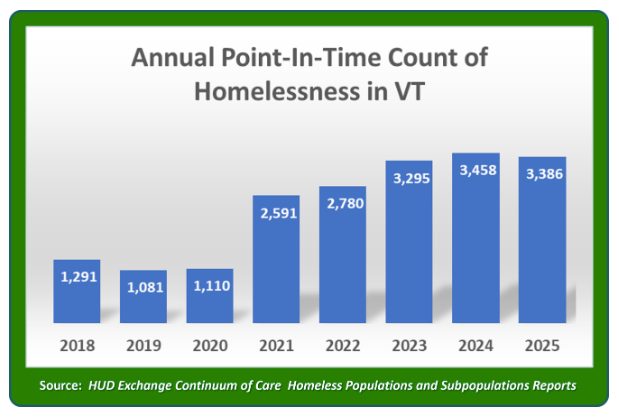
Collecting “data” and doing “analysis” that could expose the fact that taxpayer money is being spent inefficiently, wasted, or, in the case of Vermont’s homeless crisis, making matters exponentially worse is, shall we say, not de rigueur.
So, no, in-depth analysis and data-driven decisions are really not a thing. And it’s not just with homeless policy.
Where’s the data showing what the impact of our Global Warming Solutions Act will have on future climate trends and weather patterns in Vermont? And where’s the analysis of what it will cost to achieve those outcomes? To sum up the attitude, I’ll quote the movie Spinal Tap as the band recounts the death of one of their drummers, “The authorities said, best leave it unsolved.”
We’ve been spending hundreds of millions of dollars on publicly funded, government-run Pre-K programs that proponents promised would increase student outcomes, increase graduation rates, lower crime, reduce teen pregnancy, just to recount the highlights. Back when we expanded taxpayer funded pre-k to be a mandatory program, the Blue Ribbon Commission for Affordable Child Care promised, “Every dollar spent on high-quality early care and learning programs yields a return on investment that ranges from $4 – $9.” Does the data indicate this is what’s happening?
As we get ready to expand pre-k again by more than a hundred million dollars a year, maybe before we do someone should, you know, do the analysis to see if, in fact, those promises are being met, or, as with the homeless crisis, we’re spending a colossal amount of money to make a situation worse.
One state, Tennessee, actually does this for their pre-k program and the results are not good.
Data through sixth grade from state education records showed that the children randomly assigned to attend pre-K had lower state achievement test scores in third through sixth grades than control children, with the strongest negative effects in sixth grade. A negative effect was also found for disciplinary infractions, attendance, and receipt of special education services, with null effects on retention.
Studies of programs in other states show better results. Maybe Vermont should gather the data and analyze our own program to see if it’s delivering on all those promises outlined above – or, like Tennessee, not. Because casual observation would cause me to put money on “or not.” And, I don’t know about you, but I’d rather not pay higher property taxes with a payroll tax cherry on top to fund a program that’s harming – not helping – our most vulnerable students. Call me crazy.
Speaking of education, where’s the data from ten years of Act 46 that indicates school district consolidation saves money and improves student outcomes? And where’s the data that shows defunding police forces and replacing them with social workers while refusing to prosecute petty offenses reduces crime. Asking for a friend in Burlington.
Speaking of Burlington, the legislature voted to open a “safe injection site” to save lives in the Queen City because… data? I asked Grok what the data says about the model sites in New York City, and in 2020 the overdose deaths per 100,000 were 51 in the East Harlem neighborhood and 30.5 in Washington Heights. After the centers went into operation in 2021, deaths rose to 66.3 and 39.4 respectively, then to 88.9 and 43.3 in 2022, and 85.1 and 44.0 in 2023. Doesn’t sound so safe to me, but, hey, let’s get one anyway!
Vermont has a budget of over $9 billion. If we really did the data analysis on how we spend this money and eliminated all of the programs that are ineffective – or worse, detrimental – to the outcomes they promise, we could save a bundle and be all the happier and healthier for it.
