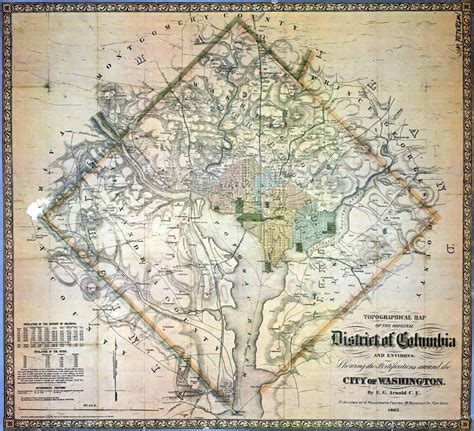
Before we even begin to answer this question, let’s look at the history behind the District of Columbia.
The US Constitution, Article 1, Section 8, provides Congress the power to “… exercise exclusive Legislation in all Cases whatsoever, over such District (not exceeding ten Miles square) as may, by Cession of particular States, and the acceptance of Congress, become the Seat of the Government of the United States…”
This clause says that Congress makes all decisions regarding laws and regulations in Washington DC. It also means that Congress must provide operating budgets and pay for the other expenses to operate the federal facilities in the District. It does not indicate where any of those federal facilities exist, but does indicate – due to legislative authority – that they should be under the control of Congress and not the state(s) from which the lands were taken. Modifying that authority would require a Constitution Amendment, not just a simple act of Congress.
The Residence Act of 1790 designated lands from Virginia and Maryland to be part of the District. A 10 mile square area became the seat of the Federal government. The portions of Virginia that were taken for the District were returned in 1846, and The District of Columbia Organic Act of 1871 merged the remaining multiple governments in those lands into a single government. Today, a single central District government runs the entire district, making the mayor of Washington DC one of the most powerful mayors in the Unites States, and the virtual equivalent of a state governor.
To make the district into a state, Congress would have to separate the part of the District of Columbia containing Federal buildings – the “Seat of Government” – from the rest of the area taken from the state from which the “cession” was made (Maryland). Any federal properties or facilities would have to be relocated into the much smaller “Seat of Government” to permit them to operate under Congressionally-determined “Legislation” without interference from the new State.
Can this be done? Probably, yes.
But then we come down to the real problems. How will this new state generate its budget? Who will determine the new state’s laws? How will they be enforced? How will the new state pay its bills?
Local taxes in the District are used to pay for some city services. However, the entire district is supported primarily from revenues provided by the Federal government. This has been an item of contention, as Congress provides barely enough for the District to maintain essential services. But the fallback is that Congress can allocate more money to the District when needed: it (Congress) does not abide by funding limitations when it wants to spend money on something. The Federally-provided part of the District budget would instantly disappear if the District becomes a State, leaving the residents of this new State to support everything themselves.
The District already surrounds one of the poorest districts in the US, mostly because people moved there to (hopefully) take advantage of federal government largesse. Those who moved there did so after the District was formed by Congress, not beforehand. That’s why the area has been called “the swamp”: the area was and remains mostly swampland surrounding the Potomac river. The new State would instantly become responsible for all of the non-Federal payments made to the poorest residents, those who survive solely on that “largesse”. It is doubtful that the current residents of the District could raise the revenues required to do this as a State.
On “Day One”, this new State would have to operate its own schools, police and fire department, collect and process trash, and run the district without aid or assistance from the Federal government. District residents already pay for part of this and already handle much of the management on their own. But, as a State, they would now be responsible for all of it. No fallback would exist. And they would be starting a new State from scratch: the startup costs could mount into the hundreds of millions or possibly billions.
So, there seem to be two almost-insurmountable problems that need to be resolved before the District can become a state.
One, how to divide the land to ensure that the Federal properties remain under Federal control and are protected by Federal troops and are only subject to Federal laws and regulations, as demanded by the Constitution?
Two, the establishment of an entirely new government for an entirely new State consisting of a State Constitution, election of state representatives, the generation of laws and statutes specific to that new State, the establishment of law enforcement authorities and courts of justice, and the establishment of new borders separating the new state from the Federal “Seat of Government”.
Democrats, in their rush to establish more control over the United States Senate and House of Representatives, have obviously not thought any of this through. I wouldn’t be surprised to see the House pass a resolution allowing DC’s statehood, but I can only hope that enough Senators will give this proposal the thought needed before making a change that will affect the future of the United States.
In this situation, I thank the Founders for allowing the Senate the power of the filibuster.