

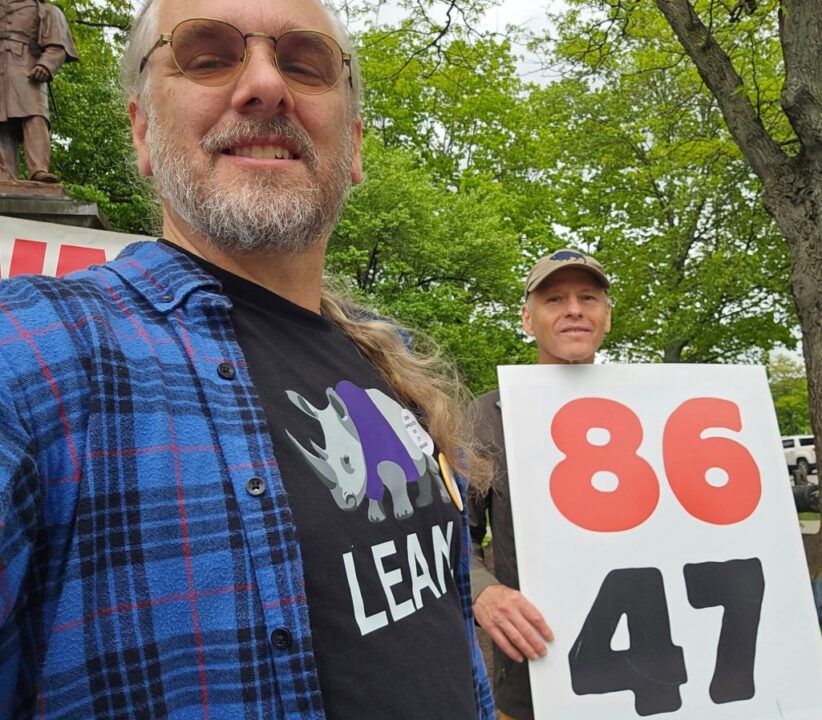
The phrase “86 Bobby Williams” has emerged in recent public discourse—not as a threat, but as a civic statement demanding that Councilor Bobby Williams be removed from office following his inflammatory comments about a political assassination. The phrase echoes a protest sign reading “86 47”, seen in a photo where Williams appears smiling in a selfie next to the protester holding the sign. While there is no evidence found that he created or explained the sign, he clearly embraced the imagery—capturing himself in a moment tied to a message of political removal.
Today, that message has turned inward. Residents of Keene are now asking: How can a man who publicly mocks assassination, ridicules grieving families, and poses proudly with provocative political language still be fit for public office?
The Words That Sparked a Movement
After the politically motivated assassination of conservative commentator Charlie Kirk, Councilor Williams responded on Facebook with ridicule rather than restraint.
He referred to Kirk as a “dirtbag” and a “piece of [expletive],” adding that he “promoted gun violence and died by gun violence.”
When a commenter urged him to consider the grief of Kirk’s wife and children, Williams replied coldly:
“His wife made her choice. His kids need to know.”
In a separate post, he escalated further, calling Kirk a:
“hate-selling fascist grifter nazi. Good riddance.”
These were not vague or impulsive statements. They were targeted, public, and deliberate—mocking a man who had just been murdered and dehumanizing his surviving family.
Weaponized Ambiguity: The Problem with “86”
The term “86” has long been slang for “get rid of.” In food service, it means something’s off the menu. But in political rhetoric—especially when tied to a specific person—it becomes dangerously ambiguous. It can mean removal from office—or something far worse.
This is exactly what makes it so insidious: it’s a rhetorical trap. If you object, you’re told you’re overreacting. If you stay silent, you’re complicit. It allows those using it to gaslight dissenters while signaling approval to sympathizers. The ambiguity becomes a feature, not a flaw.
Bobby Williams didn’t just appear near a sign reading “86 47.” He took a selfie next to it, smiling, visibly endorsing the sentiment. Whether the sign was meant to imply removal or something more disturbing, he embraced the imagery of political elimination.
Later, when commenting on the assassination of Charlie Kirk, he continued that same thread—mocking, vilifying, and using a man’s death as fuel for his own narrative. And yet, when challenged, he sought cover in claims of “free speech” and victimhood.
From Ridicule to Martyrdom
After deleting his original posts, Williams claimed they had been removed because of transphobic comments in the thread—a claim widely disputed by residents who read and archived the comments before deletion. Most were critical but respectful.
He then publicly pivoted, portraying himself as a victim of a broader conspiracy to silence dissent. He claimed that criticism of Charlie Kirk was now being used to justify deportations and suppress free speech. He warned the public:
“If they come for me in the morning, they’ll come for you in the night.”
In essence, Williams used the assassination of a political figure—one he had just mocked—as a springboard to paint himself as a political martyr.
It was calculated. And it was deeply cynical.
The Council’s Vote—and Its Deafening Silence
On September 18, 2025, the Keene City Council voted 11–4 against pursuing any disciplinary action against Councilor Williams. Public comment was not allowed before the vote.
Only Councilor Jacob Favolise directly condemned Williams’ remarks. While Kate Bosley, Thomas Powers, and Michael Remy also voted in favor of action, they did not issue public statements.
The 11 councilors who voted against discipline have remained silent—none of them condemned the comments. Worse, Councilors Catherine Workman, Edward Haas, and Kris Roberts defended Williams’ “right to free speech,” but refused to say whether they agreed or disagreed with what he said.
That silence speaks volumes. Because when an elected body refuses to reject language that dehumanizes political opponents and mocks a man’s death, that silence becomes complicity.
A Dangerous Precedent
Let’s be honest: If Bobby Williams—or any councilor defending his speech—were targeted and assassinated for their political views, would it be acceptable for a public official to say:
“Their spouse made their choice. Their children need to know”?
Of course not.
And if that would be unacceptable in that case, it was unacceptable here.
This is not about partisanship.
It’s about basic decency. It’s about whether we’re willing to draw a moral line and say:
You do not get to celebrate political violence and keep your public office.
History Has Warned Us Before
Words have power. And when those in office use them recklessly—or refuse to challenge those who do—the damage doesn’t stop with controversy. It escalates. We’ve seen it before.
- Germany, early 1930s: A fragile democracy eroded as political hate speech became normalized. Opponents were dehumanized; leaders who knew better stayed silent. That silence helped enable catastrophe.
- Rwanda, early 1990s: Years of hate radio and dehumanizing propaganda against Tutsis (“cockroaches”) set the stage for a 100‑day genocide that killed over 800,000 people. Local officials and media voices seeded the hatred in public view while others looked away.
- Myanmar, 2017: Anti‑Rohingya hate speech spread rapidly on social media, fueling mass violence and the displacement of hundreds of thousands. Vague insinuations and dehumanizing labels online translated into persecution offline.
No one is equating Keene with these tragedies.
But the lesson is unmistakable:
Democracy and civil peace don’t collapse overnight—they erode when leaders shrug off the consequences of dangerous speech.
Leadership isn’t about protecting seats.
It’s about protecting people.
What Happens Now
More than 1,100 residents and community members signed a petition asking the Keene City Council to hold Bobby Williams accountable.
The Council refused.
Now, at a minimum, each councilor who voted against the action must answer one simple question:
Do you publicly disavow the rhetoric Bobby Williams used following Charlie Kirk’s assassination?
Not his ideology.
Not his right to speak.
His words.
If a public official cannot reject dehumanizing language that mocks death and family trauma, then they have no place in leadership.
Keene Deserves Better
The people of Keene are not asking for censorship.
They are asking for standards.
They are asking for a city government that believes words matter—that dignity, restraint, and respect are not optional in public office.
Councilor Bobby Williams may still hold his seat.
But the people have spoken:86 Bobby Williams.
Not with hate. Not with violence.
With accountability.
Authors’ opinions are their own and may not represent those of Grok Media, LLC, GraniteGrok.com, its sponsors, readers, authors, or advertisers.
Got Something to Say, We Want to Hear It. Comment or submit Op-Eds to steve@granitegrok.com
