


Turnpike tolls and state park fees have stayed flat for years as inflation has eaten away at their value. To fight the effects of inflation, legislators voted this year to increase tolls and park fees for non-residents. Gov. Kelly Ayotte vetoed both bills, but in August legislators overrode those vetoes.
Now that they’re law, here’s a look at what these new fees look like.
Toll increases
Starting Jan. 1, 2027, tolls for anyone who doesn’t use a New Hampshire-issued E-ZPASS transponder will double.
Though intended to raise revenue from non-resident motorists, Granite Staters who pay tolls in cash would experience the same toll increases.
Motorists with a New Hampshire E-ZPass account already pay 30% lower toll rates than non-residents and cash payers.
These savings amount to 15 cents at the Hooksett ramp (35 cents vs 50 cents), 22 cents in Dover, Rochester and the Hampton side plaza (53 cents vs. 75 cents), 30 cents in Bedford and at the Hooksett main plaza (70 cents vs. $1), and 60 cents at the Hampton main plaza ($1.40 vs. $2).
House Bill 2026 effectively increases the NH E-ZPass discount from 30% to roughly 66%.
The incentive to get a NH E-ZPass transponder thus increases significantly.
And the bill creates a 210-day window, starting on Dec. 1, in which the Department of Transportation must issue at no cost a NH E-ZPass transponder to anyone who opens or currently maintains a funded NH E-ZPass account.
The Department of Transportation does not track cash payers by residency status, so no one knows just how many Granite Staters pay with cash vs. an E-ZPass transponder.
But the percentage of cash payers overall is low and has been shrinking for years.
Only 9.2% of all toll transactions in New Hampshire are cash transactions, according to the Turnpike System’s 2025 annual report.
The system collected $11.2 million in cash tolls in Fiscal Year 2025, representing just 8.6% of toll revenue collected.
The overall percentage of transactions processed with an E-ZPass transponder has increased over time, reaching 90.8% last year.
For passenger vehicles, anyone not using a New Hampshire-issued E-ZPass transponder will experience the following fee increases starting in 2007:
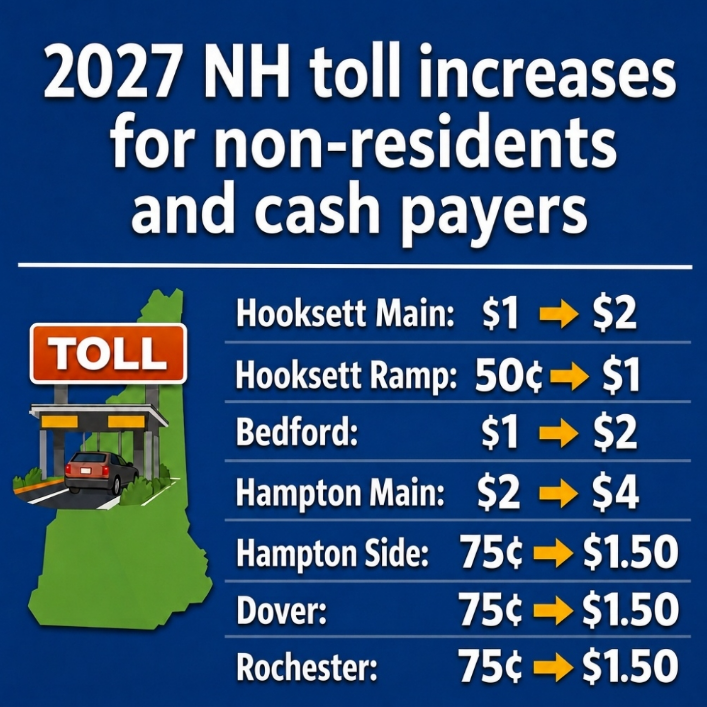
Legislators expect these increases to raise an additional $50 million a year in toll revenue.
State park fees
House Bill 1102 directs the Department of Natural and Cultural Resources to devise a state parks fee structure in which New Hampshire residents pay no more than 50% of the entry fees paid by non-residents.
For usage fees inside state parks, the bill dictates that residents be charged no more than 90% of whatever rate non-residents are charged.
Charging higher state park fees for non-residents is common in other states, but surprisingly not in New Hampshire, the only state in the nation in which the state parks are fully self-supported.
Maine charges non-residents significantly more than residents for state park camping and day use.
Connecticut years ago increased vehicle registration fees by $8 and dedicated the revenue to state parks. In exchange, residents park for free at all state parks while non-residents pay $10 on weekdays and $15 on weekends. Connecticut charges non-residents higher camping fees too.
Massachusetts charges huge markups for non-residents to access its state parks. Differences range from 300% ($5 vs $20) at Wells State Park in Sturbridge to 375% ($8 vs. $30) at Walden Pond.
Camping fees at Massachusetts state parks are more than 300% higher for non-residents than for residents.
HB 1102 does not dictate a specific fee schedule, as HB 2026 does for tolls. The commissioner is directed to set the new fees.
New Hampshire’s state park entry fees are relatively low by regional standards. With the exception of state historic sites, non-residents pay the same rates as residents.
The standard day-use fee is $4 at a regular New Hampshire state park and $5 at one of the five high-use state parks. Massachusetts residents, by contrast, pay between $5 and $8 to access their state parks.
The Massachusetts resident parking fee at state beaches is typically $15, the same as the parking fee for residents and non-residents at Hampton Beach and Wallis Sands State Parks in New Hampshire.
Because HB 1102 dictates only that Granite Staters must pay no more than half what non-residents pay to access New Hampshire state parks, and 90% of what they pay for in-park activities, there are many options for complying with the law.
Given the governor’s opposition to increasing state park fees, it’s unlikely that the department will simply double current fees for non-residents. A marginal fee increase for non-residents combined with a fee reduction for residents would be another option, provided it does not result in a revenue loss for the self-funded parks system.
Authors’ and Speakers’ opinions are their own and may not represent those of Grok Media, LLC, GraniteGrok.com, its sponsors, readers, authors, or advertisers.
Disagree, agree, Got Something to say? We Want to Hear It. Comment or submit Op-Eds to steve@granitegrok.com
