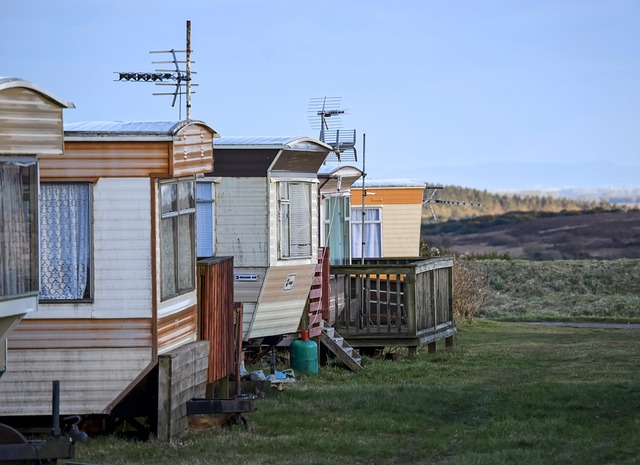
The term “mobile home” has a negative connotation. White trash Appalachian hillbilly crossed with white trash Oklahoma twister bait. I lived in one briefly and rented a room in another that was nicer than some homes I’ve been in. The latter is decidedly not mobile, while the former could have been moved. We owned the land that had the trailer home on it, the palacious one was renting the lot, which leads me to the headline with a brief aside.
Not long ago, I wrote about how investors discovered the profitability of veterinary services and had been buying up practices. Fewer local community vets and many more profit-driven, franchise-like operations. The result has been a significant rise in the cost of animal care. It’s becoming unaffordable, in part because of the pet insurance industry. It’s like the Medical Industrial Complex. We can charge more ‘cuz insurance, and they do. Prices go up across the board, and investors look for profits, and regular people get priced out of pet care.
The focus is not on making care more accessible and affordable, but on monopoly-like control of access to increase profit.
Trailer parks, more precisely, the land rented to the people who own the “manufactured” homes that sit on it, have become a hot investment prospect as well.
At least 27 mobile home parks in New England, representing more than 5,200 housing units, are owned by private equity-backed companies, according to a database compiled by the Private Equity Stakeholder Project and Manufactured Housing Action.
That footprint is drawing wider attention from lawmakers who are examining investors’ role in the housing affordability crisis across the market.
Private equity can outdo anyone, including any consortium of park residents, to buy the land even if a private owner wants to sell. They come in high and sweet, and it’s hard to turn them down. By law, at least in New Hampshire, the sellers have to be given the opportunity to buy, but it is an uphill battle against deep-pocketed experts. The result is park home owners getting their rents jacked up, making one of the more affordable housing options less so.
Mobile homes remain one of the last affordable paths to homeownership for many families, which is part of why scrutiny of park ownership carries such high stakes.
The median mobile home listing price is just $141,450, compared with $410,000 for a single-family home. The monthly housing cost differential is even more striking: The estimated monthly principal and interest on the median mobile home is just to $678, versus $1,918 for a nonmobile home.
Jacked-up rents lead to displaced owners coming out of a property situation that isn’t going to leave them with much in hand for a new place to live. Investors are also likely to jack up the rates to clear the lot so they can put something more profitable in its place. Condos, apartments, and so on. Nashua has some parks on the Nashua River that would be a great spot for a swanky retirement village, and investors will always want to optimize profit potential, and God ain’t making any more land, not that man doesn’t do it if there’s money in it. How much of Boston is filled in the harbor, I don’t recall, but it’s a good bit.
So, what about it?
One of the Democrat Party’s DC government ambassadors to New Hampshire, Maggie Hassan, has adopted this looming crisis as something worth her time and attention.
Hassan has launched a probe into some of the investment firms with the biggest stakes in New England mobile home parks, sending letters to six major players in the region. She’s asking them to turn over documentation showing how their business practices have affected park residents and how much profit those investments have generated.
If you are in this boat, her office would like a chat. What exactly Maggie “The Wood” Hassan has in mind is unclear, but this is apparently on Lizard Warren’s radar as well.
I’ve mixed feelings about it.
There is an issue, and plenty of these folks won’t have other options, but I don’t want government meddling around because they almost always make things worse. If, however, there is something nefarious and illegal going on, Hassan and Warren might actually uncover it, figure out how to turn it into a laundromat that turns tax dollars into Democrat campaign contributions, and that worries me, too.
Nearly 22 million Americans live in manufactured homes, and a large share of those are in mobile home communities. These parks have become one of the last remaining forms of naturally occurring affordable housing, or unsubsidized homes that are affordable because of low market rates.
In most of these communities, residents own their homes but rent the land underneath them. The individual lots, or “pads,” plus access to roads, water, sewer, and other shared infrastructure, are all controlled by a park owner. For decades, those owners were typically local mom-and-pop operators who kept lot rents relatively stable in exchange for steady, predictable cash flow.
I’m not certain what the answer is, but the government’s role should be limited to regulation or deregulation that allows or helps homeowners buy the land they rent without buying the whole park. Imperfect, patchwork, messy, but I’d need to think it through more to find better, which, I suspect, will happen in comments, and that is what they are for.