

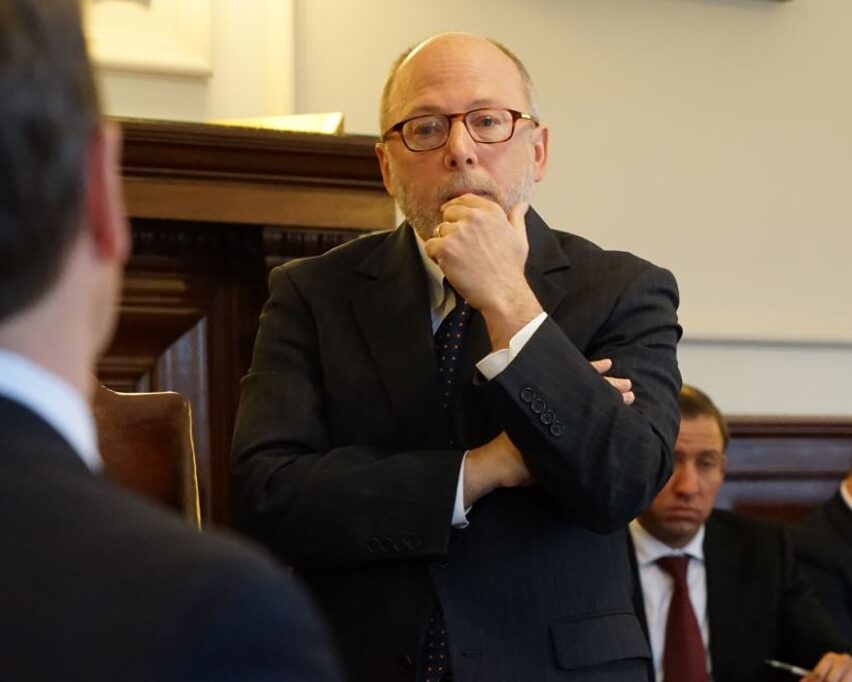
Andru Volinsky is asking people to think about what is fair in the context of raising money to pay for schools. Here’s the answer I gave him.
We can think about that by considering the following story.
One day, Pat and Chris came to do some shopping at Mr. Volinsky’s Grocery Store. Each of them bought the same items: a loaf of bread, two steaks, three apples, and a gallon of milk.
When they got to the checkout counter, Mr. Volinsky rang up Pat’s items, and said that his total came to $40. Pat paid, and went on his way.
When Mr. Volinsky rang up Chris’s items, Chris already had $40 out, ready to pay. But Mr. Volinsky said that his total came to $80, twice as much as Pat’s total.
“Why should I pay twice as much for exactly the same thing?” asked Chris.
“Because your house is worth twice as much as Pat’s house,” said Mr. Volinsky.
“But that makes no sense at all,” said Chris. “It’s not like my house is an ATM, from which I can just withdraw money.”
“That’s how you pay for schools, isn’t it?” said Mr. Volinsky.
I have yet to meet anyone who thinks this way of paying for things is fair. But it’s how property taxes work. It’s how income taxes work. In fact, if a tax can’t be assessed without knowing details about who you are and what you have – which is essential as soon as you start dealing with tax rates, as opposed to tax amounts – then it is by definition unfair, in that it forces different people to pay different amounts for the same thing.
So if fairness is the goal, taxes on property, income, and assets must be taken off the table from the start.
A straightforward extension of the grocery store situation is the per capita tax, or uniform tax, which works this way: Figure out the amount that needs to be raised, and divide it by the number of adult residents. That’s what each adult resident pays.
In the case of a school district like Croydon, this might look like this: “We need 2.1 million dollars, and there are 700 adult residents. So each adult resident must pay 3000 dollars.”
Right away, you can see why the authors of the Federalist Papers required all federal taxes to be uniform. (Note that this is almost the opposite of having uniform rates, although the courts, and many legislators, conflate those).
Apart from its obvious fairness, a uniform tax is self-limiting. You simply can’t use it to raise taxes so high that a typical person can’t pay them.
So if we’re going to use taxes at all, a per capita tax is both fair and sustainable, unlike taxes based on property, or income, or assets.
Charles Kettering once said that a problem well-posed is a problem half-solved. That is, if you ask a question in the right way, the question itself points you towards the answer you need.
Conversely, a problem wrongly-posed is a problem that will never be solved, because the question itself leads you away from the answer you need. (Always keep in mind that even the right answer to the wrong question is still a wrong answer.)
Volinsky insists on posing our current difficulties as a problem with revenue. But in fact, they are a problem with spending.
In the Claremont cases, the state supreme court said that an adequate education is one that
provides each educable child with an opportunity to acquire the knowledge and learning necessary to participate intelligently in the American political, economic, and social systems of free government.
There are two obvious points to be made here. The first is that any educable child who has a computer and an internet connection has the opportunity to learn anything he wants, with the assistance of hundreds or even thousands of people who are lined up to help him, often for free.
The second is that if some knowledge or learning is necessary, then it had better be mandatory. If it’s not important enough to be mandatory, then it clearly isn’t necessary, is it?
Note that at one stroke, this eliminates about 90 percent of what we currently teach in schools, and gives us a principled way to decide what belongs in, and what should be removed from, a tax-funded curriculum. If we’re not making every student, in every school, learn some specific information or skill, then that doesn’t belong in the curriculum. Which isn’t to say that it shouldn’t be learned by some students. That should simply happen somewhere else (like a community center), paid for without taxes (like through some combination of subscriptions and donations).
What would remain in that curriculum? Literacy – the ability to read and write. Numeracy – the ability to calculate, but also to understand the kinds of statistics that are used to rationalize public policy. Rhetoric – the ability to use language to persuade; but perhaps more importantly, the ability to avoid being wrongly persuaded through the use of the many rhetorical tricks and logical fallacies that people like Volinsky use to fool people into acting against, not just their own best interests, but the interests of everyone.
Anyone who is proficient in those things can become proficient in anything, in his own way, on his own schedule. As Joseph Campbell used to say to his students at Sarah Lawrence: “You have the rest of your life to do the reading.” Our job as a society is to make sure that every kid can do the reading.
Note that if we took the court’s words seriously, our school costs would be less than a tenth of what they are now, so our property taxes would be less than a tenth of what they are now, so Volinsky’s ‘revenue problem’ would simply evaporate, without the need to change anything at all about how we fund schools.
But even if that happens, we should still pay for schools with per capita taxes. Because every taxpayer should pay the same amount for the same thing – an educated citizenry – and every kid should get the same education, regardless of how that ends up getting paid for.
What could possibly be more fair than that?
