

Yesterday, we reported on irregularities with the Timberlane School District election (March 11, 2025), in Plaistow, where activists discovered issues with properly securing completed ballots (among other things).
From that same election, we not so proudly bring you the school Fuster Cluck in Danville, New Hampshire.
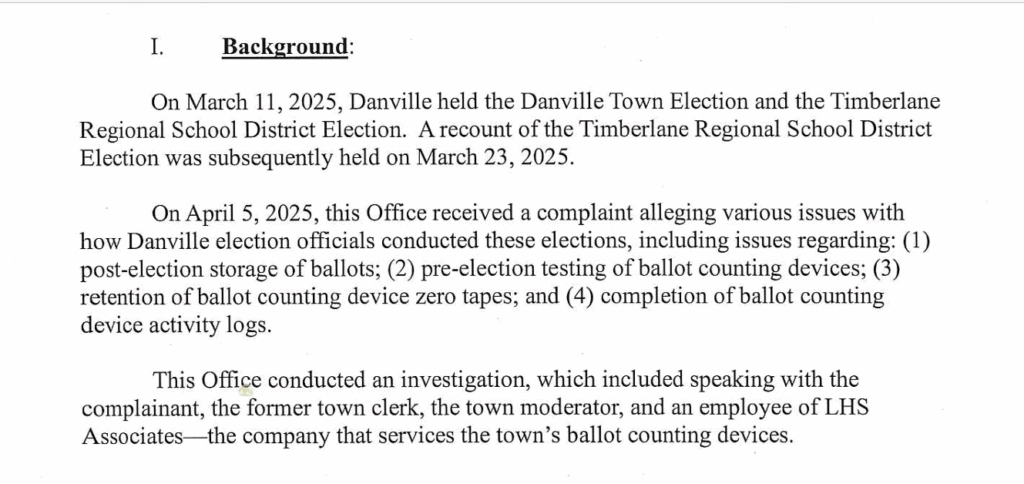
In summary, the locals responsible for ensuring election integrity and the chain of custody didn’t.
Danville officials did not retain all the zero tapes, which are run before elections to ensure the machines are at zero ballots cast. One tape they did have had a date of 10/30/24 on it instead of the current election day, which is the result of the moderator not resetting the internal device clock.
Danville uses two counting devices, both of which were designated as Machine ID 1. There were also issues with device seals and improper record-keeping, incorrect seal numbers, crossed off numbers, many of which could have been avoided if Danville had hand-counted ballots. Just sayin’.
Finally, or firstly, as this was the first of four complaints,
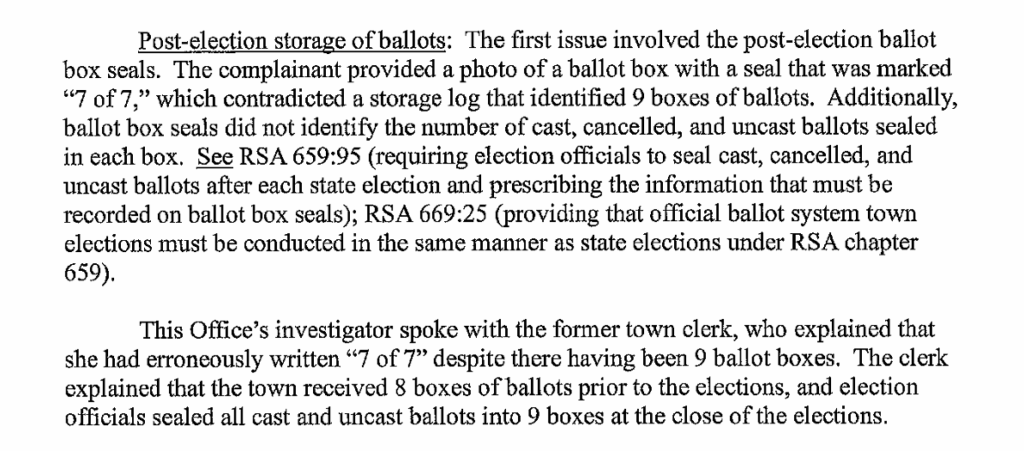
You can review the entire AG’s letter to the town of Danville here, but what was in it is about to lead us down a rabbit hole tied to the situation and the AG’s response in Plaistow, which we reported yesterday. If you recall, the AG’s office wrote that,
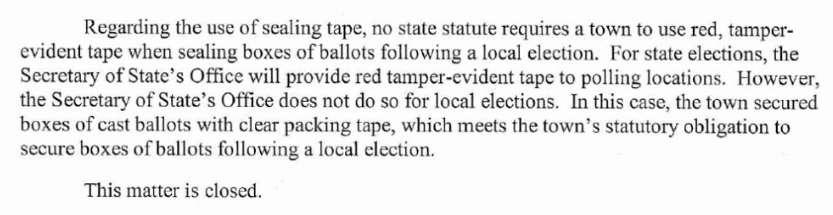
According to Sr. Asst. AG Brendon O’Donnell, towns don’t have to use red (tamper-evident) tape, and no state statute exists to require it. After looking at the cited statutes and related laws, I beg to differ.
First, this, from the Danville letter (red underline is mine).
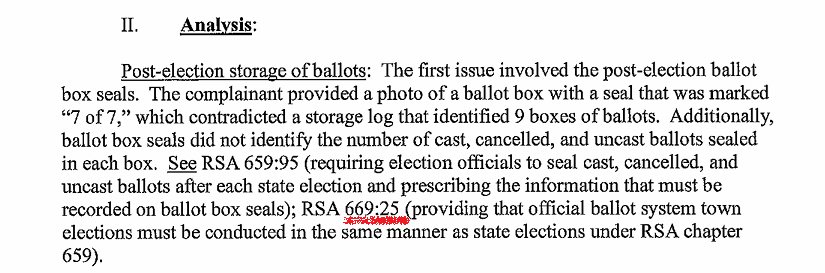
As written, the statute requires that town elections be conducted in the same manner as state elections. Here is RSA 669:25 (emphasis mine),
669:25 Conduct. – In towns which have adopted an official ballot system, the town election shall be conducted in the same manner as a state general election as provided in RSA 658 and 659, except that RSA 659:77, III-V and 659:78 shall not apply, and except that all duties required to be performed by the secretary of state under those chapters shall be performed by the town clerk, and except that no copy of marked or unmarked checklists need be forwarded to the state archives or federal district court as provided in RSA 659:102. Polling hours for a town meeting or election shall be set by the selectmen or by a vote of the town.
If the Town Clerks are required to conduct local elections “in the same manner as a state general election,” and “that all duties required to be performed by the secretary of state under those chapters shall be performed by the town clerk,” then shouldn’t any requirements or rules that apply or are requested/required by the Secretary of State (SoS) for general elections apply to town elections?
659:97 Secretary of State to Prepare Containers, Sealers. – The secretary of state shall, before any state election, prepare and distribute to each town and ward clerk containers to be used for preserving ballots and sealers to seal each such container. He shall prepare special containers and sealers to be used for preserving any special and separate ballots for questions to voters. The secretary of state shall prescribe the size and form of such containers and sealers and shall prescribe the form of any endorsement blank printed upon the sealers, provided that the blank is in substance consistent with the provisions of RSA 659:95.
The NH election manual is the tool that provides instructions for conducting an election run by the Secretary of State. He oversees all the towns in general elections (statewide or federal), which, by law (669:25), becomes the responsibility of the Clerks in run their respective local elections.
It therefore follows, at least in my head, that based on state law, if the SoS establishes rules for containers and “sealers” that aare to be followed, and those rules include contaners and tamper-evident (or resistant) tape for general elections per the election manual, this also applies to local elections and 669:25 compels clerks to use them (becasue local “election shall be conducted in the same manner as a state general election“).
This also makes sense if the goal is to ensure every election and therefore every voter enjoys the same voting process rights, privileges, and guarantees, which, according to the AG’s office, regardless of the type of election, are the town’s responsibility and problem if ballots are not secured.
Bud Fitch, who (if I remember correctly) worked for Kelly Ayotte when she was the NH Attorney General – deflecting any concerns about election integrity even back then – and who was part of her US Senate staff, responded as General Counsel and Assistant Secretary of State.
Other than the records being provided the Secretary of State’s Office does not possess “specification for tamper resistant tape supplied by your office . . .“ nor records detailing “testing” of the models of tape considered.
The security of sealed boxes of ballots from an election relies on the local election officials who box and seal the ballots, the seal that documents the contents of a box with the signatures of the election officials who boxed and sealed the contents, the packaging tape used to secure the box, the tamper evident tape, the chain of custody record on the seal when transferred from the selectmen/moderator to the clerk, and the clerks “Sealed Ballot Boxes – Chain of Custody & Storage Log.
All elections are to be conducted like general elections (669:25), and town clerks (towns) are responsible for the security of ballots, including packing tape, tamper-evident tape, and so on. This is from the same office that, in the Plaistow complaint, stated that tamper-evident tape is optional and not required by law.
Not to beat a dead horse but…
The Secretary of State is responsible for prescribing containers, sealers, and their proper use per statute. The election manual prepared by the SoS (for this purpose) defines them and their use (a role clerks assume for local elections). This includes provisions for storing, sealing, and marking containers with ballots, as defined per 669:25, referencing 659:97…and outlined in the election manual on page 98.
Securely seal each container. First seal up all sides of the box with filament tape.
Second, stick the official “Label for Resealing Ballots” on the box. Third, use the red security tape to make a tape seal around the entire box, and along the edge of the label. Then tape down the ends of the label with two short strips of the red tamper-evident tape.
This red security tape will change its appearance if it is pulled loose after being stuck to the box. This “tamper-evident” tape is intended to prove that the box of ballots has not been opened between being sealed on election night and being opened at a recount or a court hearing.
I’d like to thank Brendan for including that detail in his letter to Danville, which led me to explore what, in my opinion (and I’m not some fancy lawyer at the AG’s office), proves that state statute does require Clerks to treat local elections like state or general elections and they are responsible for doing so.
That leaves us with the matter of accountability.
- I’m sure the SoS and AG will disagree with my fisking, as will many a Town clerk or election monitors.
- According to the AG’s office, towns answer to citizens in all matters related to the proper chain of custody and storage of completed ballots.
- But citizen election complaints must go to the AG’s office.
- The AG has made it clear they don’t believe ballots in local elections need to be secured the same as general elections, and claim no statute exists to require it.
- I’ve shown (at least I think I have) that the statute does require it, but if the AG won’t see it that way, they won’t enforce it.
- If no one charged with oversight seems to think that securing ballots in town elections is required, citizens can sue towns or talk to the legislature.
- This puts the burden of enforcement on citizens, not the SoS or AG.
Elections are not secure, so stop saying it.
Evidence that they are not or may not be is dropped into the laps of citizens who are expected to assume the legal costs of lengthy court cases to force towns to follow the law.
The AG has made it clear they aren’t responsible and won’t represent towns in election lawsuits. That means the town’s legal counsel will have to explain why these laws, stacked and interlocked as I’ve suggested, don’t require towns to treat local elections like general elections. Or, that the role of the Secretary of State and the provisions from his office for securing ballots in general elections – despite what the statute suggests – don’t apply to town clerks in local elections.
Finally, regardless of your opinion on these arguments, the legislature needs to address this. Every election should be conducted the same way. Ballots and chain of custody need to be consistent to prevent mistakes or confusion. The law should make this clear with real consequences.
Many millions of dollars ride on the integrity and security of ballots and elections. If the SoS and AG aren’t responsible for enforcing laws and protecting citizens’ rights in these matters, the Legislature should revise the law to assign this responsibility to them in clear enough terms that assistant AGs in the office understand them.