

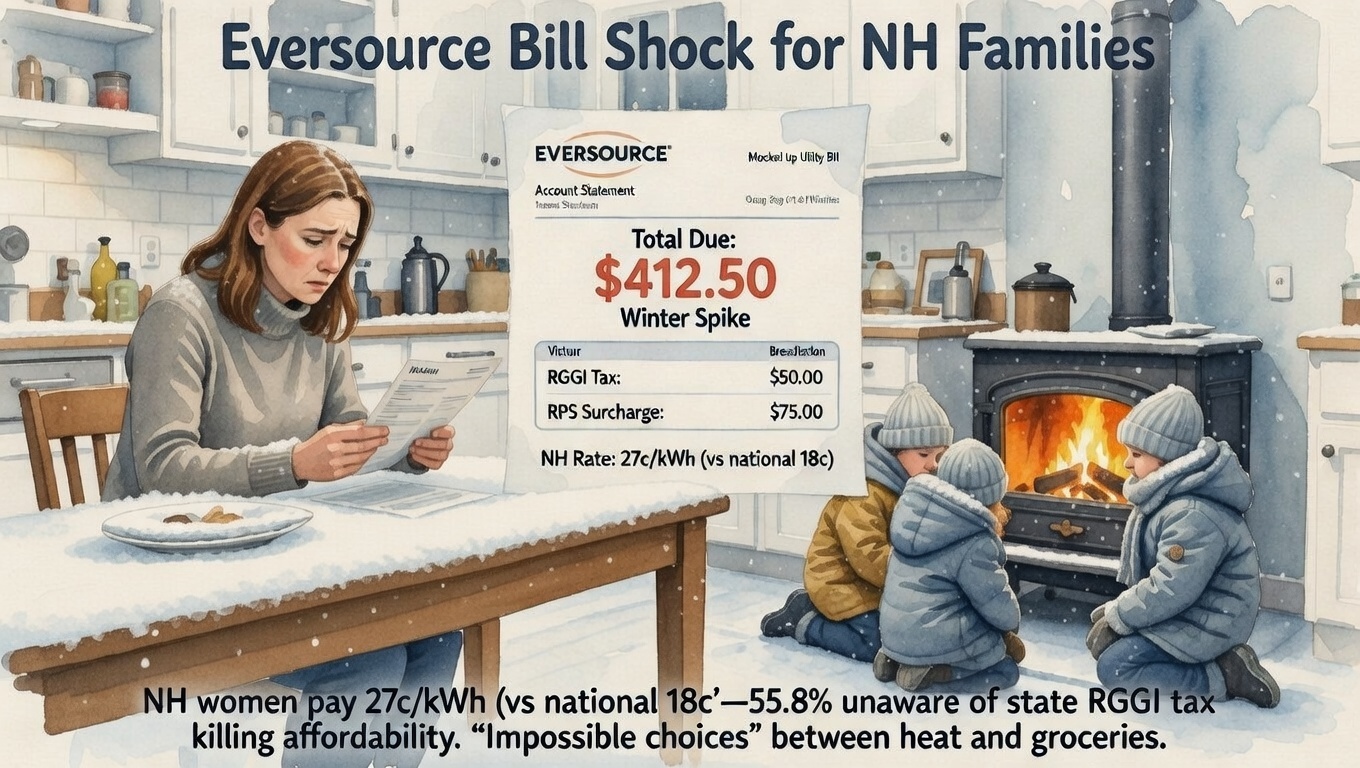
As a blizzard bears down from D.C. to Cape Cod, our fragile grid—crippled by state-level climate mandates—faces a test it may fail. New England Women are already rationing heat amid the nation’s highest bills.
A dangerous Nor’easter is about to slam our region from Washington, D.C. to Cape Cod, and New England women will once again find out the hard way what “green” energy policies really cost when the wind howls, the snow piles up, and the lights flicker. This is exactly the moment when energy policy stops being abstract and becomes brutally real: will the power stay on, and can you afford the bill that follows? What’s happening in New England is not an act of God, not “greedy utilities,” and certainly not the fault of President Trump. It is the direct result of deliberate state‑level choices—renewable mandates, net‑zero schemes, and blocked pipelines—pushed by New England politicians who cared more about climate virtue signaling than whether your kids were warm in February.
A Nor’easter Stresses an Already Fragile System
A powerful Nor’easter will roar up the East Coast from Sunday into Tuesday, dropping heavy snow and whipped‑up winds from D.C. to Cape Cod and into interior New England. That means exactly the kind of conditions—bitter cold, high wind, potential ice, and surging demand for heat—where our grid is stress‑tested and sometimes pushed to the brink. When everyone turns up their thermostats at once, when lines go down, and when solar panels are buried under snow, you find out quickly whether you have a resilient, diversified system or an ideological experiment.
New England does not have a weather problem; it has a policy problem. We will always face storms. The question is whether those storms collide with a robust grid supported by adequate natural gas, nuclear, and other reliable generation, or a fragile system deliberately made more expensive and more brittle by politicians chasing press releases about “100% renewable” and “net‑zero.”
The Most Expensive Electricity in the Mainland United States
All six New England states now sit near the top of the national rankings for residential electricity prices, with the region averaging roughly 28–29 cents per kilowatt‑hour versus under 18 cents nationally. In November 2025, federal data show New England’s average residential rate at 28.86 cents per kWh, compared with a U.S. average of 17.78 cents—roughly a 62 percent premium. Massachusetts clocked in at 31.22 cents, Rhode Island at 30.82, Maine at 27.85, New Hampshire at 27.37, and Connecticut at 27.02, putting every New England state in the top tier of most expensive power in the country.
By contrast, Midwestern and Southern states often pay 14–18 cents or less, with some below 13 cents—a fraction of what we pay for the same kilowatt‑hour. In other words, New England families pay a “blue‑state climate tax” every time they flip a switch or turn on an electric heater. These are not the prices of necessity; they are the prices of bad policy.
This Is Not D.C.’s Fault—It’s Concord, Boston, and the Rest of New England
Independent Women’s analysis is blunt: New England’s higher electricity prices are not the result of geography but of deliberate policy choices made by state governments. Under the Federal Power Act, states have exclusive authority over the electricity generated and sold within their borders. That means governors, legislatures, and regulators—not Washington, D.C.—own this crisis.
Because of that authority, New England states have piled on:
Renewable portfolio standards (RPS) that force utilities to buy more expensive, intermittent power.
Clean energy and 100‑percent renewable targets that sound virtuous but ignore reliability.
Aggressive efficiency and climate rules for homes and vehicles that quietly raise costs.
Participation in the Regional Greenhouse Gas Initiative (RGGI), a regional cap‑and‑trade system that acts as a tax on fossil fuels and discourages affordable gas generation.
The result is that New England now “boasts the highest electricity rates in the nation—with no end in sight,” as Independent Women’s research notes. These are not federal mandates. This is not President Trump. This is the handiwork of New England’s own political class.
How New Hampshire Women Are Living the Crisis
Federal data show New Hampshire households paying around 27–28 cents per kWh for residential electricity in late 2025, compared with a U.S. average under 18 cents. That means a Granite State family is effectively taxed every time they do laundry, run a space heater, or cook dinner.
The Independent Women’s New England Energy Survey—3,000 likely voters across all six states—lays out the human side:
In New Hampshire, 89 percent of women are concerned about energy costs, with 52 percent “very concerned.”
78 percent say they are paying more than they were five years ago, and 45 percent say “much more.”
Across the region, 91.1 percent of women are concerned about energy costs (58.5 percent “very”), and 82.2 percent say they’re paying more than five years ago (52.6 percent “much more”).
These aren’t minor changes; they’re life‑altering. As Bronwyn Sims, a New Hampshire resident and leading member of Independent Women’s Network, put it, “energy costs are forcing residents, especially women managing household budgets, to make impossible choices between keeping the lights on, staying warm, and stretching every dollar just to make ends meet.”
That’s the reality this Nor’easter is about to magnify. When your bill is already punishing at 27–30 cents per kWh, another multi‑day cold blast is not just a weather event—it’s a financial emergency.
Misled and Kept in the Dark About State Policies
What makes this worse is the knowledge gap. Despite living this daily reality, many New Hampshire women have not been told who is actually responsible. The polling shows:
Only 25.5 percent of female New Hampshire voters blame utility companies.
Just 18.8 percent attribute rising costs to federal policies.
Meanwhile, 34.4 percent across the region point to state energy policies and 25.5 percent to green energy mandates as the real culprits.
And yet 55.8 percent of female New Hampshire voters say they do not even know what RGGI is, despite RGGI being a state‑adopted policy that limits energy diversity, raises prices, and reduces grid flexibility during periods of high demand.
They are living under a policy they were never honestly told about, paying for it every month, and now bracing for a major storm that will expose how costly and brittle that system has become.
Jordanne Kemper, vice president of Independent Women’s Voice, warns, “Harsh winters and soaring energy costs are putting real pressure on New Hampshire households. Residents shouldn’t be paying more to keep the lights on when there are many practical reforms New Hampshire legislators can make to drive down costs today.”
Women Want Real Clean Energy—Not Slogans
One of the most striking findings from the Independent Women’s polling is that women do not hate clean energy; they hate being lied to and forced to pay for fantasies that don’t work. The survey shows:
Women favor a diverse energy mix (44.5 percent) over renewables‑only (38.3 percent) or traditional sources alone.
76.6 percent support expanding nuclear power.
61.2 percent support expanding natural gas.
Only a small minority want to keep policies like RGGI and strict renewable mandates in place, while majorities want to roll them back or leave.
68.9 percent oppose phasing out gasoline‑powered cars in favor of mandated electric vehicles.
Women understand instinctively that “clean” energy must also be affordable and reliable—especially in winter. If a source cuts emissions but can’t keep up during a Nor’easter, it’s not a solution; it’s a hazard. If a policy claims moral virtue but forces a mother to choose between medicine and heating oil, it is not justice; it is cruelty.
“Unlike Most of New England, New Hampshire Didn’t Fully Tether Itself”
New Hampshire, to its credit, did not go as far down the green rabbit hole as some of its neighbors—but it is still entangled. As Gabriella Hoffman, director of Independent Women’s Center for Energy and Conservation, notes, “Unlike most of New England, New Hampshire didn’t fully tether itself to costly green energy policies. But it has room for improvement. Women in the Live Free or Die State feel misled about costly climate policies. During her recent State of the State address, Governor Ayotte blamed net-zero climate policies for driving up energy costs in the region. She’s right. New natural gas, along with new nuclear power, can help lower costs and bring affordability in New England. New Hampshire is best positioned to lead the charge here.”
That is the pivot New Hampshire needs right now, especially with a Nor’easter bearing down: away from vague net‑zero talking points and toward specific, concrete reforms—approving new natural gas pipelines, allowing new nuclear, rolling back costly mandates, and insisting that any policy be judged on whether it works in real‑world winter conditions.
The Climate Agenda Feels Like a Quiet Wealth Transfer
For women juggling mortgages, childcare, groceries, and now exploding power bills, the climate agenda no longer feels like a noble cause; it feels like a quiet transfer of wealth from their wallets to politically favored industries. Polling shows energy is now a top‑tier concern for women, who report cutting back in other areas just to keep the lights and heat on through brutal New England winters.
They were told green policies would deliver “savings,” “resilience,” and “equity.” Instead, they got higher rates, grid stress, and growing resentment. The nor’easter forecast for the coming days will push that resentment closer to rage if blackouts occur or if the next bill arrives with another painful jump.
A Warning to the Rest of the Country
Independent Women’s research warns that New England often serves as an early adopter of policy changes that later migrate to other parts of the country. That means the pain New England women feel today—a Nor’easter on top of already staggering bills—could be a preview of what women elsewhere will face if their own states copy our standards, mandates, and net‑zero targets.
States considering similar policies should look at New England’s storm‑season reality: the promise of “100 percent renewable” looks far less appealing when you are tracking outages on your phone, counting logs for the woodstove, and praying the next bill won’t break your checking account.
What Women Are Asking For—And How Lawmakers Should Respond
Across New England, roughly nine in ten women say they are concerned about energy costs, and large majorities say they are paying much more than five years ago. Many are shocked to learn that state policies—not greedy utilities, not Donald Trump, not some abstract global trend—are central drivers of their rising monthly bills.
Independent Women’s polling makes clear what women actually want:
Lower, predictable energy costs.
Reliable power that withstands winter storms.
Honest accounting about what climate policies really cost and deliver.
A diverse energy mix—nuclear, natural gas, renewables—rather than renewables‑only dogma.
As this Nor’easter approaches, policymakers in Concord and every New England capital should hear the message loud and clear:
Stop hiding behind the climate agenda.
Admit that state‑level choices helped create this crisis.
Roll back costly mandates like RGGI and rigid RPS standards that drive prices up.
Approve new natural gas pipelines and allow nuclear to flourish alongside renewables.
Judge every “clean” policy by three simple tests: does it keep the lights on in a storm, does it lower or at least stabilize bills, and does it work in real‑world winter conditions?
New Hampshire women, and women across New England, are not asking for miracles. They are asking for competence, honesty, and a definition of “clean energy” that treats reliability and affordability as part of environmental responsibility, not as optional extras. This week’s Nor’easter will test more than our power lines—it will test whether our leaders finally admit that their green agenda broke the system, and whether they have the courage to fix it before the next storm hits.
Independent Women’s Network / Forum Energy Polling and Research
Regional Poll Release (Jan 27, 2026): 91% concerned, 82% paying more; state policies blamed over feds. https://www.independentwomen.com/2026/01/27/new-poll-new-england-women-sound-the-alarm-on-energy-costs-amid-brutal-winter-storms/
New England Women’s Energy Survey (Regional Toplines, Dec 4–15, 2025): Full poll of 3,000 women likely 2026 voters across CT, ME, MA, NH, RI, VT. https://www.independentwomen.com/wp-content/uploads/2026/01/New-England-Poll_Regional.pdf
New Hampshire-Specific Results: Detailed state poll data showing 89% concern, 78% higher bills, 55% misled by politicians. https://www.independentwomen.com/wp-content/uploads/2026/02/New-England-Poll_NH.pdf
Women Energy Polling Hub: State-by-state toplines, analysis on RGGI ignorance (55.8% in NH), policy support (nuclear 76.6%, gas 61.2%). https://www.independentwomen.com/women-energy-polling/
New Poll: NH Women Alarmed as Winter Bills Spike (Feb 12, 2026): Quotes Bronwyn Sims, Gabriella Hoffman; 27% higher costs vs. national average. https://www.independentwomen.com/2026/02/12/new-poll-new-hampshire-women-alarmed-as-winter-electricity-bills-spike/
