

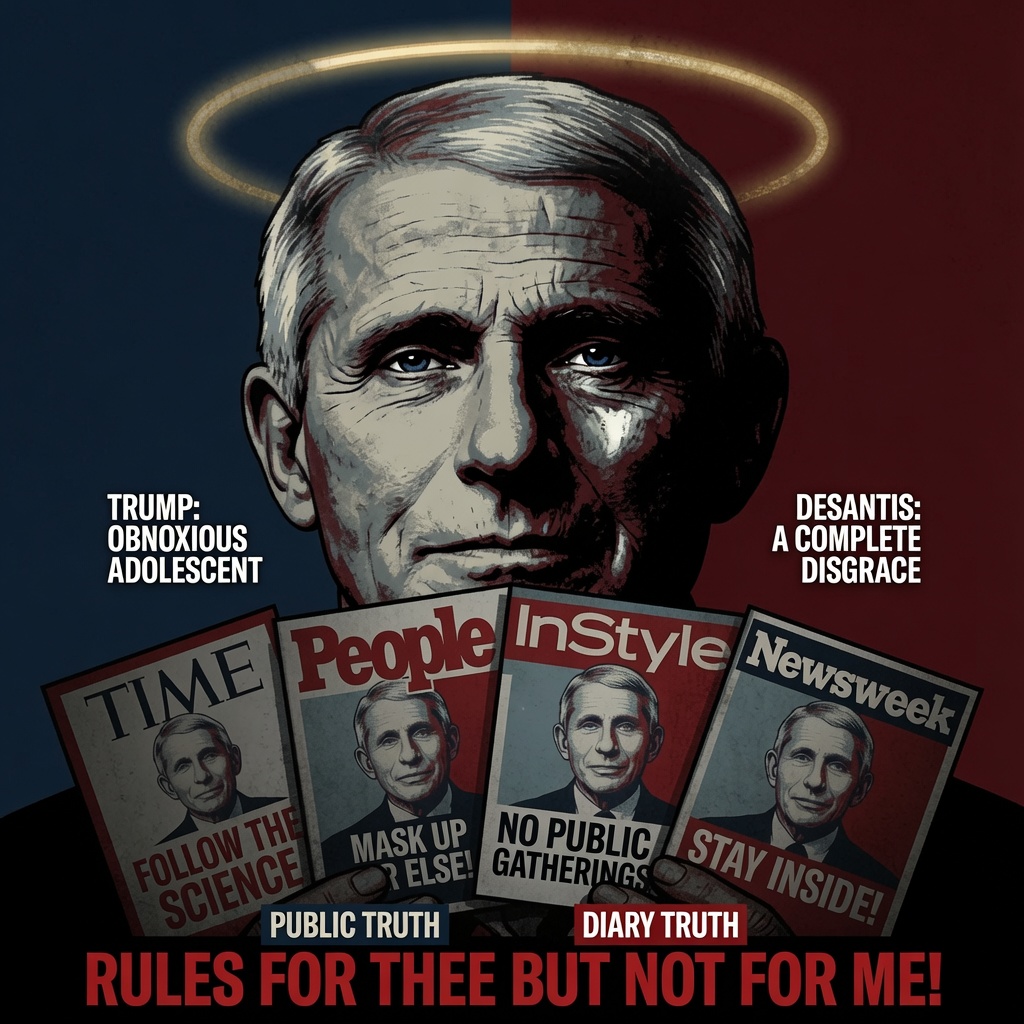
Anthony Fauci measured his fame while children lost years of their lives, workers lost their jobs, and healthy people paid the price for rules he later denied making.
- Damage done
- The Scar Left on Generation Z
- The Fatality Rate Contradiction
- The Adversary Role Began Immediately
- My Story and Conclusion
The Unforgivable Record: Fauci’s Diary and the Damage Done
The release of Anthony Fauci’s private diary — more than a thousand pages of his own contemporaneous notes — is not just another political document dump. It is a confession of character. What Fauci wrote when he thought no one was watching stands in direct contradiction to the public image he cultivated as the calm, selfless voice of science. The gap between the two is not a minor inconsistency. It is the record of a man who prioritized personal celebrity, institutional power, and narrative control over honesty and the measurable harm inflicted on millions of Americans — especially children.
Senator Rand Paul, who forced the diary into the open, has said it most simply: “What he wrote privately and what he told the country are two different stories.” Those stories are now side by side for anyone willing to read them.
On the origin of the virus, Fauci privately recorded in January 2020 that “we know the market was not the source, it was the amplifier.” He participated in early calls in which the majority of the scientists present considered deliberate insertion (lab engineering) possible. Publicly, for years afterward, he treated the lab-leak hypothesis as fringe, fringe, and then politically radioactive. The diary shows he knew better from the start.
On school closures — the policy that did the most lasting damage to a generation — the diary is equally clear. In March 2020, Fauci wrote that he “convinced” New York Mayor Bill de Blasio to close the city’s schools and that California’s closures followed from his own public statements and private advice. Years later, he claimed under questioning that he had “nothing to do” with school closures. That was a lie. The consequences for children were not abstract: years of lost learning, elevated rates of anxiety, depression, developmental delays, and social isolation whose effects are still being measured. Fauci helped lock the schoolhouse doors while privately measuring how famous he had become.
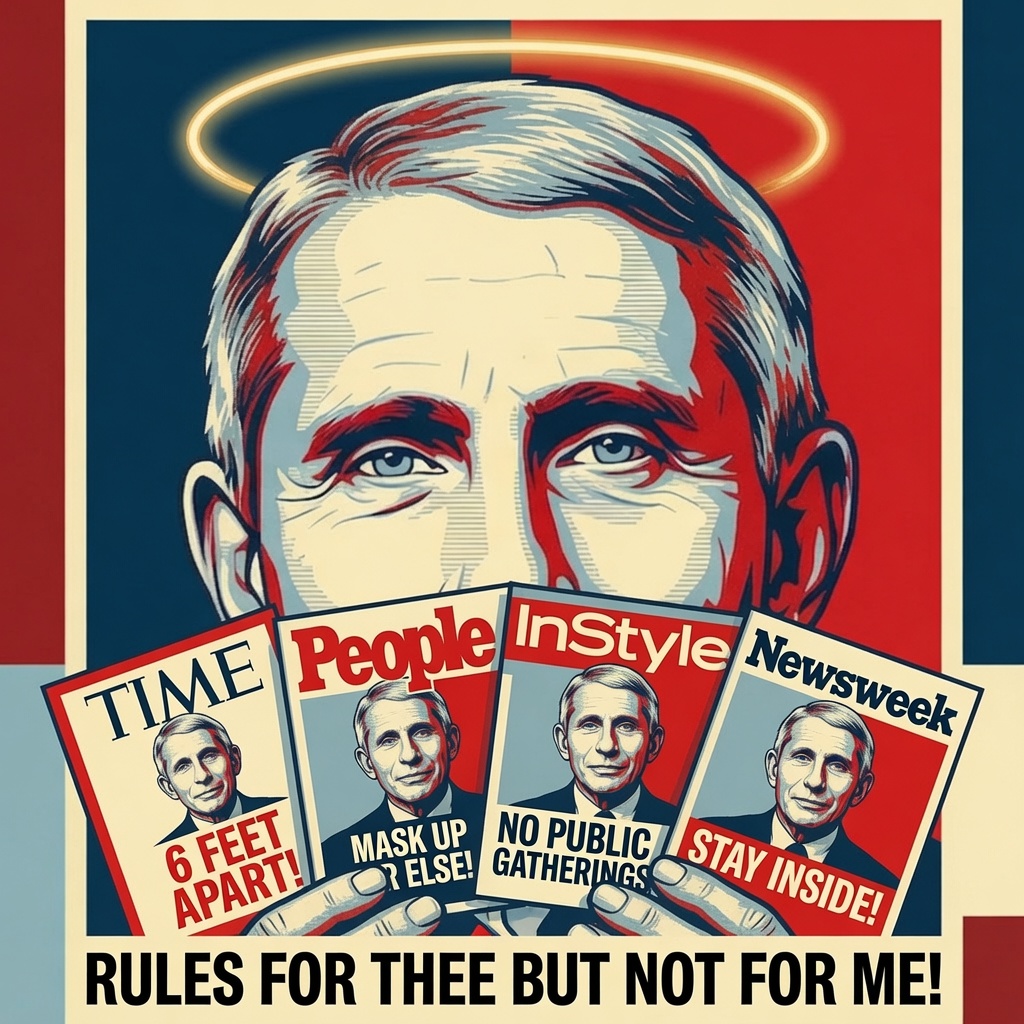
The fame obsession runs through the diary like a second pulse. In May 2020, as American death totals climbed and lockdowns deepened, he wrote: “The situation with my national and international fame is explosive and really unimaginable. It is not hyperbole to say that today I am the most famous and talked about person in the country and one of the most recognizable persons in the world.” He pasted flattering articles about himself into the diary by the hundreds. He noted celebrity praise, magazine covers, and cult-like merchandise. He tracked the media’s daily coverage of Anthony Fauci while ordinary people lost livelihoods, children lost years of education, and the working class kept serving the professional class that could work from home.
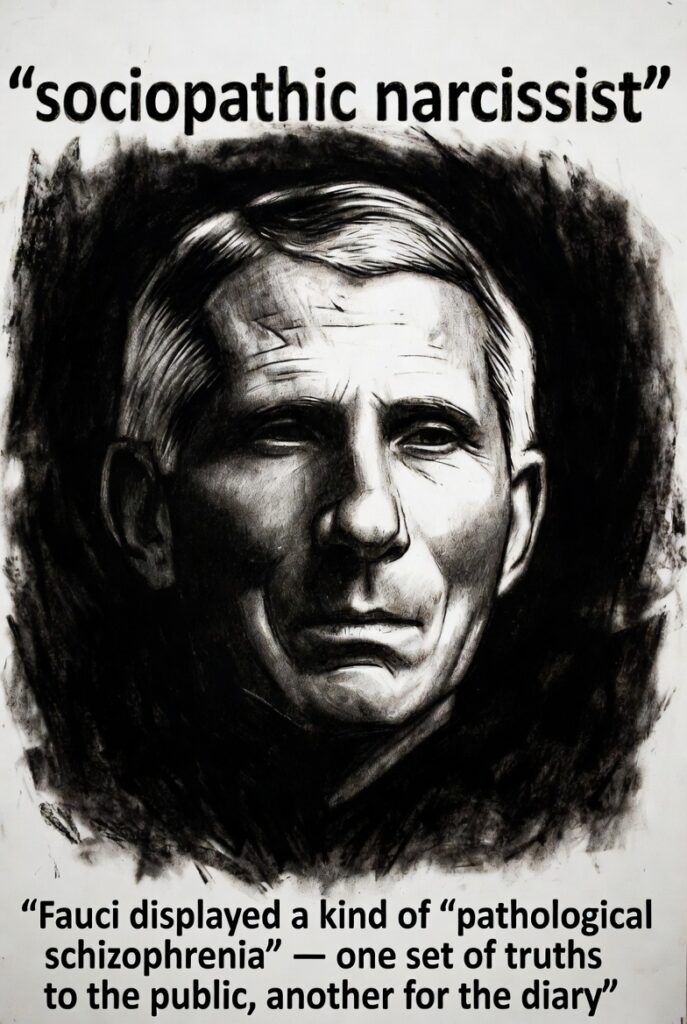
Victor Davis Hanson has described the figure that emerges from these pages without euphemism: a “sociopathic narcissist” who also displayed a kind of “pathological schizophrenia” — one set of truths for the public, another for the diary. Fauci presented himself as the non-partisan embodiment of science while privately collaborating with friendly journalists, feeding them questions, and using institutional power to sideline or demonize critics. The diary records his contempt for those who questioned the orthodoxy — Trump as an “obnoxious adolescent,” DeSantis as “a complete disgrace” for resisting school mask mandates.
The final insult was the preemptive pardon Joe Biden issued on his way out the door, covering any federal offenses related to Fauci’s service. The man who demanded absolute compliance from the public, who treated dissent as heresy, and who privately celebrated his own celebrity while the policies he advanced damaged a generation of children, was shielded from consequences by the same political system that elevated him.
What Fauci did is unforgivable not because he made mistakes under pressure — every public health official faced uncertainty — but because the diary proves he knew more than he admitted, claimed less responsibility than he exercised, and measured his own fame more carefully than the collateral damage. The record is now public. The question is whether a country that still calls itself free will treat it as anything more than another closed chapter.
The Scar Left on Generation Z
The diary and the policies it documents did not only harm children in the abstract. They left a specific, measurable scar on the cohort that came of age under those rules: Generation Z.
According to reporting that examines the long-term fallout, 46 percent of Gen Z reported developing new mental health issues during the pandemic period. Sixty-five percent said they felt “very lonely.” Many lost in-person graduations, normal social milestones, and the ordinary texture of late adolescence. Colleges shifted to virtual instruction or imposed vaccine requirements that further isolated students. One young man dropped out of Northwestern after finding online classes so empty he taught himself programming instead. Others describe friends who turned to nightly marijuana use, solitary drinking, or worse because the ordinary outlets of youth — parties, bars, sports, simply gathering — had been closed by design.
Fauci’s own diary shows him noting with satisfaction that some high-school seniors “loved” their Zoom graduations. Meanwhile he continued media appearances, anticipated normal professional breakfasts, and measured his rising celebrity. The contrast was not lost on the young people locked in their rooms or sent home from campus. For many in Gen Z the pandemic was the first major cultural and political event of their lives. It taught them, often permanently, that government statements about “following the science” could be elastic, that institutional experts could demand sacrifices they themselves did not appear to share, and that dissent was frequently treated as moral failure rather than legitimate disagreement.
That experience has political consequences still unfolding. A significant portion of young men in particular shifted away from the political coalition most closely associated with the longest and most rigid closures. Many now view the entire episode as a revealing exercise in elite overreach. They will not forget who stood at the podium telling them the restrictions were necessary, non-negotiable, and grounded in settled science — while the private record shows a different set of calculations.
The diary makes the personal responsibility clearer. The lasting damage to a generation makes the stakes clearer still.
The Fatality Rate Contradiction
One of the clearest examples of the private-versus-public gap appears in Fauci’s own notes on the lethality of the virus. On February 8, 2020, he recorded a conversation with former CDC Director Tom Frieden in which both men agreed the outbreak was “acting like a bad influenza.” Based on the numbers available at the time (more than 34,000 infections and 724 deaths), Fauci privately estimated the case fatality rate at roughly 0.2 to 0.3 percent — far closer to a severe seasonal flu than the catastrophic numbers later used to justify prolonged emergency measures.
Less than five weeks later, on March 11, 2020, Fauci testified under oath before Congress that the mortality rate was about 2 to 3 percent, and that even accounting for asymptomatic cases it might settle around 1 percent — roughly ten times higher than seasonal influenza. He used that elevated figure to underscore the seriousness of the threat and the need for aggressive action.
The diary shows he had already calculated a much lower fatality rate in private. The public testimony presented a far more alarming picture. That contradiction is not a matter of evolving science alone; it is a documented difference between what Fauci wrote for himself and what he told the country and Congress when the stakes of policy were highest.
The Adversary Role Began Immediately
The diary also reveals how early Fauci cast himself in opposition to the president. On January 21, 2020 — just one day after the first confirmed COVID-19 case in the United States — Fauci recorded his response to a public statement from Trump that everything was “under control.” In his notes he wrote that he had answered by saying the situation was being taken “very seriously” and that Americans should not be frightened, then added: “Let us see if this pits me against the POTUS.”
From the very first days of the domestic outbreak, before any lockdowns, before any school closures, and before the full scale of the crisis was known, Fauci was already framing his role in adversarial terms. The later public narrative that he was a reluctant, non-political scientist dragged into conflict with an erratic president is difficult to reconcile with a private note written at the outset in which he anticipates — and appears prepared for — a confrontation of his own making.
My Story
I was fired from my job for refusing the COVID vaccine. I was ridiculed and harassed by friends, family, and others for refusing the shot and for refusing to wear a mask in public. I told children that it is not healthy to wear a mask while exercising because it restricts breathing. For that, I was treated as a danger and a fool.
I also lost two friends — previously healthy people who had never had heart problems — after they received the vaccine. They are gone.
Our country was taken over by lies and propaganda pushed by Fauci, the CDC, and the NIH. They lied about the vaccine and its safety. They made up the six-foot distancing rule. They pushed masks that do not work and only make people’s health worse. They lied about giving the vaccine to children and about the fact that healthy kids did not need it. People who pointed out that natural immunity was real and often stronger were ostracized, attacked, and silenced.
This was government tyranny at its highest level and corruption at its peak. The elites and Hollywood knew the whole time that much of it was nonsense, yet they made the blue-collar, hard-working Americans suffer the most. I remember exactly who you are — the friends and family members who coerced others to take the vaccine and treated anyone who refused as an enemy. You helped create a climate where people lost work, lost jobs, lost friends, and lost dignity for the crime of saying no. That was despicable. I may forgive you BUT…I will not forget what you did to me and to others.
