

I should read it more often but I haven’t just yet. This post from there is from February and the numbers that will tilt to make SpaceX a more efficient, more cost-effective, and MUCH faster transport mechanisms have only continued to get better from it. What Brian Wang is postulating is that SpaceX’s StarShip, along with its mass-produced Raptor 2 rocket engines, may well put most aircraft manufacturers out of the Big Jet long haul biz both for passenger and cargo flights. It’s all about the payload, up-front and recurring costs, and turnaround times.
I’m not going to regurgitate and extremely detailed tabular data Wang has assembled outlining the costs of the “Heavy” jets but I would suggest that if you have the hankering of reviewing data, you should go and look. Instead, a few “narrative snippets (reformatted, emphasis mine). First the Summary:
I have some detailed calculations. Starship will double the payload capacity. Full fueling costs are about the same for the 1200 tons of fuel for Starship versus 50,000 gallons of jet fuel for a long-range cargo plane for each flight. However, twice payload means half the cost. Non-fuel costs for the vehicles and the frequency of flights are hugely in Starship favor. Starship should have twice the payload.
Starship starts off at half of the loaded cost per flight and four times cheaper per ton of payload and then will proceed to be ten to fifteen times cheaper. Plus they will have some initial new no competition markets for ultra-fast delivery.
About the “heavy” jet costs:
The average price for a pre-owned BOEING 787-8 is $175,000,000. A new 787 is about $300 million. A $87,500,000 loan over 120 months including $364583 per month in interest equates to a $4,387,575.02 per-period payment. Based on 450 annual owner-operated hours and $4.25-per-gallon fuel cost, the BOEING 787-8 has total variable costs of $4,056,300, total fixed costs of $532,500, and an annual budget of $4,588,800. This breaks down to $10,197 per hour. Currently, higher fuel costs push this towards $11,000 per hour…A fully fueled 747 costs about $280,000 per long flight. A A350 might be fully fueled for $170,000 per long flight.
And for Starship? The cost savings are almost immediate if a trip (passenger or freight) isn’t orbital – just go up high enough to then descend. And Musk’s folks have all of that stuff down to a “T” – minimal testing is required, IMHO.
Point to point SpaceX Starship (no heavy booster needed for non-orbital flights) will be able to carry 180-230 tons in payload. This about double the payload of the largest long haul airplanes. The cost for each Starship is currently about $30 million – made mostly of steel and with 6-9 Raptor engines. Raptor 2 engines are half of the cost of Raptor 1. SpaceX will mass-produce Raptor engines and targets engines costs getting down to $200,000 to $300,000 each. This would put the price of the SpaceX Starship as low as $3-5 million each. The SpaceX Starship is already 5 to 10 times cheaper than an airplane. The SpaceX Starship costs will become sixty to one hundred times cheaper.
That’s what happens when new tech is brought into an “established” industry – a new way of looking at a problem and then working towards it. This is a TOTAL disruption of the airline industry financial story.
…SpaceX Starships will be 20 times faster than current passenger aircraft. They will be able to have ten to twenty long-haul flights per day versus one to two long haul flights for passenger aircraft. This means more flights in a day to spread labor and other non-consumable costs.
…SpaceX will be start at four times lower cost per ton of cargo payload for earth-to-earth long distance delivery and then drop to ten to fifteen times cheaper.
Passenger flights for SpaceX Starship will be moving 1200-2000 people per flight. People will be seated like being strapped in for a roller coaster. The flights will be 30-45 minutes long and involve no food or restroom breaks. People will load, fly up and then unload. Again the costs of each flight will be reduced for each person because more people will be on each flight.
SpaceX will be able to bring costs down below $1000 per long haul ticket and then approach $300-500 per long half ticket.
And instead of the regular passenger cattle-call way of loading passengers on and then off, SpaceX will further use the idea of cargo containers that are loaded into a freight cargo jet for passengers as well:
I believe that the passenger compartments might be swapped in and out of each Starship using a Mechazilla.
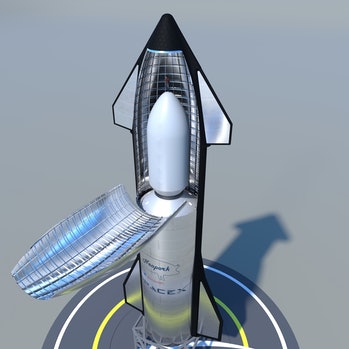
A fast load in and out could then take less than a minute. The cargo or passenger section gets leisurely loaded and unloaded and then the section gets lifted in and lifted out.
So all the time necessary for cargo (passengers, freight) is spent “offline” while waiting for a StarShip land, being serviced for its next flight; that becomes the bottleneck instead of folks stowing their carry-on luggage and squeezing into their seats yielding even faster turnaround times.
I’d certainly try it!
