

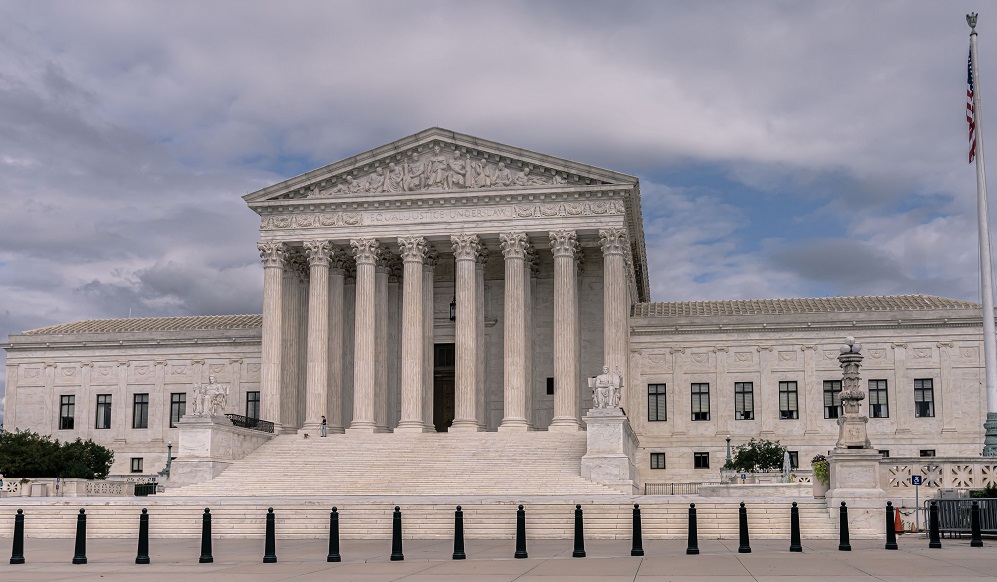
SCOTUS recently issued a pair of rulings that appear, on the surface, to contradict each other. In the first, the court ruled that the federal government couldn’t force private companies with 100 or more employees to require those employees to accept either vaccination or weekly testing as a condition of employment.
In the second, the court ruled that the federal government could force the same condition on millions of health care workers.
Say what?
There appears to be a contradiction, but there really isn’t. This becomes clearer when we consider the third of President* Biden’s mandates, the one covering federal employees and contractors.
That mandate is currently on hold, but it will almost certainly end up before SCOTUS. And we can use the two recent rulings to predict how that’s going to go.
The large company mandate was based on this argument: If we think that something is in your best interest, then you have to do it. And although the Court has, on many occasions, been persuaded by this argument, it wasn’t this time around.
The health care worker and federal employee/contractor mandates are based on a different argument: If we’re paying you, we get to tell you what to do. Apparently the Court does find that argument persuasive, as it will when the third mandate comes before it.
That is, the health care worker mandate doesn’t apply to all workers providing particular kinds of health care services. It applies only to those working in facilities that accept payments from Medicare and Medicaid.
Which, if you think about it, makes it a special case of the federal employee/contractor mandate.
So it really comes down to this: Even when the federal government can’t directly require you to certain things, it can still indirectly require them by threatening to stop giving your own money back to you.
The federal government has been aware of this distinction for some time, and has directed its efforts accordingly. To take just one example, the federal government can’t tell a state that it has to lower its speed limits, or raise its legal drinking age. But it can tell a state that if it fails to do those things, it won’t receive certain kinds of federal funding.
As is so often the case, what we have here is partly a vocabulary problem. The large company mandate that was rejected was, in fact, a mandate. ‘Do this, or we’ll punish you.’
But the health care mandate that was upheld, and the contractor mandate that will be upheld, are not really mandates, but rather incentives. ‘Do this, or we won’t purchase certain goods and services from you.’
See the difference?
As soon as we the right words to describe what’s going on, we can see that anyone who doesn’t want to be vaccinated shouldn’t work at a place that depends on federal funding.
In particular, if you’re a doctor who doesn’t accept Medicare or Medicaid for your services, you don’t have to get vaccinated. If you work for such a doctor, you don’t have to get vaccinated.
Unfortunately, the number of businesses that do not depend on federal funding is small, and getting smaller by the day.
And this, I believe is the lesson that SCOTUS is trying, in its typically obscure way, to teach us by juxtaposing these two rulings: If you’d like to remain free, stop using the federal government to hand out money!
