

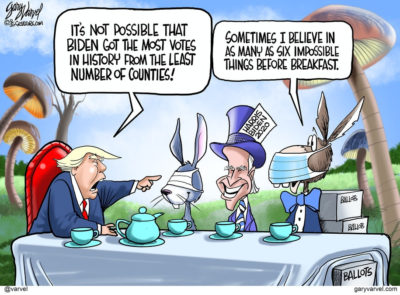
Last week the U.S. Supreme Court made a decision to not hear the Pennsylvania election cases. The cases had been on appeal to the justices. The question was whether to decide or not to decide. There should no have been any question.
The majority of the court left in place the “shroud of doubt” about election law. That was Justice Thomas’ description. He went on to say the court in doing so is “invit[ing] further confusion and erosion of public confidence” in our elections. He sounds pretty emphatic in his dissent, So what went on?
Have you forgotten the chaos of this last election season? There were attempts to change election rules and procedures. They began early, before any the casting of ballots began. In some cases, state executive branch officials changed the rules. In other cases judges made the changes. Under the U.S. Constitution neither judges nor executive branches had the authority to do so.
Justice Neil Gorsuch wrote late last year, “[t]he Constitution provides that state legislatures—not federal judges, not state judges, not state governors, not other state officials—bear primary responsibility for setting election rules … [a]nd the Constitution provides a second layer of protection, too. If state rules need revision, Congress is free to alter them.”
Which branch of government has jurisdiction?
There were instances In Pennsylvania during and after the election where those involved did not follow procedure. There, the state’s Supreme Court wrote and order to election officials. It requires accepting late arriving mail in ballots. Allowing their inclusion in the election up to three days after Election Day is a matter of principle and law. The election officials had to count them even if they didn’t have a postmark showing their mailing was on or before Election Day.
There is something particularly problematic about the Pennsylvania Supreme Court’s decision. The Pennsylvania Legislature had explicitly made the decision not to extend the ballot receipt deadline past Election Day. The court took it upon itself to overrule the legislature. The legislature appears to be within its area of authority under the constitution.
The Pennsylvania court cites as authority for overriding state law a “vague clause” in the state’s constitution providing that elections “shall be free and equal.” That was the ludicrous justification used by the state court.
How is requiring receipt of absentee ballots by Election Day not “free and equal” in the election? And allowing ballots to come in for three days after Election Day is a “free and equal” election? What point of freedom point are we violating here? What is the test for “equal” in the election which we are violating?
Process wins over the merits of the case because…
The plaintiffs were asking SCOTUS to stop the Pennsylvania Supreme Court’s ruling from taking effect. The justices came to a 4-4 deadlock. Justice Ruth Bader Ginsburg died. Justice Amy Coney Barrett had not yet reached confirmation; she was ineligible to join the court. Thus, the decision remains in place.
Later, the state Republican Party and others asked the high court to hear the cases on the merits. The request was for a hearing on an “expedited basis“. Again, the court decision was to decline. The cases is following the court’s normal procedures. This has now led to SCOTUS declining to review the case at all.
It is difficult to grasp how preventing a reoccurrence is not among the most important things the court will decide this session. The court’s position prompts blistering dissents from Justice Thomas, and separately Alito, with Gorsuch joining Alito’s dissent.
